Navigating En Primeur Amidst a Challenging Fine Wine Market
For a growing number of merchants, the central challenge of En Primeur is no longer uncertainty, it is credibility.
When the En Primeur model breaks down
For a growing number of merchants, the central challenge of En Primeur 2025 is no longer uncertainty, it is credibility. In recent campaigns, new releases have frequently struggled to justify their pricing when compared with the broader secondary market. In many cases, buyers have been able to purchase back vintages that are physically available, already approaching drinkability, or with a few years of age, at prices below those asked for wines still in barrel.
This dynamic has fundamentally altered how En Primeur is perceived. What was once a route to early access and long‑term value increasingly carries the risk of immediate underperformance. For merchants committing capital, the danger is not only financial. Advising clients to buy wines that later trade cheaper on release can erode confidence and damage long‑standing relationships.
Against this backdrop, intuition and tradition are no longer sufficient. En Primeur decisions now demand far greater scrutiny.
Why data now matters more than ever
What does this mean for merchants, and their customers, who are still drawn to the tradition and excitement of buying En Primeur?
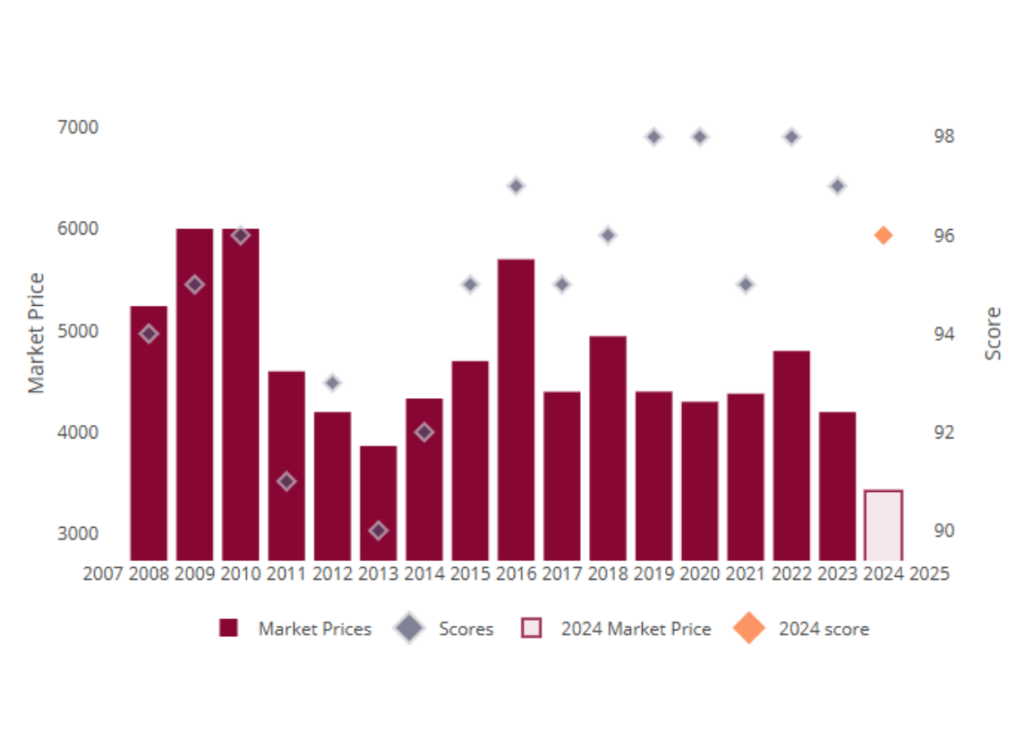
Merchants must interrogate En Primeur offers far more rigorously than before. That means understanding how critics’ scores have translated into real‑world pricing in previous vintages, how similar wines have performed after release, and whether a new price genuinely reflects scarcity, quality and demand.
Without this context, En Primeur becomes a speculative exercise. With it, merchants can begin to distinguish between releases that may still offer value and those where patience is the more rational strategy.
This is where transactional data and historical market performance become essential tools. Looking beyond list prices to examine how wines have actually traded over time allows buyers to sense‑check release decisions against market reality, not marketing narrative.
Analysing new releases within market context
One of the biggest mistakes a merchant can make during En Primeur is treating each campaign in isolation. Critics scores alone cannot be relied on to assess the opportunity, and risk, at hand. Capital committed to Bordeaux must now compete with opportunities across regions, vintages and styles that are already available and proven in the market.
Being able to compare new releases with established alternatives, and to understand how price, score and demand have interacted historically, gives merchants a clearer framework for decision‑making. It also enables more transparent conversations with clients, grounded in evidence rather than expectation.
Liv‑ex support during En Primeur
This is where Liv‑ex plays a central role during En Primeur. By providing access to independent analysis, as well as transactional exchange data and historical pricing, alongside vital critics scores.
During the campaign, Liv‑ex supports members with ongoing insight, helping them interpret critics’ scores, track sentiment as it evolves, and understand how new prices sit relative to both back vintages and the wider fine wine market. This allows merchants to remain selective, adapt strategy as the campaign unfolds, and avoid being locked into early decisions that no longer make sense.
Crucially, this support extends beyond allocation. Once wines enter the secondary market, merchants can benchmark performance, refine pricing strategies and respond quickly to demand, protecting both margins and reputation.
It’s not too late to access Premium Market Intelligence to help you navigate the campaign with confidence . Contact our business development team to prepare for En Primeur 2025