The Impact of Macro Economics on the Fine Wine Market
Fine wine prices rise and fall, not just in line with quality or reputation, but in response to economic forces shaping demand around the world.…

What’s the relationship between the global economy and the fine wine market?
Despite thousands of years of production, distribution, consumption and culture, fine wine is not abstract from modern economies. Like all product classes, its prices are impacted by the surrounding economic landscape.
Fine wine prices rise and fall, not just in line with quality or reputation, but in response to economic forces shaping demand around the world. For wine businesses navigating today’s environment and understanding that relationship has never been more important.
A Market Defined by Dual Demand
Unlike many luxury products, fine wine is sought for two very different purposes: consumption and investment. This dual demand makes fine wine even more susceptible to macro-economic patterns and cultural phenomena, because it’s impacted by consumption trends, as well as investment behaviour and wealth more broadly.
When consumer confidence is high, discretionary spending grows. When investors feel optimistic, alternative assets attract interest. When either shift, the fine wine market feels it.
Interest Rates: More Than a Simple Cause and Effect
Interest rates are often used as an indicator of overall economic health, and while their relationship with fine wine is often discussed, its rarely quantified. In theory, low rates should lead to increased demand.
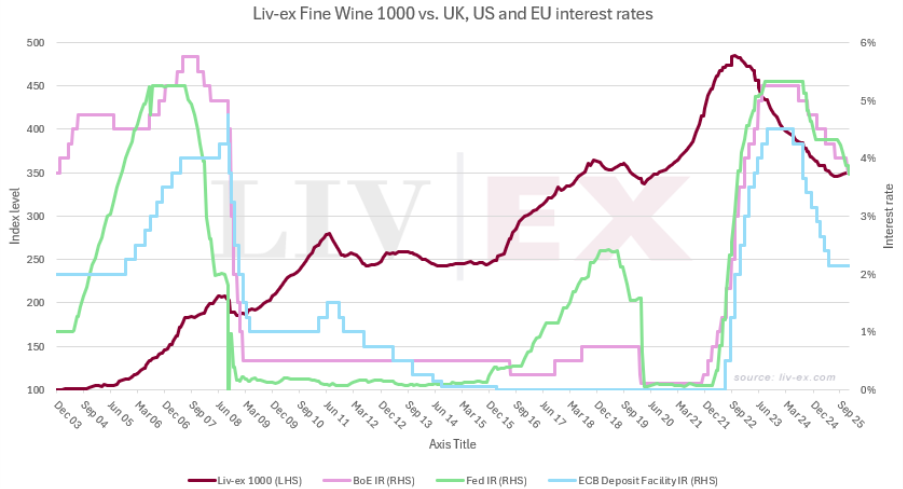
The chart shows that in periods of ultra-low rates, such as the COVID-19 lockdowns and the 2008 financial crisis, fine wine prices immediately rose. Conversely, fine wine has also performed well during moments of relatively high rates, such as in 2018. This suggests that it’s not the headline rate that matters, but the underlying conditions policies are responding to.
Inflation, growth expectations, investor appetite and access to capital all play interconnected roles in shaping demand for fine wine and subsequent price performance.
Inflation: A More Direct Link to Fine Wine Prices
Inflation has shown a more consistent relationship with fine wine pricing. Not because it’s part of the consumer shopping basket. The factors impacting the price of eggs, petrol and milk are different from those impacting fine wine. Although production costs are affected, most of the wine traded on the secondary market was manufactured years ago.
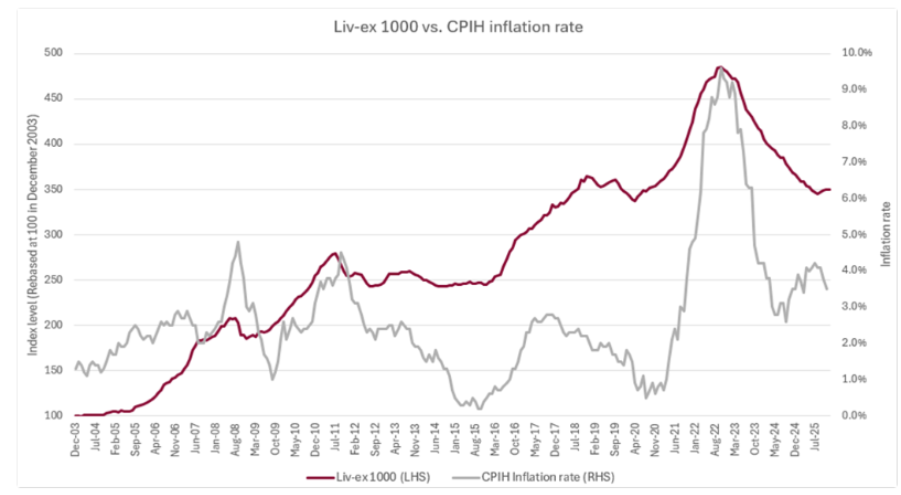
During periods of high inflation, tangible assets often gain appeal as investment opportunities. Fine wine can benefit from this as investors look to diversify beyond public markets.
Wine differs from housing and even luxury goods, such as watches and bags, in the nature its collected and the scale of its production. Traditionally, a fine wine collector will buy cases of six or more bottles of wine and continue to do so year after year. While release pricing is a product of labour, materials and perceptions of quality, and will in turn rise with inflation. Therefore, production costs are more relevant compared to other asset classes.
Recent years, however, have highlighted the risks: release prices have been set beyond what the market has been willing to pay, creating a mismatch between cost expectations and investor appetite.
As inflation has normalised over the past year, stability has returned, reducing volatility and helping rebuild confidence. For merchants, importers and producers, these dynamics underline a key point: inflation doesn’t just affect costs, it shapes behaviours.
The full article explores the interaction between real interest rates and fine wine prices, accessible only to Liv-ex Members.
What This Means for the Fine Wine Trade Today
After three years of disruption; marked by high inflation, rising rates and overly confident release prices – the environment is shifting.
Inflation has eased. Monetary policy is stabilising. And prices for many recent vintages have corrected to more appealing levels for buyers.
But monetary policy alone cannot reset the fine wine market. The stock cycle must play out. Vintages produced during periods of high cost and high expectation still need to be absorbed before the next growth phase can begin.
Why Market Intelligence Matters
For businesses operating in the fine wine industry, the lesson is clear – fine wine does not exist in isolation. Its performance is tied to the same macroeconomic factors influencing global wealth, investor sentiment, consumption patterns and financial stability.
To make informed decisions, whether in pricing, buying, inventory management or strategy, wine businesses need visibility into these relationships.
This is where intelligence becomes indispensable.
Liv-ex Market Intelligence helps wine businesses:
- Understand the market you operate in
- Act early on emerging trends
- Optimise your commercial performance
- Empower your whole team