Author: Grace Geldard
The History of LWIN: How a Common Language Changed the Wine Trade
In 2011, Liv-ex introduced LWIN, a universal identifier for wine & spirits. Learn why it was created to give the wine trade a common language

Twenty years ago, few people in the wine industry gave much thought to product identifiers.
Wine was bought and sold using names, vintages, bottle formats, but in many cases, businesses maintained their own naming conventions. It wasn’t unusual for the same wine to appear in different ways across systems, spreadsheets, and stock lists.
For merchants, warehouses, publications and logistics providers, this created occasional confusion. For computers, it created a much bigger problem…
As wine trading became increasingly global and technology-driven, the need for a common language became impossible to ignore. The solution was LWIN: the Liv-ex Wine Identification Number.
Today, LWIN underpins thousands of wine businesses worldwide and has become the industry’s leading standard for wine identification. But its impact extends far beyond simply assigning a code to a bottle; it has helped create the foundations for a more connected, efficient and data-driven wine market.
The Birth of LWIN
In 2011, Liv-ex introduced the Liv-ex Wine Identification Number, commonly known as LWIN. Its purpose was simple: to create a universal identifier for wine and spirits that any business could use.
Much like an ISBN identifies a book, an LWIN identifies a wine.
By assigning a unique code to each product, it created a common language that could be shared across industry participants. This made it easier to exchange information, reduce the risk of costly human errors, and ensure everyone was referring to exactly the same wine, regardless of how it was named in their own systems.
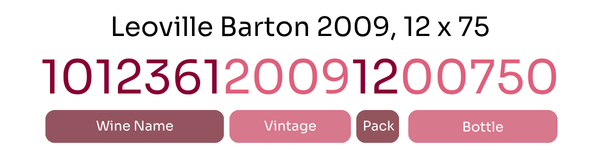
Crucially, LWIN was made freely available to the industry under a Creative Commons licence and remains free to use today. Rather than being a proprietary product code tied to a single system or company, it was designed as an open source database that anyone could adopt.
More Than Just a Number
Once businesses can identify wines accurately and consistently, they can automate workflows, integrate systems and exchange information with confidence. Pricing data, trading data, logistics information and market insights become exponentially more useful when everyone is referring to the same wine.
Stock lists can be shared more easily. Shipping instructions become clearer. Market data becomes easier to distribute. Trading systems can communicate directly with one another.
Without reliable identification and matching, even the best pricing, analytics or AI models will struggle to deliver reliable outcomes.
The LWIN database is continuously reviewed by professionals with expertise and qualifications in the wine space. This kind of standardisation and maintenance rarely results in headlines, but it is often the invisible infrastructure that enables industries to modernise.
Liv-ex has made significant contributions to the world of fine wine by championing its LWIN unique identifiers for fine wine. Antonio Galloni Vinous
The Impact on Pricing, Valuation and Trading
The rise of digital wine trading has made accurate wine identification more important than ever.
A valuation is only as reliable as the underlying wine identification. The same is true of pricing data, market analytics and trading opportunities. Without a common standard, inconsistencies can quickly undermine the quality and reliability of the data businesses rely on every day.
This is one reason LWIN has become deeply embedded within many wine businesses’ operational workflows. Once wines are mapped to a common standard, businesses can enrich their inventories with additional data, benchmark prices, automate valuations and connect to external systems with significantly less manual work.
London City Bond (LCB) provides a notable example. Prior to adopting LWIN, inconsistent naming conventions resulted in repeated manual data entry and reporting challenges. By incorporating LWIN into its systems and connecting to Liv-ex market data, the business improved consistency, reduced errors and enhanced valuation processes.
The wine descriptions on our customers’ inventories are now completely consistent – it looks far more professional. Jane Renwick LCB
What’s Next for LWIN?
Liv-ex continues to invest heavily in the tools and technology that help businesses map their inventories to LWIN quickly and accurately.
In October, Liv-ex will launch significant upgrades to the matching engine behind Wine Matcher, an exclusive matching tool available to Liv-ex members. Powered by AI and machine learning, the enhanced engine is designed to improve automatic match rates, reduce manual intervention and help members move more efficiently from list upload to pricing, valuation and trading workflows.
Because while identifying wine correctly may seem like a small task, it sits at the heart of everything that follows. Every valuation, every dataset, every trading decision and every automated workflow depends on knowing exactly which wine you’re dealing with.
Twenty years after its creation, LWIN remains the common language of the wine trade, quietly powering a more connected, efficient and data-driven global market.
Author: Grace Geldard
This Week In Fine Wine: EU buyers take the lead; Lafite & Leroy top-traded overall
In this week’s Talking Trade, we look at the week’s key fine wine market trends. European buyers were the only segment to increase their purchasing…

- Bordeaux maintained its lead of the market, claiming 32% of traded value
- DRC’s Romanee-conti 2013, Lafite 2019 and Fuligni Brunello 2021 were the top-traded wines by value.
- European buyers were the only segment to up their purchasing on last week, taking the lead with a 37% share of traded value.
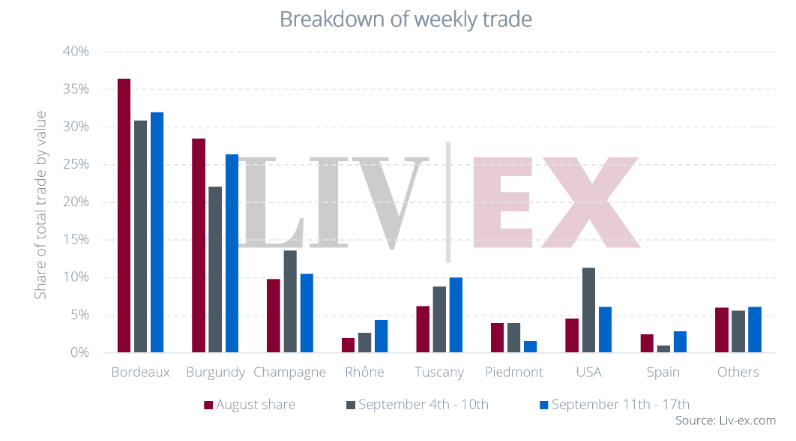
Bordeaux kept its lead of the market, claiming 32.0% of traded value. Chateau Lafite Rothschild took the lead, accounting for 21.6% of the region’s trade. The 2019 also featured amongst the top-traded wines by value overall.
Burgundy, following in second place, saw its share of traded value increase from 22.1% last week to 26.4% this week. Domaine Leroy surpassed Domaine de la Romanee-Conti as the region’s top-traded producer, with 9 different cuvees (one or more vintage of each) changing hands.
Champagne’s share fell to 10.5% from 13.6% last week, just taking the edge over Tuscany to claim third place. The 2008 vintage continues to reign, changing hands more frequently than even non-vintage wines this week.
Having seen its share of the market slip slightly over the summer, Tuscany had a stronger week, accounting for 10.0% of traded value. Brunellos traded actively, with both Fuligni and Biondi-Santi amongst Tuscany’s top three producers by traded value.
The Rhone had a relatively strong week, its share rising to 4.4%. This was supported by decent volumes of Domaine de la Janasse’s Châteauneuf-du-Pape Vieilles Vignes and Famille Perrin’s Beaucastel changing hands.
The US’s share fell from 11.3% to 6.1%. US buyers accounted for 42.5% of traded value, spending mostly on Opus One, Promontory and Harlan Estate. UK buyers focused on Screaming Eagle, while EU buyers took smaller parcels of a wide variety of wines.
Missed last week’s trade blog? Read it here.
Copyright © 2026 Liv-ex Ltd. All rights reserved.
Author: Grace Geldard
Liv-ex Burgundy Report 2026
Burgundy has overtaken Bordeaux as the most traded wine region by value, according to new analysis from Liv-ex.

Download the Report
Topics covered in the report:
- Burgundy overtakes Bordeaux for the first time since 2022
- Rising demand for Burgundy’s top-tier producers
- UK buyers account for 58% of Burgundy’s bid exposure
Liv-ex is the exchange for fine wine, market data and insight. Membership brings wine professionals independent market data and insights and the ability to price, buy and sell wines through one point of contact.
Author: Grace Geldard
This Week In Fine Wine: US buyers keep the lead; Opus One top-traded producer
In this week’s fine wine investment news, following its release earlier this week, Opus One 2023 was the top-traded wine of the week by value

- Bordeaux maintained its lead of the market, buyers focusing largely on mature, exceptional vintages. Burgundy following in second place.
- Following its release earlier this week, Opus One 2023 was the top-traded wine of the week by value.
- Though continuing to lead purchasing, US buyers bought less this week than last week. UK and Asian buyers both upped their purchased value, both concentrating on Burgundy.
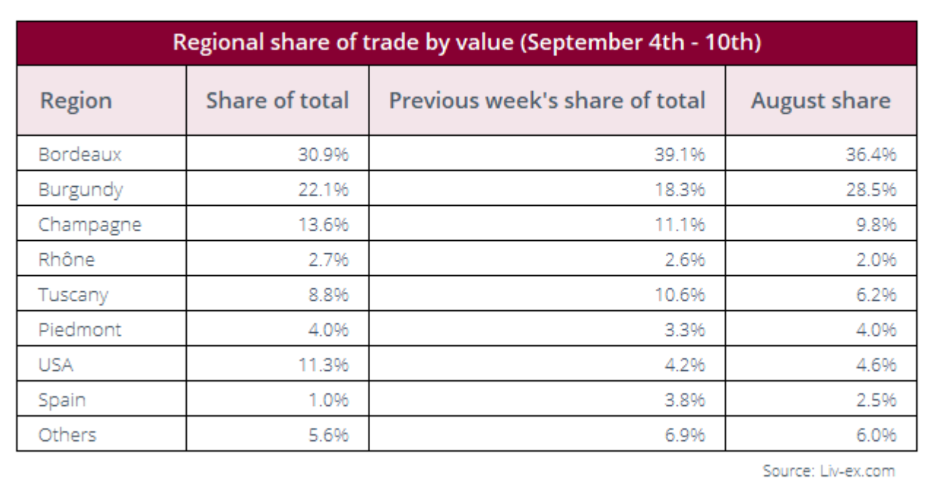
Bordeaux led the market, claiming 30.9% of traded value. Though Mouton Rothschild 1986 was the region’s top-traded wine of the week by value, Latour and Margaux were the region’s top-traded producers. Buyers focused mainly on legendary pre-2000 vintages.
Burgundy followed in second place, taking 22.1% of traded value. DRC’s Romanee-Conti 2020 took the lead, followed by Armand Rousseau Chambertin 2022 and DRC Richebourg 2016.
Champagne’s share increased from 11.1% last week to 13.6% this week. Dom Perignon shared the stage with smaller production labels this week, c.50% of traded value fairly evenly split between DP, Salon, Jacques Selosse and Egly-Ouriet.
The US claimed 11.3% of traded value, overtaking Tuscany. Opus One claimed over half of the region’s trade, the newly released 2023 trading in decent volumes alongside the 2016, 2019 and 2013.
Tuscany’s share fell to 8.8%. The usual Super Tuscans took a back seat, Bibi Graetz and Fattoria le Pupile the top two producers.
Missed last week’s trade blog? Read it here.
Author: Grace Geldard
New Guide: Liv-ex for Fine Wine Businesses in France
French fine wine businesses benefit from access to international export markets with the ease of fully managed logistics.

Download the Guide
Guide Summary
This guide explores how French wine businesses are using Liv-ex to access global demand, expand their customer base, and trade more efficiently. Learn how merchants are leveraging market data, technology and streamlined logistics to unlock new opportunities and support business growth.
Get practical insights and actionable takeaways in this free 20-page guide.
Other Guides You Might Be Interested In…
Guide to Data-Driven Buying, Selling and Pricing of Fine Wine
Author: Grace Geldard
Rapport sur le marché du vin S1 2026 de Livex
Alors que les principaux indices du vin poursuivent leur stabilisation, les performances restent contrastées selon les marques et les millésimes
Rapport S1 2026 de Liv-ex
• Alors que les principaux indices du vin poursuivent leur stabilisation, les performances restent contrastées selon les marques et les millésimes.
• Le marché demeure marqué par la prudence, avec une activité d’échange relativement modérée.
• Les États-Unis ont représenté une part croissante des achats au deuxième trimestre les acheteurs américains ayant eu tendance à acquérir des vins du Fine Wine 1000 à des prix supérieurs au Prix de Marché.
• Les perspectives des grands vins sont plus favorables pour les millésimes anciens que pour les millésimes récents.
Introduction
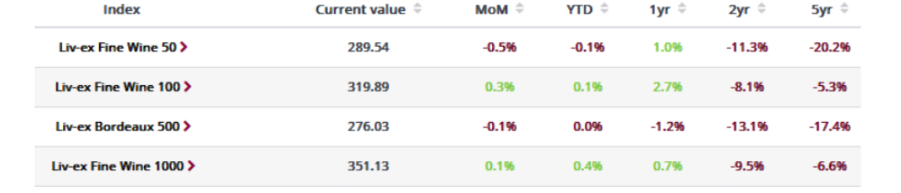
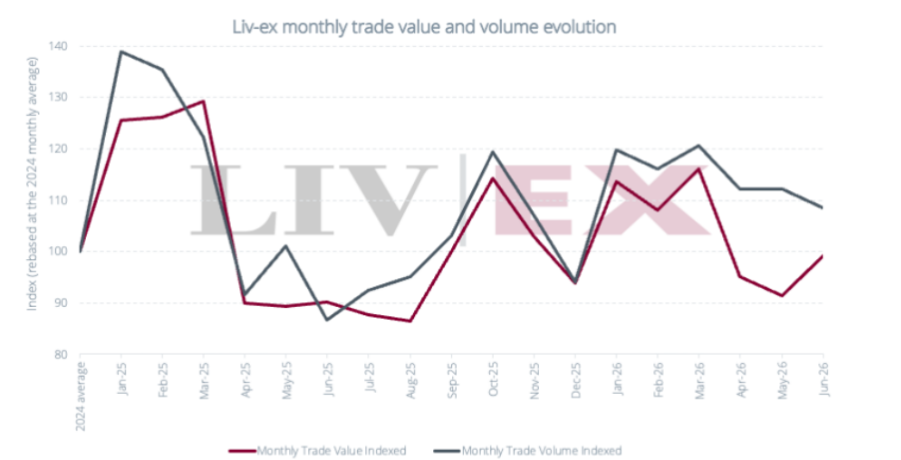
Les perspectives actuelles du marché des vins fins restent difficiles à décrypter. En moyenne, les principaux indices se sont stabilisés. Toutefois, au sein du Fine Wine 1000, davantage de millésimes ont vu leur valeur reculer qu’augmenter au cours du deuxième trimestre. Les vins en hausse ont néanmoins progressé plus fortement (+5,2 % en moyenne) que les vins en baisse n’ont reculé (-4,1 %).
Si le deuxième trimestre 2026 s’est montré plus dynamique que celui de 2025, fortement marqué par les droits de douane, la stabilisation générale des prix ne s’est pas encore traduite par un regain de confiance — ni de demande — suffisant pour entraîner une hausse globale des volumes d’échanges.
Comme chaque année, la campagne Bordeaux En Primeur a dominé le deuxième trimestre, même si elle représente aujourd’hui une part bien plus limitée du chiffre d’affaires qu’auparavant. Selon les membres britanniques interrogés par Liv-ex, la valeur des ventes est restée globalement stable par rapport à la campagne En Primeur 2024.
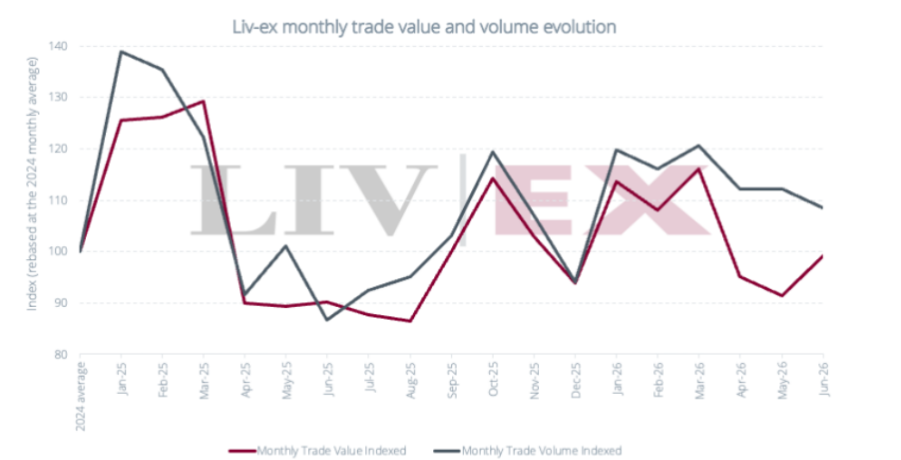
Les négociants en vins fins continuant d’adopter une approche prudente et de limiter leurs achats destinés au stock, les collectionneurs privés jouent toujours un rôle déterminant dans l’activité du marché. Dès lors, tout facteur susceptible d’alimenter leurs inquiétudes quant à l’évolution future de leur patrimoine pèse directement sur la demande.
Alors que l’accord de paix mettant fin au conflit avec l’Iran semblait encore fragile au moment de la rédaction de ce rapport, les pressions inflationnistes pourraient de nouveau s’intensifier. Ce facteur supplémentaire, peu favorable, pourrait peser sur les décisions des collectionneurs au moment d’envisager de nouvelles offres d’achat.
Aperçu géographique des achats
• Les acheteurs américains ont représenté 26,9 % de la valeur totale des achats au T2, contre 23,3 % au T1 et bien au-dessus de la moyenne de 2025 (20,7 %).
• Dans les autres régions, l’activité d’achat a reculé au cours du trimestre. Les États-Unis se distinguent comme la seule zone géographique à avoir enregistré une progression des achats depuis le début de l’année 2026.
Répartition de la valeur des achats par région
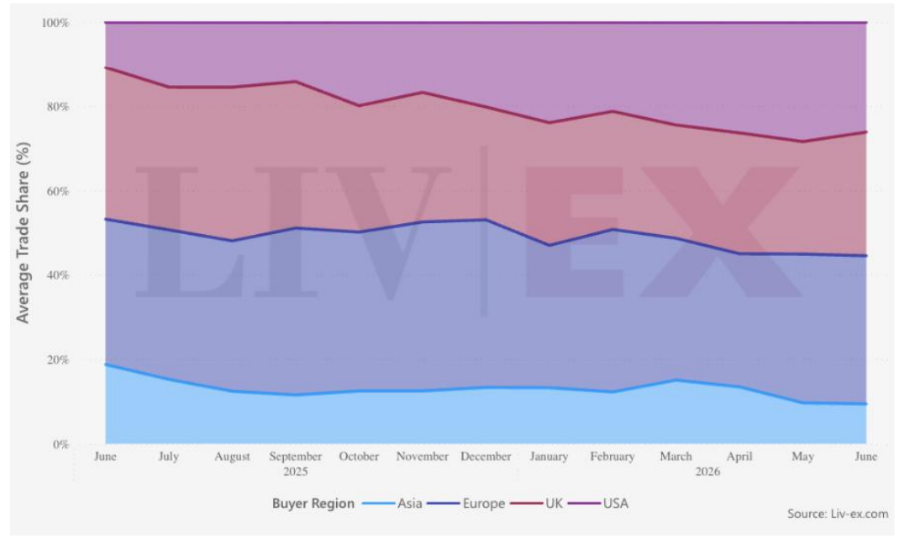
Comme nous l’avions précédemment indiqué, cette évolution semblait inévitable à mesure que les différents acteurs de la chaîne d’approvisionnement américaine s’adaptaient aux droits de douane et que les stocks se réduisaient naturellement au fil du temps.
Si la hausse de la valeur globale des échanges est une évolution positive, il convient également de souligner le rôle des acheteurs américains dans le maintien des prix. Au T2, les vins composant le Fine Wine 1000 ont été achetés par les Américains à un prix moyen supérieur de 1,1 % au Prix de Marché, contre +0,03 % au T1.
Si les achats américains continuent de progresser au second semestre et que les prix d’achat restent proches, voire au-dessus, du Prix de Marché, la stabilité des prix devrait se poursuivre.
Les acheteurs asiatiques ont adopté une posture plus attentiste en 2026. Si les prix mondiaux se sont stabilisés, les prix des transactions locales ont continué de s’assouplir, notamment sous l’effet d’importantes ventes réalisées de manière informelle. Par ailleurs, les coûts d’expédition ont augmenté jusqu’à 60 % dans certains cas après le début du conflit avec l’Iran, ce qui a directement pesé sur l’activité d’achat.
Divergence entre les millésimes
Une tendance que nous continuons d’observer — et que nous pensons durable — est la divergence croissante entre les perspectives des différents millésimes.
Bordeaux en offre un bon exemple. À l’exception des jeunes 2022, les Bordeaux antérieurs à 2017 ont généralement fait preuve d’une plus grande résilience et semblent avoir atteint leur point bas plus rapidement.
Si l’on revient sur la récente campagne Bordeaux En Primeur, les sorties les plus réussies présentaient généralement deux caractéristiques :
• Le prix de sortie du millésime 2025 était inférieur au Prix de Marché actuel de tous les millésimes comparables en qualité.
• Les millésimes comparables affichaient désormais une stabilité des prix, voire une hausse.
La première condition est indispensable à toute sortie réussie sur le marché des vins fins.
La seconde dépend davantage des conditions de marché et n’était pas réunie lors de la campagne 2024.
Ensemble, ces deux facteurs offrent à une nouvelle sortie les meilleures chances de préserver sa valeur.
En d’autres termes, la hausse des prix sur les millésimes plus anciens ne crée pas seulement des opportunités de valorisation pour ces vins ; elle apporte également un soutien aux millésimes plus récents.
Lafite, l’un des succès de la campagne 2025, illustre parfaitement cette dynamique : chacun de ses grands millésimes postérieurs à 2014 a progressivement gagné en valeur depuis le début de l’année.
Perspectives pour le second semestre
Alors qu’une grande partie de l’hémisphère nord ralentit son activité à l’approche de l’été, marqué une nouvelle fois par une forte vague de chaleur en Europe, quelles tendances pourraient se dessiner au second semestre 2026 ?
Les perspectives restent meilleures qu’il y a douze mois.
Pour certaines marques et certains millésimes, la demande reste suffisante aux niveaux de prix actuels pour soutenir le marché, plusieurs vins combinant désormais hausse des prix et volumes d’échanges solides.
Avec un marché américain plus dynamique qu’à la même période l’an dernier, la stabilité des prix semble appelée à se poursuivre.
Même si la prudence continue de dominer le marché, les acheteurs avisés pourraient y trouver une période discrètement propice aux opportunités.
Author: Grace Geldard
Business Development Manager
An exciting opportunity for an ambitious, driven BDM who wants to take the lead in growing the Liv-ex member portfolio on an international scale.
Location: Borough, London
With regular travel to territories under management
Competitive salary dependent on experience plus performance-related bonus, healthcare insurance and wellbeing benefits.
With customers in 50 countries, Liv-ex is the leading fine wine exchange globally. Our vision is to make the wine market more transparent, efficient, and safe, for the benefit of our members and wine lovers everywhere. Our culture is hardworking, entrepreneurial and friendly. Founded in 2000, Liv-ex’s trading, data and market intelligence platform is used by wine businesses around the world to better understand the market and execute buying and selling opportunities. We’re at an inflection point in our journey, embarking on a transformational phase that will redefine how the wine industry operates, trades, and leverages data intelligence. Despite our market leadership, we remain an agile, entrepreneurial, focused organization where senior leaders are involved in driving execution and delivering results.
Summary Purpose
The Business Development Manager is responsible for generating and converting high-quality new member opportunities across assigned territories. Territory coverage may vary depending on business priorities and can include the UK, Europe, the Middle East, Asia and support for the US market where required
Reporting to a Senior Business Development Manager, the role combines pipeline generation, consultative selling and disciplined opportunity management. The Business Development Manager works closely with Account Management, Customer Success, Broking, Marketing, Product, Data, Finance and Operations teams to ensure prospects understand Liv-ex’s value and transition smoothly into membership.
Responsibilities:
- Research, identify and prioritise new business prospects that fit Liv-ex’s ideal customer profile and have a realistic path to value.
- Generate pipeline through a disciplined mix of outbound calling, email, social outreach, events, referrals and marketing-led opportunities.
- Qualify prospects rigorously, understanding their trading model, regions, stock profile, current processes, decision-makers, budget, timing and success criteria before progressing opportunities.
- Lead discovery, pitch and demo meetings that connect Liv-ex’s Exchange, data, settlement, logistics and LWIN capabilities to clear commercial outcomes for the prospect.
- Manage opportunities from initial engagement through proposal, negotiation, close and handover, using judgement to hold value and protect commercial quality.
- Maintain an accurate, current pipeline forecast and use evidence to focus time on the opportunities most likely to convert.
- Keep CRM complete and up to date, ensuring all accounts, contacts, activity, next steps, close dates and decision criteria are captured consistently.
- Collaborate with Account Management, Customer Success, Broking, Marketing, Data, Product, Finance and Operations to shape credible proposals and ensure smooth onboarding for new members.
- Travel as required to meet prospects, attend relevant wine trade events and build relationships across the assigned territory.
Knowledge, Skills and Experience
Essential
- Proven experience in B2B business development, new business sales or a closely related commercial role, ideally in wine, marketplace, data, SaaS, trading or another relationship-led B2B environment.
- Track record of building and converting pipeline, meeting targets and managing opportunities through a consultative sales process.
- Strong communication, questioning, presentation and negotiation skills, with the ability to adapt style to different buyers and cultures.
- Commercially curious, organised and resilient, with strong time management and the confidence to lead outbound activity, follow up consistently and close cleanly.
- Comfortable using CRM systems, and committed to accurate data, clear next steps and disciplined pipeline management.
- Wine trade knowledge is desirable; genuine interest in fine wine, trading models and the commercial realities of merchants, brokers, producers and collectors is important.
Desirable
- Experience in marketplace, SaaS, technology, data, trading or subscription businesses.
- Experience using HubSpot.
- Knowledge of the wine trade, fine wine market or luxury goods sectors
- Additional languages, particularly French or Chinese, would be useful.
What Success Looks Like
- Owns their territory with confidence: spots issues early, comes with options and challenges existing processes where they do not serve member needs.
- Builds enough qualified pipeline to support target delivery, with clear evidence of ICP fit, customer need and a realistic route to close.
- Runs structured, insight-led discovery and captures the buying picture before progressing an opportunity.
- Sells on value and outcomes, not price, and can explain how Liv-ex helps prospects improve trading access, pricing confidence, operational efficiency and market visibility.
- Forecasts honestly, keeps pipeline hygiene high and records activity so the wider team can rely on the data.
- Works constructively with colleagues, shares craft and knowledge, gives and receives direct feedback, and supports smooth handover once a prospect becomes a member.
Author: Grace Geldard
This Week In Fine Wine: Total trade value rose 53.6% week-on-week
In this week’s wine market news, total trade value rose sharply as buying activity from US and European buyers increased.
In this week’s wine market news, total trade value rose sharply as buying activity from US and European buyers increased. Bordeaux and Burgundy both recorded strong gains in purchase value, while back-vintage Bordeaux and Tuscany remained key areas to watch.
- Total trade value rose 53.6% week-on-week, driven by a rise in purchasing from US and European buyers.
- Bordeaux and Burgundy purchase value rose 36.7% and 31.0% respectively week-on-week.
- Back vintage Bordeaux continues to be a category to watch, the Legends 40 up 0.8% month-on-month and leading wines figuring in this week’s top-traded.
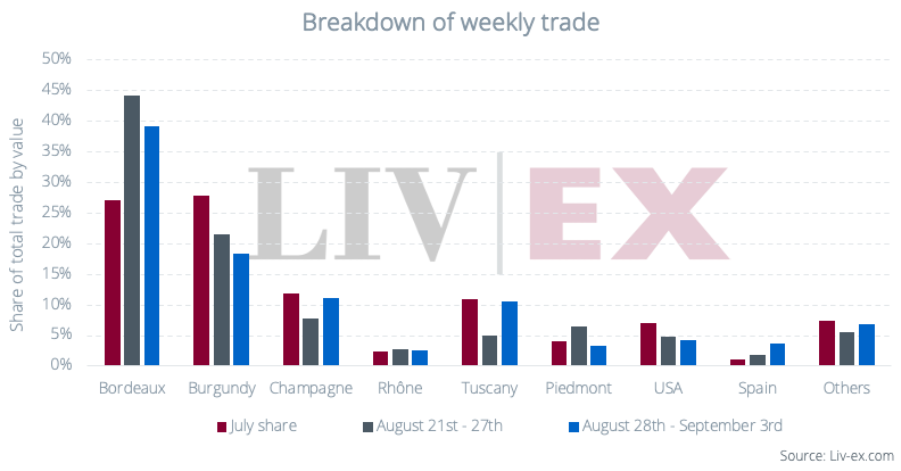
Despite its share falling slightly on last week, Bordeaux continued to hold a strong lead of the market. Lynch-Bages was the top-traded producer of the week. As recent analysis has shown, Lynch-Bages is a brand to watch, with the brand-level index up +5% over the past 12 months.
Burgundy’s share also fell below recent levels despite trade value rising. DRC was the region’s top-traded producer, followed by Pierre-Yves Colin Morey which had a strong week having seen trade across a broad range of cuvées.
Tuscany bounced back after a quiet week last week, with trade value more than tripling week-on-week. Masseto was the region’s top-traded producer. In the week it was released, the 2023 traded 6.4% below its release price.
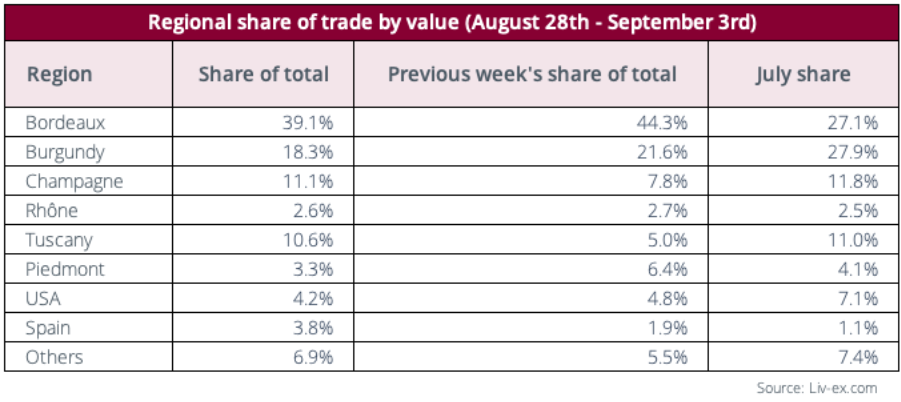
Missed last week’s trade blog? Read it here.
Author: Grace Geldard
New Guide: Liv-ex for Fine Wine Businesses in Europe
French fine wine businesses benefit from access to international export markets with the ease of fully managed logistics.

Download the Guide
Guide Summary
This guide examines how European wine businesses are using Liv-ex to expand their reach, improve decision-making and trade more effectively. From accessing global demand to leveraging market data and automation, learn how merchants are finding new opportunities to grow and improve efficiency.