The History of LWIN: How a Common Language Changed the Wine Trade
In 2011, Liv-ex introduced LWIN, a universal identifier for wine & spirits. Learn why it was created to give the wine trade a common language

Twenty years ago, few people in the wine industry gave much thought to product identifiers.
Wine was bought and sold using names, vintages, bottle formats, but in many cases, businesses maintained their own naming conventions. It wasn’t unusual for the same wine to appear in different ways across systems, spreadsheets, and stock lists.
For merchants, warehouses, publications and logistics providers, this created occasional confusion. For computers, it created a much bigger problem…
As wine trading became increasingly global and technology-driven, the need for a common language became impossible to ignore. The solution was LWIN: the Liv-ex Wine Identification Number.
Today, LWIN underpins thousands of wine businesses worldwide and has become the industry’s leading standard for wine identification. But its impact extends far beyond simply assigning a code to a bottle; it has helped create the foundations for a more connected, efficient and data-driven wine market.
The Birth of LWIN
In 2011, Liv-ex introduced the Liv-ex Wine Identification Number, commonly known as LWIN. Its purpose was simple: to create a universal identifier for wine and spirits that any business could use.
Much like an ISBN identifies a book, an LWIN identifies a wine.
By assigning a unique code to each product, it created a common language that could be shared across industry participants. This made it easier to exchange information, reduce the risk of costly human errors, and ensure everyone was referring to exactly the same wine, regardless of how it was named in their own systems.
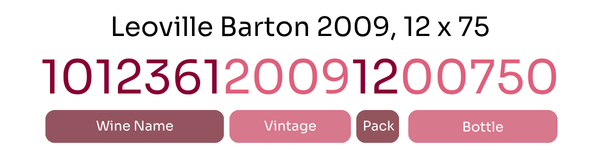
Crucially, LWIN was made freely available to the industry under a Creative Commons licence and remains free to use today. Rather than being a proprietary product code tied to a single system or company, it was designed as an open source database that anyone could adopt.
More Than Just a Number
Once businesses can identify wines accurately and consistently, they can automate workflows, integrate systems and exchange information with confidence. Pricing data, trading data, logistics information and market insights become exponentially more useful when everyone is referring to the same wine.
Stock lists can be shared more easily. Shipping instructions become clearer. Market data becomes easier to distribute. Trading systems can communicate directly with one another.
Without reliable identification and matching, even the best pricing, analytics or AI models will struggle to deliver reliable outcomes.
The LWIN database is continuously reviewed by professionals with expertise and qualifications in the wine space. This kind of standardisation and maintenance rarely results in headlines, but it is often the invisible infrastructure that enables industries to modernise.
Liv-ex has made significant contributions to the world of fine wine by championing its LWIN unique identifiers for fine wine. Antonio Galloni Vinous
The Impact on Pricing, Valuation and Trading
The rise of digital wine trading has made accurate wine identification more important than ever.
A valuation is only as reliable as the underlying wine identification. The same is true of pricing data, market analytics and trading opportunities. Without a common standard, inconsistencies can quickly undermine the quality and reliability of the data businesses rely on every day.
This is one reason LWIN has become deeply embedded within many wine businesses’ operational workflows. Once wines are mapped to a common standard, businesses can enrich their inventories with additional data, benchmark prices, automate valuations and connect to external systems with significantly less manual work.
London City Bond (LCB) provides a notable example. Prior to adopting LWIN, inconsistent naming conventions resulted in repeated manual data entry and reporting challenges. By incorporating LWIN into its systems and connecting to Liv-ex market data, the business improved consistency, reduced errors and enhanced valuation processes.
The wine descriptions on our customers’ inventories are now completely consistent – it looks far more professional. Jane Renwick LCB
What’s Next for LWIN?
Liv-ex continues to invest heavily in the tools and technology that help businesses map their inventories to LWIN quickly and accurately.
In October, Liv-ex will launch significant upgrades to the matching engine behind Wine Matcher, an exclusive matching tool available to Liv-ex members. Powered by AI and machine learning, the enhanced engine is designed to improve automatic match rates, reduce manual intervention and help members move more efficiently from list upload to pricing, valuation and trading workflows.
Because while identifying wine correctly may seem like a small task, it sits at the heart of everything that follows. Every valuation, every dataset, every trading decision and every automated workflow depends on knowing exactly which wine you’re dealing with.
Twenty years after its creation, LWIN remains the common language of the wine trade, quietly powering a more connected, efficient and data-driven global market.