Resources
Liv-ex: Your Trusted Partner for Seamless Wine Logistics
Liv-ex moves wine from seller to buyer, checks and verifies wine in our high tech, bonded warehouses, and ensures sellers are paid correctly and on…
Buying and selling wine internally involves a maze of alcohol import/export laws, bonded warehousing rules, and customs documentation. Moving wine across borders, and trading with new regions increases operational costs and can lead to longer lead times for your customers.
At Liv-ex we handle every aspect of logistics. This includes moving the wine from seller to buyer, checking and verifying wine in our high tech, bonded warehouses, and ensuring sellers are paid correctly and on time.
Liv-ex reduces the complexity of buying and selling fine wine as we act as the single point of contact on the other side of every deal, meaning one invoice, one transportation partner, one payment, despite doing businesses with other wine businesses all over the world.
So how does it work?
- Once a seller accepts a buyers bid on their wine, the trade is matched, and the wine is sold
- We collect stock from the seller, or the seller delivers directly to one of the Liv-ex warehouses, in either London, Bordeaux or Belgium
- Our warehouse team validates the wine ensuring that it complies with the Liv-ex contract
- The seller is paid as soon as we validate the wine
- The buyer pays and we move the wine to them
How does Liv-ex reduce risk in the secondary market?
To keep our exchange safe, each prospective Liv-ex member undergoes a thorough vetting process; two trade references are required, and an Exchange Committee is in place to assess every prospective member.
Liv-ex trading contracts ensure buyers know the condition of wines, delivery parameters and packaging before they bid on wine, so buyers know what they are getting with no surprises. Our benchmark SIB contract (Standard in Bond) requires the wine to be in good condition, that packaging is original and in good condition, and that the duty status is In Bond, meaning the buyer can receive their wine in 30 days.
Our wine storage facilities include state-of-the-art security and climate control systems to ensure wines are protected around the clock. Members can store their wines in our warehouses pre and post trade, before deciding whether to trade again or ship onwards.
When thorough checks are required, we take the bottles out of cases to photograph them. We use ultraviolet torches to check the labels as well as checking them for other producer specific anticounterfeiting measures such as microprint, holograms and QR codes. We inspect capsules, including checking any prooftags. And we also check the cork, sediment and glass embossing or laser etching.
How does Liv-ex simplify buying and selling internationally?
Liv-ex arranges and handles the full process of bonded transport and storage, manages customs paperwork, and oversees chain-of-custody checks, cross-border transfers and warehouse reconciliation. We also use a trusted network of Liv-ex-approved storage partners to bolster these capabilities. For businesses managing high volumes of trades, we overcome common bottlenecks in invoicing, logistics, and fulfilment that would otherwise drain profitability.
We understand that sellers require prompt payment, and buyers expect fast delivery. We have a standardised payment calendar so that sellers know exactly when they will be paid. And an individual stock management portal so that buyers can access live updates on their purchases and arrange onward movement of their stock as soon as it hits their account.
If you’d like to reduce the logistic burden of trading wine on the secondary market, speak to us about becoming a Liv-ex member.
Resources
Confidence in every Case: Liv-ex Reduces Risk & Streamlines Fine Wine Operations
Liv-ex reduces the threat of fraud and remains at the forefront of industry efforts to stop counterfeiting.
In the fine wine industry, logistics and payments can be a slow, complex process – with delays, errors, and unnecessary costs eating into margins every step of the way. Liv-ex has revolutionised this process – streamlining buying and selling, transportations and payments, to offer seamless operations for your wine business.
As part of our logistics offering, we not only move the wine between seller and buyer, and handle all paperwork and payments, we also check the veracity and condition of many wines sold on the exchange. Our dedicated verification team, led by our Authentication Manager Jess Dunn, is continuously improving our processes to avoid the risk of counterfeits.
We maintain open channels of communication between members of the trade, producers, and authentication experts to reduce the threat of fraud and remain at the forefront of industry efforts to stop counterfeiting.
Reducing Risk
Before joining Liv-ex, every prospective member undergoes a thorough vetting process; they need to provide two trade references, and an Exchange Committee vets the business to ensure every member dealing on the Liv-ex Exchange is reputable.
When it comes to listing wines for sale on Liv-ex, our employees are expertly trained to ask the right questions and dig into the facts to help flag suspicious products. This starts with our brokers, who frequently ask for evidence of provenance when listing high-risk cases or bottles on the Exchange. For wines of a certain vintage and value, photographs may be requested as a pre-trade check.
Liv-ex warehouse employees undergo regular authentication training to ensure they feel confident identifying issues with stock. We have developed a bespoke algorithm to quantify the fraud risk surrounding a wine so the appropriate checks can be conducted. As a result, around 28,000 cases of wine were checked by our warehouse teams in 2024.
When thorough checks are required, we take the bottles out of cases to photograph them. We use ultraviolet torches to check the labels as well as checking them for other producer specific anticounterfeiting measures such as microprint, holograms and QR codes. We inspect capsules, including checking any prooftags. And we also check the cork, sediment and glass embossing or laser etching.
To further enhance security for our members, Liv-ex engages the services of an independent authentication expert who conducts ad-hoc audits of our warehouses and assists in training our staff to spot potential counterfeit bottles.
Our wine storage facilities include state-of-the-art security and climate control systems to ensure wines are protected around the clock. Our storage facilities also have comprehensive security features such as alarms, CCTV, or periodic security patrols.
Our warehouses have 24-hour climate control, humidity control and are free from vibrations and daylight, maintaining the quality of goods for as long as they are stored with us.
Resources
En Primeur Reflections from Tom Burchfield, Head of Market Intelligence
Tom talks to us about his experience of attending En Primeur; the Chateau he visited, the wines he tasted, and his expectations of pricing to…
En Primeur Reflections from Tom Burchfield, Head of Market Intelligence
Along with most of the UK trade, we boarded the first Easy Jet flight from Gatwick to Bordeaux on Sunday morning. Bleary-eyed, I travelled with our CEO James Miles, Chief Commercial Officer Anthony Maxwell, and our Broker for Europe, Paolo-Luca Rossi. There was a sense of nervous anticipation. Rumours had it that the wines in Bordeaux had turned out better than expected. Word on the street was that producers were ready to face the current market state. We would see…
We headed straight to the Ballande & Meneret tasting. A huge warehouse, almost devoid of human life greeted us. Stacks of 2021s lined the tasting space, hoping for another day in the sun. We tasted c.50 wines, organised by appellation, and mostly towards the lower end of the price scale. I tasted quite a lot of green and unripe tannins. There were a few successes (Rauzan-Segla was a team favourite), but we left fearing that this year may not be the turning point we’d hoped for. After a streak of bad vintages, and a tough growing season, we wondered what the rest of En Primeur week would bring?
Day two began with a trip up the Left Bank to Saint-Estephe, starting with Montrose. After the mixed bag at Ballande, Montrose lifted our spirits – it was a very delicious wine. A quick hop skip and a jump over to Calon where we had a chance to chat with the team around the vintage, the market, and their plans.
In advance of tasting week, the Liv-ex Market Intelligence team (Market Analyst Sophia Gilmour, Data Analyst Alex Chisholm and I) had published our En Primeur book. We included an opening ‘state of the Bordeaux market’ report and individual analyses on each major wine. I brought a copy of the book along to Bordeaux, with individual printouts of the wine analyses, which I offered to each producer we met.
When we showed the data, the response was generally consistent insofar as there really did appear to be a willingness to support the campaign (this gave me a boost). There was also talk about reducing the number of negociants they worked with. Among other things, we routinely ask:
- How many full-time employees do you have?
- What about producing more grand vin and less of the second and third wines?
- How much is one critics’ point worth to you?
- Will you release at a price that will make the 2024 the cheapest in the market?
In that very charming bordelais manner, our hosts managed to come across as both humble and confident, that the market would come around to their will.
Day three begins with a drive to Libourne for the Moueix tasting, followed by a mind-altering sequence at Le Pin, Lafleur, Petrus, and lunch at Cheval Blanc. Possibly the most fascinating meeting of the trip, the Cheval team appeared committed to releasing the 2024 at a ‘no-brainer’ price. This left us feeling confident that we’d touch down in the UK with a promising En Primeur campaign ahead….
We took the last flight back to London for the Easter break and the anticipation of Pontet-Canet kicking things off next week.
EP campaign – hard work
At Liv-ex, we send our members real-time analysis of each major release. As the campaign began, we hopefully asked each other the same question: ‘Do you think Chateau X will do enough’? The further the campaign went on, the more inevitable the answer became: ‘They’ll get close, but probably not do quite enough’.
En Primeur coverage had been too focused on the percentage increase or decrease from the previous year’s release. While this made for good marketing material and enticing news stories, it is largely insignificant. Moreover, comparing a decade of generally poor release prices to one another makes little sense at all.
The crux of whether a release represented a good buying opportunity was simple and boiled down to one question: Were there less expensive back vintages, of similar or better quality, available on the market?
If the answer was no, then it could have been a ‘buy’. You do need to factor in costs of carry, and with storage currently c.£15 per 12×75 a year, this is not insignificant. .
However, if the answer was yes, then the release could not be considered a no-brainer ‘buy’. If there were multiple better rated and considerably less expensive back vintages available, then it really wasn’t a buy.
Unfortunately, this year’s campaign had few instances where the price and quality presented a better offer than what was already available on the market from previous years. Lafite and Mouton spring to mind, and Carmes Haut-Brion ascent continued. While release price reductions were commendable, there were better alternatives available.
It’s was notable that, according to our members, even when a release appeared a no-brainer buying opportunity, it was often been met by disengaged end consumers. Buyer’s apathy had taken hold, or as one more forthright traditional EP buyer told me: ‘We’ve been ****** for too many years, why buy this middling vintage?’
It was interesting that the frustration with the system had reached a point where participants from across the supply chain were now daring to put their heads above the parapet. As the first releases came out, UK merchants publicly told their customers that they had hoped for better prices. This was quite remarkable. There couldn’t have been many other industries where sales emails told you that the price wasn’t great.
Similar stories emerged from La Place, where negociants had not been shy of showing their dismay at prices they knew wouldn’t sell. Reportedly, the courtiers were also shaking their heads in disbelief.
So what might the future hold?
Before the campaign kicked off, we had thought that the small crop of 2024s represented an opportunity for producers to reset and price at a level that would invigorate the market. There may not have been any price good enough to reinvigorate the market, but now we’ll never know… So what could 2025 hold?
We had to hope that 2025 would be a beautiful and bountiful vintage. One that was cheaper for producers to make, and theoretically gave the trade an easier thing to sell. While still 12 months away, we anticipated that the market could not stomach further price rises. It would have to be priced well below other back vintages. In a falling market, this was no easy feat, and one that might be hard to contemplate. But that’s what needed to be done. If the 2024 campaign had felt like last chance saloon, then for some another misstep might well result in closing time.
Resources
Offer Your Customers Greater Variety Without Investing in New Stock
Liv-ex members can pull over 23,000 Liv-ex listings onto their ecommerce site to offer their customers increased choice and variety.

It’s more important than ever for wine businesses to find ways to attract new customers and appeal to a broader audience. But for many businesses, investing in new stock and experimenting with new offers requires upfront investment and risk that’s hard to justify in a downward market.
At Liv-ex we’ve developed a solution that lets you showcase all the wine available on the Liv-ex exchange, without the need to invest in the stock upfront. Liv-ex members that connect their ecommerce site to the exchange can automatically show wine available on Liv-ex, offering more variety to their customers.
Bulk out your portfolio at no extra cost
Liv-ex members can pull over 23,000 Liv-ex listings onto their ecommerce site to offer their customers increased choice and variety. Members who choose to integrate with Liv-ex are able to create tailored views for each of their customers, to showcase only the most relevant, and of-interest wines, to create a personalised buying experience for them.
Liv-ex is very powerful as a way to expand your offering! Starting with 1,000 wines, we now have a ‘virtual cellar’ of 23,000 wines, thanks to Liv-ex. Gianluca Queiroli Wine Empire
Read full case study here.
Reduce Risk and Streamline Operations
Before becoming a Liv-ex member, every prospective member undergoes a thorough vetting process; they need to provide two trade references, before an Exchange Committee vets the business, so you know every wine you are listing on your ecommerce site comes from a trusted and reputable wine business.
Additionally, most wines on the exchange are available under the Standard in Bond (SIB) contract, meaning its condition is verified and the wine is held in bonded storage. Members can connect their ecommerce sites knowing that if the wine is listed, it is available and can be delivered in 30 days.
Liv-ex moves the wine between seller and buyer, and verifies it in one of our state of the art warehouses. Liv-ex warehouse employees undergo regular authentication training to ensure they feel confident identifying issues with stock. We have developed a bespoke algorithm to quantify the fraud risk surrounding a wine so the appropriate checks can be conducted. As a result, around 28,000 cases of wine were checked by our warehouse teams in 2024.
When thorough checks are required, we take the bottles out of cases to photograph them. We use ultraviolet torches to check the labels as well as checking them for other producer specific anticounterfeiting measures such as microprint, holograms and QR codes. We inspect capsules, including checking any prooftags. And we also check the cork, sediment and glass embossing or laser etching.
To further enhance security for our members, Liv-ex engages the services of an independent authentication expert who conducts ad-hoc audits of our warehouses and assists in training our staff to spot potential counterfeit bottles.
Resources
Arbitrage – The Opportunity You Could Be Missing
Liv-ex members can see the regional value of wines, helping them to identify opportunities to drive the highest margins.

Arbitrage—the practice of buying in one market and selling in another at a higher price—is a well-established strategy in the world of finance. For fine wine traders, it’s a powerful way to increase margins and diversify income at a time when margins feel increasingly squeezed and threatened by geopolitical factors. But identifying arbitrage opportunities in wine can be time-consuming and complex.
Different regions often place different values on the same wine, or have varying levels of demand, which in turn influences pricing. For example, a case of Bordeaux might drive a different price in Asia versus Italy. At first glance, the opportunity is clear – buy wine where it’s cheaper, sell where it’s more valuable. In practice, it’s not that simple.
Until now, uncovering these opportunities has meant hours of manual work: checking regional marketplaces, calculating exchange rates, and estimating tariffs, duties, and shipping costs. It takes time that most wine businesses don’t have to spare.
Introducing Regional Benchmarks on Liv-ex
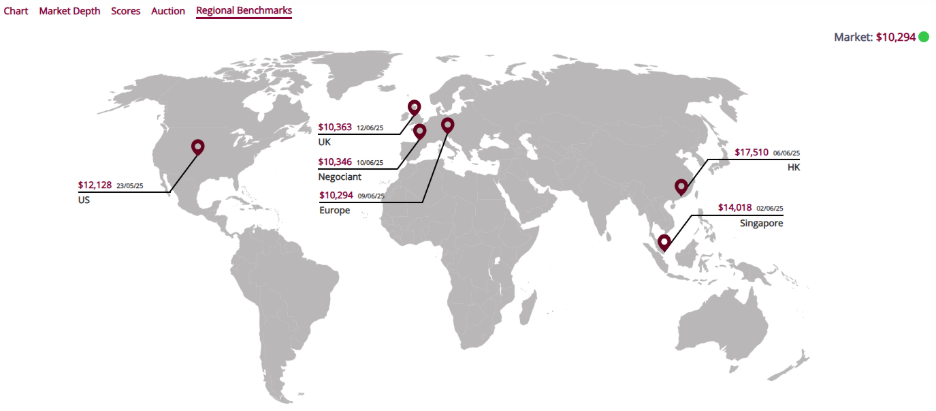
We recently expanded our Regional Benchmark offering. Previously, members could view the best listed price for a wine in key markets including the US, Hong Kong, Singapore, and among négociants in La Place de Bordeaux. Now, the data is broader — with the UK and EU added — and even more actionable than before.
For the first time, there is a single trusted reference point for each region— saving merchants valuable time that was previously spent cross-checking multiple, fragmented sources.
Not only can Regional Benchmarks now be viewed side by side in a ‘world map’ view on every individual wine page, but they are also integrated into Liv-ex’s List Studio. Here, members can upload a stock list — or a client list — and instantly receive a regional benchmark for each wine.
Members can use this valuable data to identify the wines most of value in their region. They can compare prices at scale, including against other Liv-ex proprietary data points such as Bid and Offer, and sort by percentage difference.
Where’s the opportunity in arbitrage?
For professional traders, arbitrage offers:
- Quick-turn profits—no need to wait for prices to rise organically.
- Stock rotation—move wines faster by tapping into markets with higher demand.
Within seconds, Liv-ex members can identify:
- The value of their stock list or a clients’ lists in each region
- Where they are most and least competitive
- Opportunities to sell stock in regions where prices are higher
- Where to source wines more affordably in the future
It’s complex, but Liv-ex makes it easier
Unlike high-frequency trading in finance, wine arbitrage isn’t instant. But with Liv-ex, you can gain a competitive advantage. Our pricing data, logistics services, and trading platform help you move confidently, minimise risk, and execute faster than ever before.
Resources
The Industry Standard for Pricing Fine Wine
At Liv-ex we’ve dramatically reduced the time it takes for wine businesses to value wine, by bringing a wealth of data points into one place.
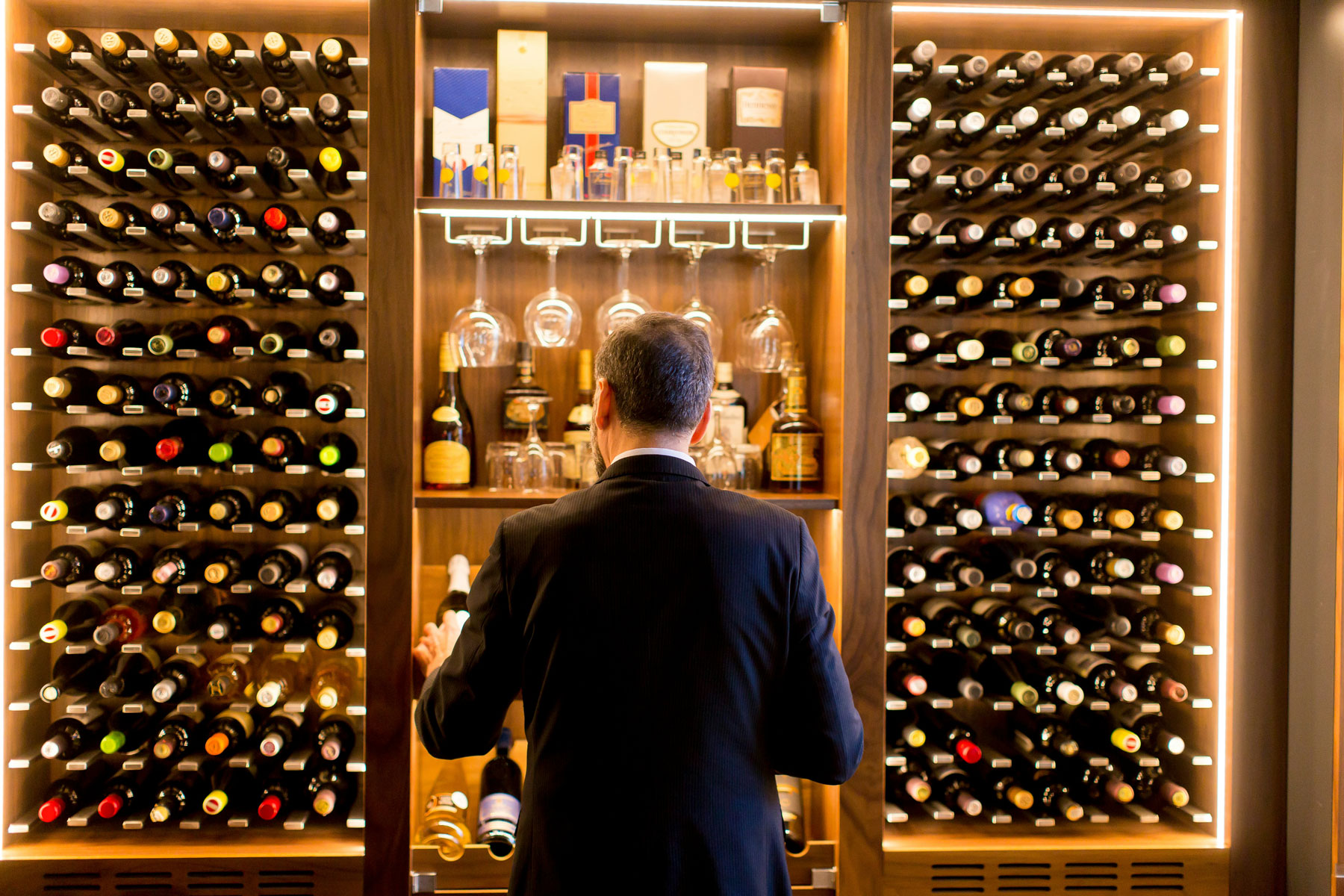
Do you remember the days when buying and selling wine was done over the phone? And the market lacked transparency without readily available data on the value and price of wine. Our founders, James Miles and Justin Gibbs, certainly do, because that’s exactly why they started Liv-ex back in 2000. With a mission to make the fine wine industry more transparent, efficient and safe.
The internet brought with it the ability to buy and sell wine with businesses further afield, opening new opportunities and expanding the possibility of growth. But the internet age also brought an added burden, with information more available than ever, pricing wine became more complex than ever. With numerous sources across the web, diligent wine businesses could spend hours searching, scrolling, and documenting price points in a spreadsheet, ready for analysis.
At Liv-ex we’ve dramatically reduced the time it takes for wine businesses to value wine, by bringing a wealth of data points into one place, and creating tools to support rapid price matching for even the longest lists of wine. We’ve brought transparency to the market by showing a wealth of data points, enabling businesses to make informed and therefore accurate decisions.
Liv-ex Transactional Data
Many online merchants showcase advertised or ‘desired’ prices. This is the price a seller hopes to get for the wine, but it isn’t possible to see the price the wine actually sold for. Liv-ex is different.
Liv-ex Transactional Data shows the price at which a wine has sold, providing the most accurate view of a wines value in the market. Historic Transactional Data can be seen for the past 25 years, allowing members to see the changes and trends in a wines value over time. We supplement Transactional Exchange Data, the sale price of wine on Liv-ex, with Transactional Auction Data, to show the sale price of wine from major auction houses as well.
Transactional Exchange Data is unique to Liv-ex and cannot be found anywhere else, and the combination of Exchange Data and Auction Data provides members with the genuine value of a wine at any given movement in time.
List Data
List data shows advertised prices of wine, although not as accurate as transactional data, list data adds a depth of insight, beyond the sales made on the Liv-ex Exchange and at Auction Houses. We obtain, clean and categorised list data at scale, showcasing perceived value across the secondary market.
Long gone are the days of website-hopping, complex spreadsheets, and countless hours spent compiling data. We save our members time by bringing a vast array of data sources into one place, and not only this, we standardise, categorise and dissect the data, and turn it into several meaningful data points for our members. These data points include the average list price, the lowest list price and the availability of stock across the market.
Relying on limited data from a small number of sources can lead to inaccurate pricing, stock not moving or selling your wines at too low of price point. At Liv-ex we analyse 200 million data points daily.
How do we gather so much information? Liv-ex has members and industry connections that provide their list data to us. They trust us because we are totally independent in the market, we do not hold stock and we do not compete with our members for business. We work with merchants that do not list their data anywhere online, and this breadth of data cannot be found anywhere else.
Product Data
Liv-ex pulls essential product data into the exchange so that you can build a view of a wines value, including critics scores, drinking windows and ABVs. Find all of this information alongside Transactional Data and List data to save you time when it comes to client consultancy, as well as import and tax documentation that may come next.
List Valuations with Liv-ex
Not only does the Liv-ex Exchange house an extensive dataset to support accurate valuations, we have tools to help you value an entire list of wines in minutes. By simply uploading a spreadsheet of wines, we can return the last Transactional price of each wine, as well as the lowest and average List prices, and details of the same wines currently for sale on the Liv-ex Exchange.
Resources
Inspired Money: How to Invest in Fine Wine: A Masterclass on Auctions, Fakes & Profits
We’re excited to share that Robbie Stevens, our Head of Broking at Liv-ex, recently featured on the Inspired Money podcast – a series that explores the intersection…

We’re excited to share that Robbie Stevens, our Head of Broking at Liv-ex, recently featured on the Inspired Money podcast – a series that explores the intersection of finance, investment, and lifestyle.
He joins an expert panel to explore auction strategies and how to spot investment-grade bottles. This masterclass reveals what makes wine one of the most compelling alternative assets today.
What You’ll Learn in This Episode
- Wine as an Investment Asset
Discover why fine wine is increasingly viewed as a “passion asset” and how it compares to traditional investments like art or cars. - Auction Strategies and Market Access
Learn the basics of bidding, the hidden costs of auctions, and how online platforms are attracting a new generation of investors. - What Makes a Wine Investment-Grade?
Explore the three pillars of value – rarity, provenance, and maturity – and why secondary market liquidity is the most important metric. - Managing Your Collection for Maximum Value
From optimal selling windows to the importance of a complete paper trail, find out how professional cellar management can protect and grow your portfolio. - Provenance and Counterfeit Risks
Hear how authentication processes and emerging technologies like blockchain are shaping the fight against wine fraud. - Exit Strategies and Market Timing
Understand when to sell, how to read market signals, and why emotional investors need a clear plan to monetise their collections.
Watch the full episode here:
https://www.youtube.com/watch?v=nx9GNRrowmE&list=PLaTmIwOdrI5o2bUmo6XRyVJti9QYN1BFE&index=99
Resources
Bottled In China x Liv-ex Podcast: Wine, Wealth, and Data: Inside Liv-ex’s Asia Playbook
In a recent episode of The Bottled in China podcast, Liv-ex co-founder and CEO James Miles joins Emilie Steckenborn.

In a recent episode of The Bottled in China podcast, Liv-ex co-founder and CEO James Miles joins Emilie Steckenborn.
He unpacks the story behind Liv-ex, shares his insights on wine as an asset class, discusses Gen Z’s growing interest in wine, and explores Asia’s rising influence in the fine wine market.
Listen here:
Resources
TheDrinksBusiness Podcast x Liv-ex 25 Years of Liv-ex with founders, James Miles & Justin Gibbs
In a recent episode of The Drinks Business Podcast, Liv-ex co-founders Justin Gibbs and James Miles joined host Patrick Schmitt MW

In a recent episode of The Drinks Business Podcast, Liv-ex co-founders Justin Gibbs and James Miles joined host Patrick Schmitt MW to reflect on the transformation of the fine wine market over the past 25 years.
They discussed how Liv-ex has helped bring transparency to what was once an opaque space, and how the exchange is now evolving into a more data-driven platform, aligned with the changing needs of the global wine trade.
Listen to the the full TheDrinksBusiness podcast here -> Liv-ex with James Miles and Justin Gibbs – The Drinks Business Podcast | Acast