Resources
European Buyers Became Key Market Support Following US Retreat
Following the withdrawal of US buyers in early-mid 2025, European buyers stepped in, increasing both their market share and nominal spend, according to new analysis…

European Buyers Became Key Market Support Following US Retreat
Following the withdrawal of US buyers in early-mid 2025 (a consequence of Trump’s tariff threats), prices fell quickly. Before, US buyers were able to purchase at higher levels while maintaining margins, propping levels up. Now, European buyers, perhaps finding value at these new lows, stepped up their purchasing.
Central European Buyers Increase Purchasing Share from 10% to 35%
Over the past three years, Central European buyers (mainly from Switzerland, Denmark, the Netherlands, Germany & the Czech Republic) have accounted for an expanding share of European purchasing. Their share of purchases by value increased from 10% in 2023 to 35% today, while France’s share declined from 75% to 55%.
European Buyers Buy Closest to Market Price After the US
Though US buyers are the most competitive segment, EU buyers follow close behind, consistently purchasing closer to Market Price than the overall average. On the other hand, EU members sell significantly below the market average.
About Liv-ex
Liv-ex is the exchange for fine wine, market data and insight. They offer a membership that brings wine professionals independent market data and insights, and the ability to price, buy and sell wines through one point of contact.
Liv-ex offers automation services that enable fine wine businesses to streamline buying and selling, and gain operational efficiencies, including the ability to bring critics scores directly into their own systems.
Resources
Fine Wine News: EU buying up 140% on week-on-week
In this week’s Talking Trade, US buyers maintained their lead of purchasing, with EU buyers behind increasing their purchased value by 140% week-on-week.

- Bordeaux led the market, followed by Burgundy and Champagne.
- DRC’s Romanee-Conti 2008 and Dominio de Pingus 2016 were the top-traded wines by value.
- Despite purchasing 18% less this week than last week, US buyers maintained their lead of purchasing. EU buyers followed close behind, increasing their purchased value by 140% week-on-week.
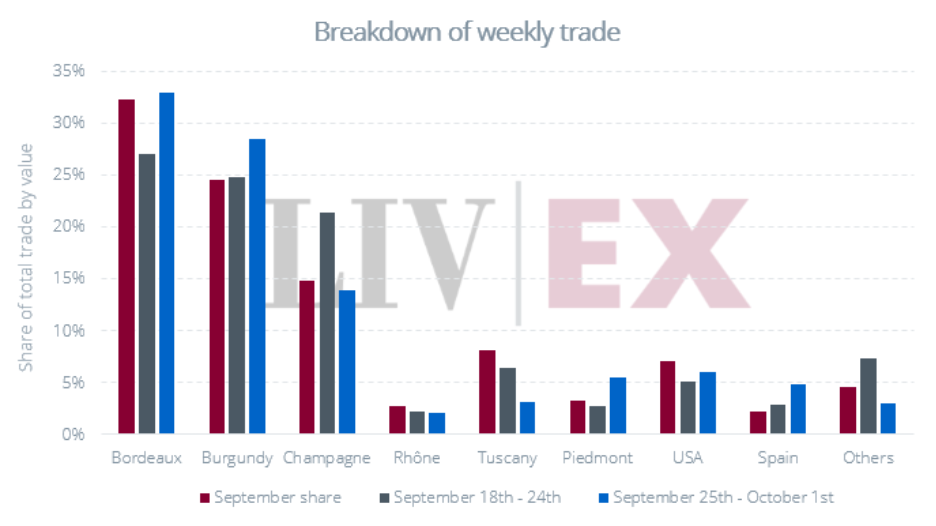
Bordeaux led the market, claiming 33.0% of traded value. The 2009 and 2019 vintages were the top-traded by value; the 2023s led by volume.
Burgundy came in second place with a 28.5% share. Domaine de la Romanee-Conti was by far the top-traded producer, accounting for over a third of the region’s trade and 10.6% of overall trade.
Champagne claimed third place, down from its strong close last week at 21.4% to 13.9% this week. US buyers accounted for 47% of the region’s purchasing (by value), focusing their efforts on Dom Perignon.
Piedmont overtook Tuscany, the two regions taking a 5.5% and 3.2% share of traded value respectively. Giacomo Conterno and Gaja were the top-traded producers, followed by Antinori (Tignanello) and Casanova di Neri.
US wines accounted for 6.0% of traded value. Scarecrow was the region’s top-traded producer, though Opus One and Screaming Eagle also traded actively.
Spain had a strong week, claiming 4.8% of traded value, thanks largely to active trading of Dominio de Pingus.
Missed last week’s trade blog? Read it here.
Copyright © 2026 Liv-ex Ltd. All rights reserved.
Resources
The Drinks Business Conference: State Of The Market
Tom Burchfield, Head of Decision Intelligence at Liv-ex, presented at the Drinks Business Conference 2026 on the state of the fine wine market.

Introduction
When I was invited to kick off the Drinks Business conference with a presentation on the State of the Fine Wine Market, ahead of sessions which were going to cover a broad range of topics including fine wine retail, fine wine in the on-trade, fine wine for Gen Z and AI, I couldn’t shake the famous ‘How do you like it? More More More’ lyric. Across every aspect of the fine wine supply chain, it is more complex, more competitive and more demanding than ever.
The good news is that the fine wine market continues to show signs of stability and recovery. While the market, particularly in the UK, is characterised by a shortness of confidence and a risk-off approach, there continue to be signs that it is turning a corner.
Major Liv-ex indices have risen ever so slightly over the past year. Demand continues to return to the market, particularly at the top end and for back vintages. Q3 Liv-ex trade value has risen steeply compared to Q2 2026 and Q3 2025.
Inconsistency reigns
However, the overwhelming trend in the market is inconsistency. Price and trade performance varies widely by wine region, producer, brand and vintage. Not all wines have found their floor, others are bumping along the bottom, while others have definitively started to rise again.
As one would expect, recovery has started off very narrow. Demand is returning to the top, with trade picking up there. We anticipate that enough confidence in the top of the market will be required for that to then seep further down through the tiers. For now, the market remains stratified.
Back vintage stability is another trend that appears set to continue. Consumption-induced scarcity is playing an important role in resetting the demand:supply balance for back vintages, which subsequently leads to greater price stability. Q3 has also seen a sharp rise in pre-2011 Bordeaux trade on Liv-ex, a sign perhaps that price stability is now translating into enough confidence for buyers to really reengage.
Is now the best time to by fine wine in a decade?
A contentious topic, but by nature of it being contentious means that there must be an argument for why it is the best time to buy fine wine in recent memory.
The Fine Wine 1000 in real terms is back to where it was in 2015. So yes, there is clearly an argument for why it is the best time to buy fine wine in a decade.
But it’s no good if prices fall and it would be better to buy in a couple of years’ time. However, at a high level, we don’t anticipate prices to fall. The bid:offer ratio (total value of bids against total value of offers) for the Fine Wine 1000 is at a level where we have historically seen price stability.
The key therefore is to be extremely fastidious and search out wines that have definitely bottomed out. This is why I would call it the time of the canny buyer. For an example of what this looks like in Champagne, here are some wines that have shown positive trade price performance over recent months.
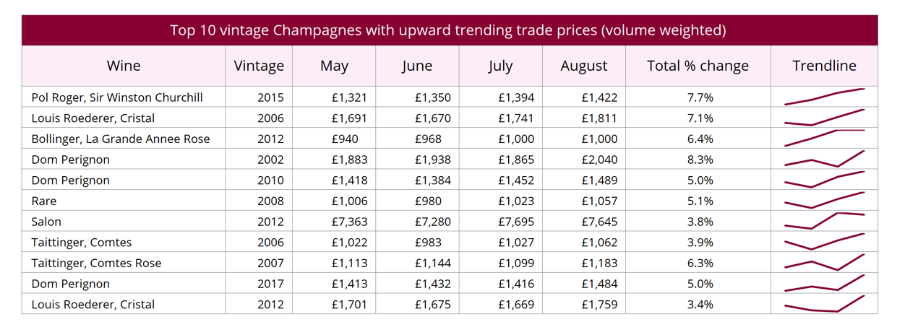
One size fits all doesn’t work
The huge amount of market inconsistency and an increasingly complex industry point towards the critical need to treat every customer as an individual. As much as fine wine professionals are generally short on confidence, many end collectors have lost faith in the market and the companies they have historically bought from. To win them back will require a tailored, unique experience. Personalisation will be critical.
The good news is that fine wine professionals now have a set of wines they can confidently recommend, provided of course that they know the customer likes the style and doesn’t already have the wine in their cellar.
To download my presentation slides, please fill out the form below.
Download the presentation slides
Resources
This Week In Fine Wine: Champagne takes 21% of traded value; US buying climbs further
In this week’s Talking Trade, Bordeaux led the market, though shared the stage with both Burgundy and Champagne, each taking over 20% of traded value.

- Bordeaux led the market, though shared the stage with both Burgundy and Champagne, each taking over 20% of traded value.
- US buyers returned in full force, claiming 40% of purchased value.
- Krug 1996, now trading on its long-term upwards trendline, and Lafite 1986, trading at its 2008 and 2015 lows, were the top-traded wines by value.
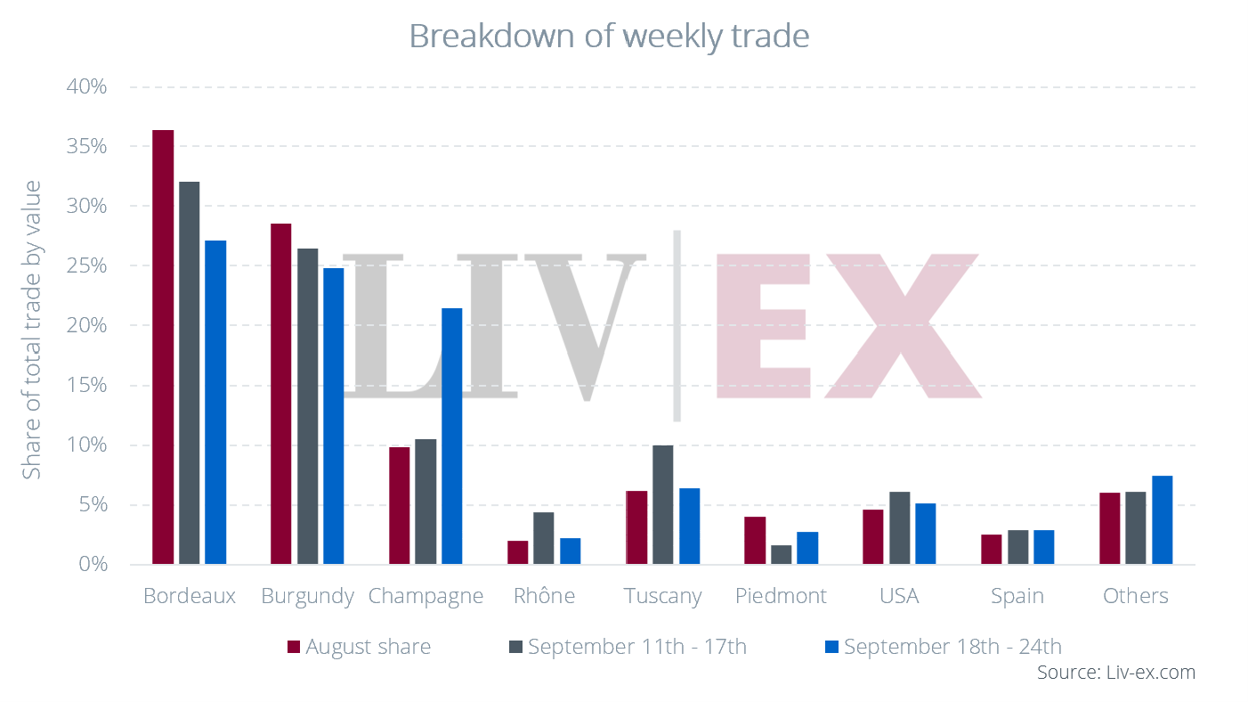
Bordeaux maintained its lead of the market, though its share of traded value fell from 32.0% last week to 27.1% this week. Mature, strong vintages continue to draw demand, with the 1986, 2000 and 2010 the top-traded by value.
Burgundy followed in second place, claiming 24.8% of traded value. Following weeks dominated by rare Leroy, d’Auvenay and Romanee-Conti, slightly lower value wines in decent volumes led the region this week, with Lamy-Caillat and Jean-Claude Ramonet coming ahead of DRC.
Champagne’s share of the market rose to 21.4% — its highest weekly share in recent memory. US buyers accounted for over half of the region’s trade, focusing their efforts on Krug, Jacques Selosse and Salon.
Italian trade remained subdued, Tuscany and Piedmont claiming a combined 9.1% share of traded value.
The US claimed 5.1% of traded value. Opus One was by far the region’s top-traded wine by value, claiming 59% of the region’s trade.
Included in the ‘Others’ section, Australia claimed 3.6% of traded value. Wines from Leeuwin, Henschke and Penfolds traded actively.
Missed last week’s trade blog? Read it here.
Copyright © 2026 Liv-ex Ltd. All rights reserved.
Resources
Château Palmer 2016 (Second Parcel) Release
Palmer 2016 Library Release, published by Market Analyst Sophia Gilmour last month, is now available to non-members. Complete the form below to download the analysis.

Download the Guide
Inside you’ll find:
- Release Analysis
- Château Palmer Market Prices vs. Critic Scores Graph
- Market Price Index Graph
Liv-ex is the global exchange for fine wine, market data and insight.
Resources
Automation Guide
Automation is transforming the wine trade. To keep up, businesses need more efficient ways to price, buy and sell wine.

Download the Guide
Guide Summary
The 10 page guide outlines practical ways automation can help your business to streamline operations, accelerate growth and in turn, deliver greater value to your customers.
Other Guides You Might Be Interested In…
The Importance of Quality Data Guide
Guide to Data-Driven, Buying, Selling and Pricing of Fine Wine
Resources
LWIN Database Download
Download the Liv-ex Wine Identification Number (LWIN) database, which contains unique identifiers for more than 205,000 wines

Download the Database
Have you downloaded our LWIN Intro Guide?
Get a complete understanding of how LWIN could support your wine business as the industry’s global standard for wine identification.
Resources
New Guide: LWIN Intro
Get a complete understanding of how LWIN could support your wine business, then download the database to get started.
Download the Guide
Have you downloaded our LWIN database?
Download the Liv-ex Wine Identification Number (LWIN) database, which contains unique identifiers for more than 205,000 wines
Resources
The History of LWIN: How a Common Language Changed the Wine Trade
In 2011, Liv-ex introduced LWIN, a universal identifier for wine & spirits. Today, LWIN underpins thousands of wine businesses worldwide.

Twenty years ago, few people in the wine industry gave much thought to product identifiers.
Wine was bought and sold using names, vintages, bottle formats, but in many cases, businesses maintained their own naming conventions. It wasn’t unusual for the same wine to appear in different ways across systems, spreadsheets, and stock lists.
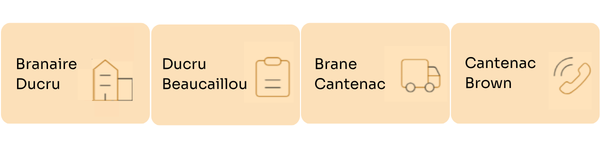
For merchants, warehouses, publications and logistics providers, this created occasional confusion. For computers, it created a much bigger problem…
As wine trading became increasingly global and technology-driven, the need for a common language became impossible to ignore. The solution was LWIN: the Liv-ex Wine Identification Number.
Today, LWIN underpins thousands of wine businesses worldwide and has become the industry’s leading standard for wine identification. But its impact extends far beyond simply assigning a code to a bottle; it has helped create the foundations for a more connected, efficient and data-driven wine market.
The Birth of LWIN
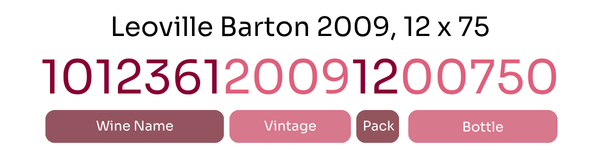
In 2011, Liv-ex introduced the Liv-ex Wine Identification Number, commonly known as LWIN. Its purpose was simple: to create a universal identifier for wine and spirits that any business could use.
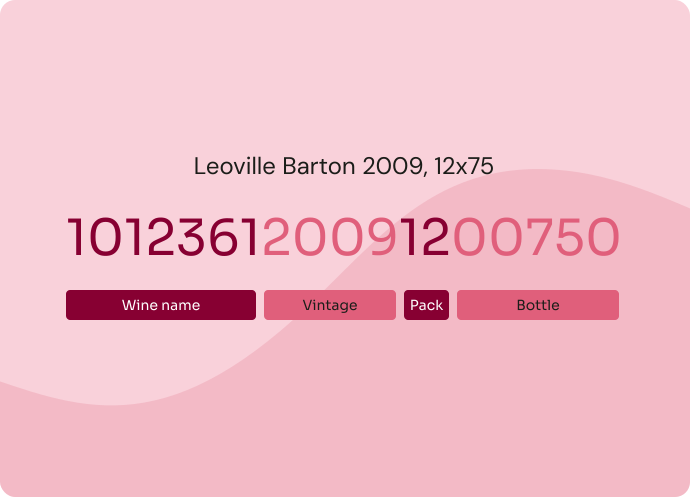
Much like an ISBN identifies a book, an LWIN identifies a wine. Download our LWIN Guide here.
By assigning a unique code to each product, it created a common language that could be shared across industry participants. This made it easier to exchange information, reduce the risk of costly human errors, and ensure everyone was referring to exactly the same wine, regardless of how it was named in their own systems.
Crucially, LWIN was made freely available to the industry under a Creative Commons licence and remains free to use today. Rather than being a proprietary product code tied to a single system or company, it was designed as an open source database that anyone could adopt.
More Than Just a Number
Once businesses can identify wines accurately and consistently, they can automate workflows, integrate systems and exchange information with confidence. Pricing data, trading data, logistics information and market insights become exponentially more useful when everyone is referring to the same wine.
Stock lists can be shared more easily. Shipping instructions become clearer. Market data becomes easier to distribute. Trading systems can communicate directly with one another.
Without reliable identification and matching, even the best pricing, analytics or AI models will struggle to deliver reliable outcomes.
The LWIN database is continuously reviewed by professionals with expertise and qualifications in the wine space. This kind of standardisation and maintenance rarely results in headlines, but it is often the invisible infrastructure that enables industries to modernise.
Liv-ex has made significant contributions to the world of fine wine by championing its LWIN unique identifiers for fine wine. Antonio Galloni Vinous
The Impact on Pricing, Valuation and Trading
The rise of digital wine trading has made accurate wine identification more important than ever.
A valuation is only as reliable as the underlying wine identification. The same is true of pricing data, market analytics and trading opportunities. Without a common standard, inconsistencies can quickly undermine the quality and reliability of the data businesses rely on every day.
This is one reason LWIN has become deeply embedded within many wine businesses’ operational workflows. Once wines are mapped to a common standard, businesses can enrich their inventories with additional data, benchmark prices, automate valuations and connect to external systems with significantly less manual work.
London City Bond (LCB) provides a notable example. Prior to adopting LWIN, inconsistent naming conventions resulted in repeated manual data entry and reporting challenges. By incorporating LWIN into its systems and connecting to Liv-ex market data, the business improved consistency, reduced errors and enhanced valuation processes.
The wine descriptions on our customers’ inventories are now completely consistent – it looks far more professional. Jane Renwick LCB
What’s Next for LWIN?
Liv-ex continues to invest heavily in the tools and technology that help businesses map their inventories to LWIN quickly and accurately.
In October, Liv-ex will launch significant upgrades to the matching engine behind Wine Matcher, an exclusive matching tool available to Liv-ex members. Powered by AI, the enhanced engine is designed to improve automatic match rates, reduce manual intervention and help members move more efficiently from list upload to pricing, valuation and trading workflows.
Because while identifying wine correctly may seem like a small task, it sits at the heart of everything that follows. Every valuation, every dataset, every trading decision and every automated workflow depends on knowing exactly which wine you’re dealing with.
Fifteen years after its creation, LWIN remains the common language of the wine trade, quietly powering a more connected, efficient and data-driven global market.