The Drinks Business Conference: State Of The Market
Tom Burchfield, Head of Decision Intelligence at Liv-ex, presented at the Drinks Business Conference 2026 on the state of the fine wine market.

Introduction
When I was invited to kick off the Drinks Business conference with a presentation on the State of the Fine Wine Market, ahead of sessions which were going to cover a broad range of topics including fine wine retail, fine wine in the on-trade, fine wine for Gen Z and AI, I couldn’t shake the famous ‘How do you like it? More More More’ lyric. Across every aspect of the fine wine supply chain, it is more complex, more competitive and more demanding than ever.
The good news is that the fine wine market continues to show signs of stability and recovery. While the market, particularly in the UK, is characterised by a shortness of confidence and a risk-off approach, there continue to be signs that it is turning a corner.
Major Liv-ex indices have risen ever so slightly over the past year. Demand continues to return to the market, particularly at the top end and for back vintages. Q3 Liv-ex trade value has risen steeply compared to Q2 2026 and Q3 2025.
Inconsistency reigns
However, the overwhelming trend in the market is inconsistency. Price and trade performance varies widely by wine region, producer, brand and vintage. Not all wines have found their floor, others are bumping along the bottom, while others have definitively started to rise again.
As one would expect, recovery has started off very narrow. Demand is returning to the top, with trade picking up there. We anticipate that enough confidence in the top of the market will be required for that to then seep further down through the tiers. For now, the market remains stratified.
Back vintage stability is another trend that appears set to continue. Consumption-induced scarcity is playing an important role in resetting the demand:supply balance for back vintages, which subsequently leads to greater price stability. Q3 has also seen a sharp rise in pre-2011 Bordeaux trade on Liv-ex, a sign perhaps that price stability is now translating into enough confidence for buyers to really reengage.
Is now the best time to by fine wine in a decade?
A contentious topic, but by nature of it being contentious means that there must be an argument for why it is the best time to buy fine wine in recent memory.
The Fine Wine 1000 in real terms is back to where it was in 2015. So yes, there is clearly an argument for why it is the best time to buy fine wine in a decade.
But it’s no good if prices fall and it would be better to buy in a couple of years’ time. However, at a high level, we don’t anticipate prices to fall. The bid:offer ratio (total value of bids against total value of offers) for the Fine Wine 1000 is at a level where we have historically seen price stability.
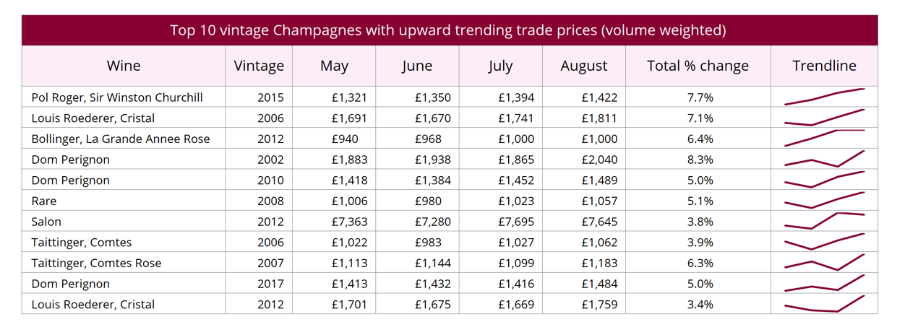
The key therefore is to be extremely fastidious and search out wines that have definitely bottomed out. This is why I would call it the time of the canny buyer. For an example of what this looks like in Champagne, here are some wines that have shown positive trade price performance over recent months.
One size fits all doesn’t work
The huge amount of market inconsistency and an increasingly complex industry point towards the critical need to treat every customer as an individual. As much as fine wine professionals are generally short on confidence, many end collectors have lost faith in the market and the companies they have historically bought from. To win them back will require a tailored, unique experience. Personalisation will be critical.
The good news is that fine wine professionals now have a set of wines they can confidently recommend, provided of course that they know the customer likes the style and doesn’t already have the wine in their cellar.
To download my presentation slides, please fill out the form below.