Author: Marianne Marfleet
Senior Customer Success Manager
An exciting opportunity for an experienced, knowledgeable and driven Customer Success Manager who wants to take the lead in managing international client relationships and driving subscription growth.
Location: Borough, London
With regular travel to territories under management
- Department: Membership
- Reports to: Head of Membership
Competitive salary dependent on experience plus performance-related bonus, healthcare insurance and wellbeing benefits.
With customers in 50 countries, Liv-ex is the leading fine wine exchange globally. Our vision is to make the wine market more transparent, efficient, and safe, for the benefit of our members and wine lovers everywhere. Our culture is hardworking, entrepreneurial and friendly. Founded in 2000, Liv-ex’s trading, data and market intelligence platform is used by wine businesses around the world to better understand the market and execute buying and selling opportunities. We’re at an inflection point in our journey, embarking on a transformational phase that will redefine how the wine industry operates, trades, and leverages data intelligence. Despite our market leadership, we remain an agile, entrepreneurial, focused organization where senior leaders are involved in driving execution and delivering results.
Summary Purpose
The Senior Customer Success Manager is responsible for building and establishing the Customer Success function at Liv-ex, as well as ensuring the quality, consistency and effectiveness of its delivery.
The role will combine leadership with hands-on delivery. The postholder will directly manage a portfolio of members across onboarding, adoption, engagement, health and renewal preparation while establishing the team, methodology, standards and operating model.
As the function develops, the Senior CSM will lead and grow the CSM team, own Customer Success methodology and standards, handle complex adoption and retention cases, support AMs on strategic relationships, and develop scalable Customer Success journeys for lower-touch members.
Responsibilities:
- Lead the CSM team – line-manage, coach and develop the CSMs, setting clear expectations and improving capability and consistency.
- Own Customer Success methodology – establish and maintain standards and playbooks for onboarding, adoption, health, engagement, value evidence and renewal readiness.
- Manage complex customer situations – lead higher-risk adoption, engagement and retention cases and coordinate appropriate interventions.
- Own customer health and retention discipline – ensure risks are identified early, actions are clear and customer value is evidenced.
- Support strategic accounts – work alongside AMs on strategic relationships, particularly where senior stakeholder engagement, adoption or retention support is required.
- Improve the customer journey – identify gaps and improve the consistency of the member experience across onboarding, adoption, engagement and renewal.
- Develop scalable Customer Success – shape the digital and one-to-many customer journey, working with RevOps, Marketing and other teams on delivery.
- Represent the customer internally – bring structured customer insight to Product, Marketing, Commercial and other teams.
Measures of success
- GRR and overall retention performance.
- Reduction in preventable churn.
- Improvement in customer adoption and health.
- Quality and timeliness of renewal readiness.
- Consistency and effectiveness of CSM delivery.
- Development and performance of the CSM team.
- Effectiveness of the digital/customer journey.
- Quality of Customer Success support provided to AM-led strategic relationships.
Expectations
- Operate with a high degree of ownership and judgement.
- Lead through others rather than focusing only on their own customer portfolio.
- Establish standards and improve how Customer Success operates.
- Coach and develop colleagues.
- Handle complex or sensitive customer situations confidently.
- Work effectively across Membership, Product, Marketing, Rev Ops and other teams.
- Identify problems early and bring practical solutions.
- Balance customer outcomes with Liv-ex’s commercial objectives.
To apply, please send your CV with a cover letter detailing why you are interested in this role to [email protected]
Author: Marianne Marfleet
Bordeaux claims 40% of traded value, Lafite 2005 in the lead
Bordeaux led the market, claiming 39.6%, Lafite accounting for over a quarter of its trade.
- Bordeaux led the market, claiming 39.6%, Lafite accounting for over a quarter of its trade.
- Lafite 2005, Tignanello 2023 and Domaine Louis Latour, Corton-Charlemagne 2023 were the top-traded wines of the week by value.
- EU, UK and US buyers shared the stage this week, each buying geography accounting for 27-30% of traded value.
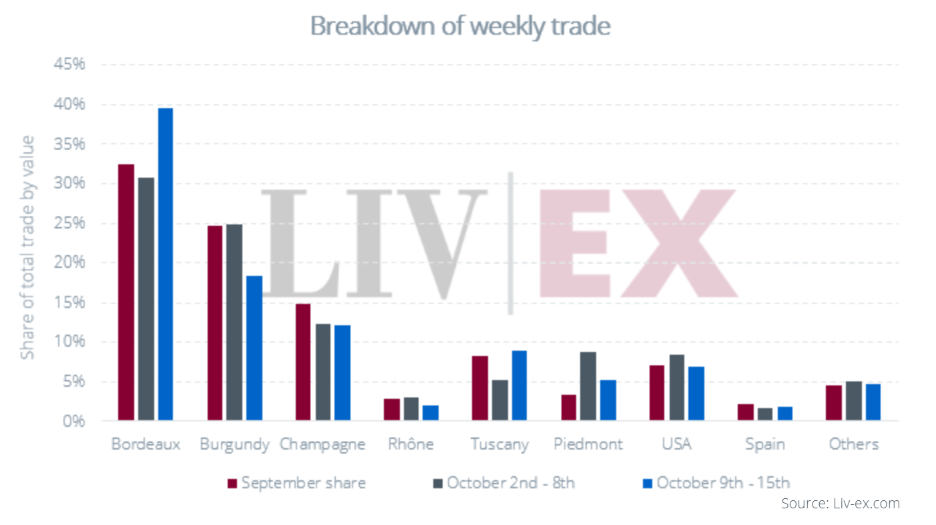
Bordeaux took a strong lead of the market, claiming 39.6% of traded value. Lafite was by far the region’s top-traded wine, accounting for over a quarter of its traded value.
Burgundy followed in second place, its share falling from 24.8% last week to 18.4% last week. Louis Latour, Domaine de la Romanee-Conti and Louis Jadot were the top-traded producers, with the 2022s and 2023s trading most actively.
Champagne’s share remained flat at 12.2%, coming in third place. Bollinger pulled ahead of Dom Perignon and Louis Roeder as the top-traded producer by value, with R.D. 2008 the region’s top-traded wine overall.
Tuscany’s share rose from 5.2% last week to 8.9% this week. UK buyers led purchasing of Super Tuscans – largely Tignanello and Tua Rita – while US buyers led purchasing of Brunello, focusing on Fuligni and Biondi-Santi.
Piedmont’s share fell to 5.5% following its strong close last week, with Gaja accounting for close to half of the region’s traded value.
The US claimed a 7.0% share of traded value, with Opus One, Promontory and Screaming Eagle the top-traded producers. US buyers accounted for 58% of region’s purchasing by value.
Missed last week’s market update? Read it here.
Copyright © 2026 Liv-ex Ltd. All rights reserved.
Author: Marianne Marfleet
Warehouse and Risk Supervisor - France
Department – Operations
Reporting To – Senior Warehouse Manager
Location – Bordeaux Warehouse
Employment Type – Full-time
Working Hours – Monday to Friday, 8:00am to 3:30pm
About Liv-ex
With customers in 50 countries, Liv-ex is the leading fine wine exchange globally. Our vision is to make the wine market more transparent, efficient, and safe, for the benefit of our members and wine lovers everywhere. Our culture is hardworking, entrepreneurial and friendly. Founded in 2000, Liv-ex’s trading, data and market intelligence platform is used by wine businesses around the world to better understand the market and execute buying and selling opportunities. We’re at an inflection point in our journey, embarking on a transformational phase that will redefine how the wine industry operates, trades, and leverages data intelligence. Despite our market leadership, we remain an agile, entrepreneurial, focused organization where senior leaders are involved in driving execution and delivering results.
Objective of the Role
Oversee and coordinate daily warehouse operations, from the receipt to the dispatch of wines and associated products, ensuring accurate checks, operational quality and compliance with safety procedures. Take overall responsibility for the smooth running of the site, team organisation and the timely completion of operational activities.
Key Tasks and Responsibilities
- Ensuring warehouse operatives have completed tasks in a timely fashion
- Operational leadership for the site
- Following all Liv-ex instructions and procedures
- Accurate and timely processing of inbound goods
- Verification and authentication of goods in line with Liv-ex processes, including photographing goods and recognising and reporting on any issues
- Processing of outbound orders
- Liaising with the UK Warehouse, Logistics, Authentication and Settlement Teams
- Operating and maintaining warehouse equipment where authorised
- Assisting with stock checks and audits
- Maintaining a clean, organised and safe working environment
- Operating in-line with Liv-ex health and safety procedures
Experience, Knowledge, Skills and Qualifications
Essential:
- Positive attitude
- Team player
- Excellent attention to detail
- A self-starter who is eager to consistently learn and improve
- Adaptable to change
- English language proficiency
- Experience of working in a fast-paced warehouse environment
Preferred:
- Previous warehouse supervisor experience
- CACES R489
- Wine knowledge
- Excel proficiency
- Photography experience
To apply, please send your CV with a cover letter detailing why you are interested in this role to [email protected]
Author: Marianne Marfleet
Warehouse and Risk Operative – France
Department – Operations
Reporting To – Senior Warehouse Manager
Location – Bordeaux Warehouse
Employment Type – Full-time
Working Hours – Monday to Friday, 8:00am to 3:30pm
About Liv-ex
With customers in 50 countries, Liv-ex is the leading fine wine exchange globally. Our vision is to make the wine market more transparent, efficient, and safe, for the benefit of our members and wine lovers everywhere. Our culture is hardworking, entrepreneurial and friendly. Founded in 2000, Liv-ex’s trading, data and market intelligence platform is used by wine businesses around the world to better understand the market and execute buying and selling opportunities. We’re at an inflection point in our journey, embarking on a transformational phase that will redefine how the wine industry operates, trades, and leverages data intelligence. Despite our market leadership, we remain an agile, entrepreneurial, focused organization where senior leaders are involved in driving execution and delivering results.
Objective of the Role
Ensuring the safe, accurate and efficient receipt, verification, authentication, storage and dispatch of wine and associated products to support business operations
Key Tasks and Responsibilities
- Following all Liv-ex instructions and procedures
- Accurate and timely processing of inbound goods
- Verification and authentication of goods in line with Liv-ex processes, including photographing goods and recognising and reporting on any issues
- Processing of outbound orders
- Operating and maintaining warehouse equipment where authorised
- Assisting with stock checks and audits
- Maintaining a clean, organised and safe working environment
- Operating in-line with Liv-ex health and safety procedures
Experience, Knowledge, Skills and Qualifications
Essential:
- Positive attitude
- Team player
- Excellent attention to detail
- A self-starter who is eager to consistently learn and improve
- Adaptable to change
Preferred:
- English language proficiency
- Experience of working in a fast-paced warehouse environment
- CACES R489
- Wine knowledge
- Excel proficiency
- Photography experience
To apply, please send your CV with a cover letter detailing why you are interested in this role to [email protected]
Author: Marianne Marfleet
The Next Evolution of LWIN: Turning Wine Lists into Value Faster
Liv-ex has introduced two connected improvements designed to help members work with wine lists more efficiently and at scale.
Fifteen years ago, Liv-ex introduced LWIN: a common language for wine.
At the time, the challenge facing the wine trade was simple but significant. Different merchants, systems, warehouses and marketplaces often described the same wine in different ways. Without a shared identifier, exchanging information accurately and efficiently was difficult.
Today, millions of wines are identified using LWIN. It underpins pricing, trading, logistics, inventory management and data exchange across the global fine wine industry.
But mapping a wine list to LWIN is only the beginning. Once wines have been identified, businesses need trusted data to value stock, identify opportunities and decide what to do next.
Liv-ex has now improved both the matching process and the workflows that follow, making it easier to move from identifying wines to enriching matched lists.
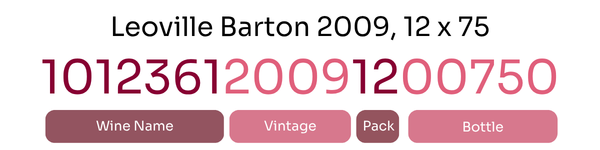
Introducing the next generation of LWIN matching
Liv-ex has introduced two connected improvements designed to help members work with wine lists more efficiently and at scale.
Wine Matcher in List Studio
Wine Matcher, Liv-ex’s member-exclusive matching tool, is now available directly within List Studio. Members can upload a wine list, match it to LWIN, and layer in trusted price and product data in bulk.
Once matched, lists can be enriched with Liv-ex data including Market Price, Last Trade, Best Bid and Best Offer, alongside product information including critic scores and ABVs. This gives members the data they need to support valuations, benchmark stock, identify buying and selling opportunities, and build out their e-commerce websites.
A redesigned LWIN matching engine
Behind Wine Matcher, Liv-ex data scientists have redesigned the LWIN matching algorithm.
The new engine combines modern AI with Liv-ex’s proprietary wine data and specialist matching expertise. This allows it to recognise a broader range of variations in wine names, vintages and formats, improving automated wine identification without compromising accuracy.
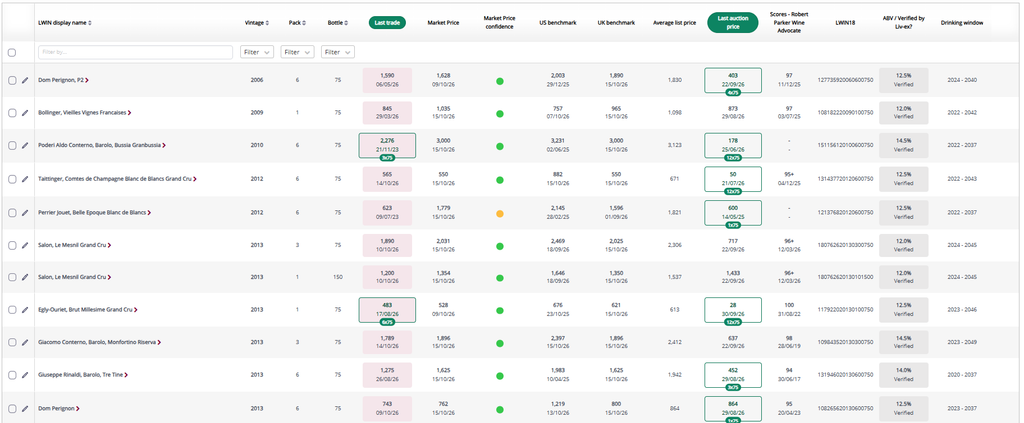
Higher match rates without compromising accuracy
The redesigned engine delivers significantly higher automatic match rates while maintaining precision above 99%.
This means more wines can be matched automatically, reducing the number that require manual review or correction while preserving the accuracy businesses need when working with wine and pricing data.
It is also built to process larger workloads. The engine can match up to 1,500 lines per minute and supports lists containing up to 10,000 lines.
Members can run multiple matching jobs simultaneously and continue working on other tasks while their lists are processed in the background.
From matching wines to creating value
Matching a list to LWIN makes the information within it more useful. Once wines have been identified, members can enrich their lists with Liv-ex price and product data and use that information to support their next decision.
Depending on the list, that could mean valuing inventory, benchmarking prices, identifying opportunities to sell or finding wines they may want to buy.
Our long-term vision for LWIN is to make it easier for the wine trade to identify products and work with wine data at scale. AI gives us new ways to solve the complexity of wine matching, but it is most effective when combined with Liv-ex’s proprietary dataset and the expertise we have built over many years. Greater automation is important, but not at the expense of accuracy. The trade needs both. Marco Alparone Chief Product & Technology Officer – Liv-ex
Continued investment in wine data
As businesses invest in modern inventory systems, e-commerce platforms, trading tools and pricing technology, reliable product identification becomes increasingly important.
This latest evolution of LWIN reflects Liv-ex’s continued investment in technology that helps members work with wine data more efficiently, accurately and at greater scale. By combining a more powerful matching engine with one connected workflow, members can spend less time preparing their data and more time acting on it.
Author: Marianne Marfleet
Fine Wine News: US buyers maintain lead; DRC top-traded overall
US buyers maintained their lead of purchasing, upping their purchasing on last week. While EU buyers pulled back after a strong week last week, UK…
- Bordeaux led the market with a 30.7% share of traded value, followed by Burgundy with 24.8% and Champagne with 12.4%.
- Two vintages of Romanee-Conti – the 2011 and 1988 – featured amongst the top five wines by traded value, alongside Opus One 2018, Cristal 2008 (Late Release) and Giacomo Conterno’s Barolo Francia 2022.
- US buyers maintained their lead of purchasing, upping their purchasing on last week. While EU buyers pulled back after a strong week last week, UK buyers held strong and claimed second place.
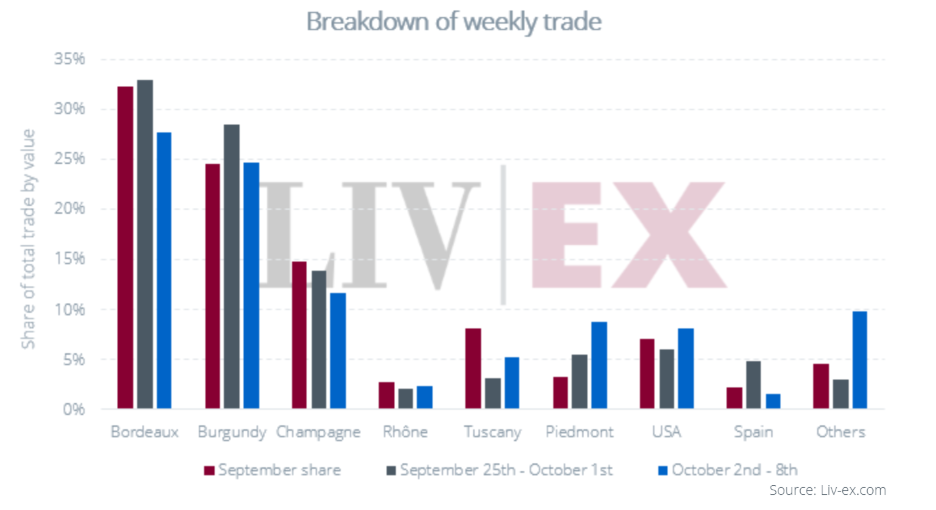
While maintaining its lead of the market, Bordeaux’s share of traded value fell slightly from 33.0% last week to 30.7% this week. Lafite and Cheval Blanc led the region, claiming a combined 26% of its traded value.
Burgundy, keeping second place, also saw its share fall – from 28.5% last week to 24.8% last week. Domaine de la Romanee-Conti was by far the region’s top-traded producer, with Romanee-Conti 1988, 2011, 2017 and La Tache 2015 comprising the region’s top four wines by traded value.
Champagne claimed third place with an 11% share of traded value. Non-vintage wines were the top-traded by value and volume (Bollinger’s Special Cuvee and Veuve Cliqueout’s Yellow Label most popular), though Cristal 2008 Late Release was the top-traded overall.
Missed last week’s market update? Read it here.
Copyright © 2026 Liv-ex Ltd. All rights reserved.
Author: Marianne Marfleet
This Week In Fine Wine: Bordeaux back on top; US buyers claim 45% of weekly trade
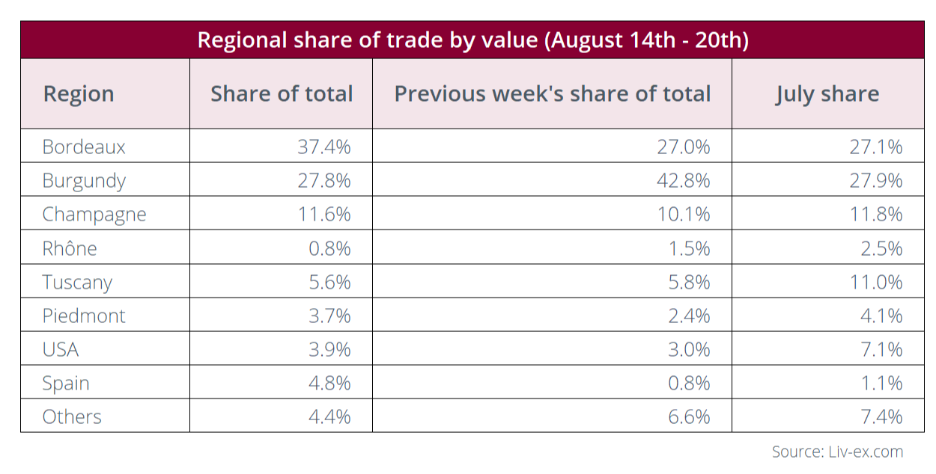
Bordeaux reclaimed its lead of the market from Burgundy, accounting for 37.4% of traded value.

- Bordeaux reclaimed its lead of the market from Burgundy, accounting for 37.4% of traded value.
- Two vintages of Latour – the 2006 and the 2009 – featured amongst the top five wines by traded value
- With many European members away from their desks for August, US buyers took the lead, claiming 45% of purchased value
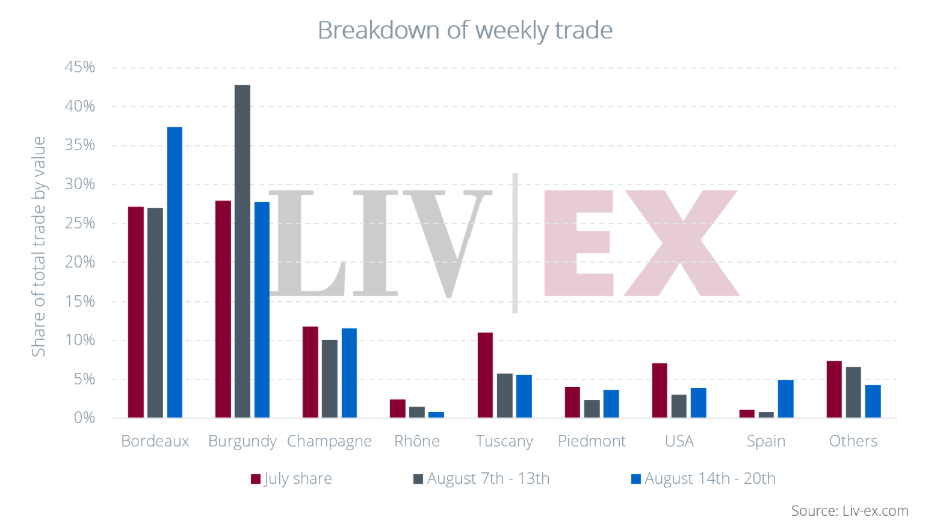
Bordeaux reclaimed its lead of the market, its share of trade rising from 27.0% last week to 37.4% this week. Latour was the region’s top-traded producer, across vintages accounting for 20% of the region’s traded value.
Burgundy’s share fell from 42.8% last week to 27.8% this week. Nevertheless, high value, rare wines from the region continued to trade actively, with Domaine de la Romanee-Conti, Leflaive, Leroy and Kei Shiogai in the lead.
Champagne followed in third place with an 11.6% share of the market. Salon was the top-traded producer across vintages, though Jacques Selosse’s Substance was the top-traded individual wine.
Demand for Italian wines remained weak, Tuscany and Piedmont together accounting for just 9.3% of traded value. Tignanello and Gaja, Barbaresco were the regions’ top-traded wines by value respectively.
Spain had a strong week, claiming 4.8% of traded value, thanks largely to US purchasing of Vega Sicilia.
Author: Marianne Marfleet
What Happened In Fine Wine This Week: Lafite drives Bordeaux trade
Lafite and Carruades account for 10% of weekly trade as Bordeaux strengthens share.

Lafite Rothschild and its second wine, Carruades de Lafite, together accounted for around 10% of total traded value this week, highlighting continued demand for the First Growth and its wider range.
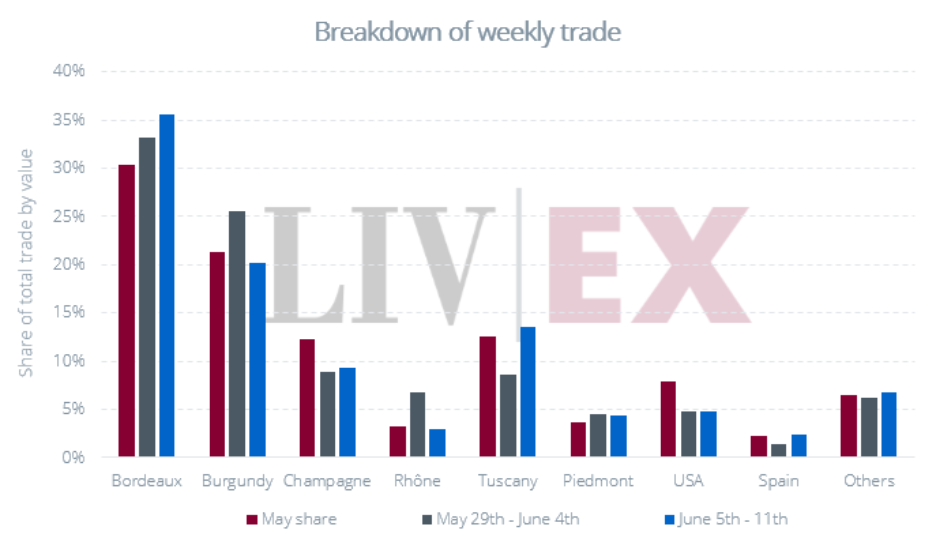
Overall trading volumes were lower week-on-week, with UK participation seeing the most notable decline. Despite this, Bordeaux increased its share of traded value, rising from 33.2% last week to 35.6%.
Within the region, Lafite featured prominently among the most actively traded wines by value, while Petrus ranked second in terms of Bordeaux trade. Activity was also influenced by the release of several 2025 vintages, although UK buyers were relatively subdued, accounting for 15.5% of Bordeaux trade during the period.
Burgundy held its position as the second most traded region, though its share fell from 25.6% to 20.2%. Trading focused on the 2023 vintage, with wines from producers including Joseph Faiveley, Sylvain Cathiard and Claude Dugat seeing consistent volumes.
Champagne’s share increased slightly to 9.3%, although it remains below levels seen in May. Jacques Selosse 2008 was the region’s top-traded wine by value, with transactions reported at £22,800 per 12×75 case.
Tuscany recorded one of the more notable increases in share, rising from 8.6% to 13.5%. Sassicaia was the leading wine by value both within the region and across the wider market, accounting for a significant proportion of Tuscan trade.
Piedmont remained broadly stable, representing 4.4% of total traded value. Activity was concentrated among established producers including Giacomo Conterno, Produttori del Barbaresco and Gaja, which together made up around half of the region’s trade.
A concentrated week for top names
While overall activity declined, trading continued to focus on a relatively small number of regions and producers. Bordeaux’s increased share, supported by strong demand for Lafite and Carruades, was a key theme, alongside steady interest in Burgundy 2023s and continued liquidity for leading Italian wines.
Access the full insight for a detailed breakdown of weekly trade, pricing movements and buyer activity by becoming a Liv-ex member.
Copyright © 2026 Liv-ex Ltd. All rights reserved.
Author: Marianne Marfleet
Tom Burchfield, Head of Market Intelligence, ProWein Agora Takeaways
Tom Burchfield, Head of Market Intelligence, shares insights from his presentation and panel discussion at ProWein Agora, alongside his takeaways from the event itself.

First time at ProWein Agora. A maze of stands. The no and low section was pretty massive, a sign of it being perhaps the one wine category that is growing. The spirits section also vast.
I managed to locate my former Vivino colleagues (where I worked for six years) to catch up with old friends. They told me the fair was half as big as last year, itself half as big as the year before and that there were fewer attendees. Still felt vast to me.

Agora
This year ProWein reintroduced the Agora stage, where various experts present on and discuss key topics within the industry. How to market to the new generation? How to market no and low? How to leverage new technologies including AI to better serve customers? What is the current state of the fine wine market and where is it going?
That one was the topic I presented on. A lot of ground to cover in 20 minutes, and the aim was to set the scene for a debate with Krister Bengtsson (founder of Star Wine List) and Robert Joseph (journalist and consultant). To further condense my 20 minutes into a 3-bullet point summary of where the market is and where it’s heading:
- Price stability. At the top of the fine wine market, more wines are now either seeing flat or gently rising prices than falling prices.
- Fragmentation. The fine wine market is broader than ever, and this trend is likely to continue with the next generation of collectors.
- Stratification. At the same time, across segments within traditional regions like Bordeaux and Burgundy we see the top of the pyramid looking more secure than further down. Within Bordeaux the portion of the industry that is at risk is growing.
Scene set, half an hour of interesting debate.
Is demand for fine wine elastic?
Yes, in my opinion, not for others.
My take is that participants are doing everything they can to maintain higher release prices – squeezing supply, pouring cash into production to achieve high scores. Is that sustainable on their side? Is it worth the effort with prices softening post-release? I believe there is a price that works. We see this consistently with Bordeaux after release. There is a price at which demand is unlocked. You can try to avoid market reality or you can accept it.
To download Tom’s presentation slides, please fill out the form here.
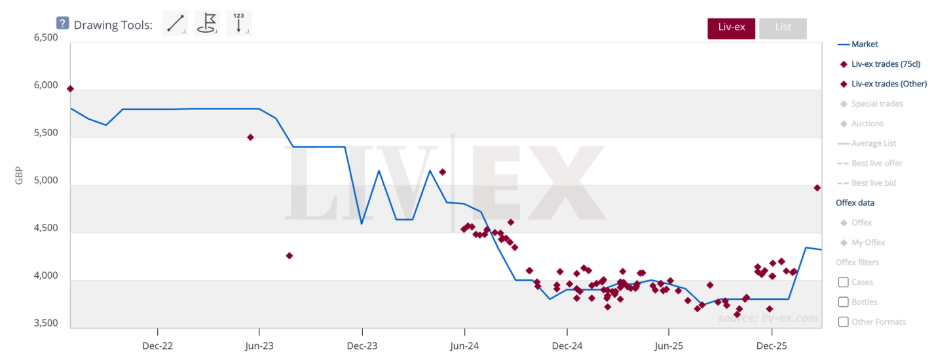
Liv-ex trades of Lafite 2021
A flight to value. Something we all agree upon. Whether that’s the collapse in demand for Second Wines or changing tastes in the on-trade, consumers are after value.
The next generation of collectors. We agree that price is a challenge. The industry needs a broad base of potential collectors. How does that happen for Burgundy, where even regional wines are becoming a special occasion indulgence? The on-trade needs sommeliers that have not just tasted, but drunk both the classics and the future classics.
GLP-1 medications. An existential threat for the fine wine market? Some say yes, I say not at this point. Fine wine is sheltered to some degree.
Other reflections
- Betraying my ignorance, but I had no idea that Dusseldorf has a big Japanese community? I do now, and can vouch for some excellent ramen as a counterpoint to wurst.
- The drinks industry is clearly faced with many challenges. The more we discuss these, try things, share successes and challenges the better. But don’t forget that wine has an incredible ability to bring people together. Despite the current challenges, people were having fun at ProWein.
- Of the UK contingent travelling to Dusseldorf on the Saturday, judging by how many were supporting the team in blue in the 6 Nations rugby decider, a high proportion were Scottish.
- Was everyone in the brauerei? Heading to Brauerei Schumacher to sample the city’s trademark Alt Bier on Saturday night, it was packed full of Proweiners – probably to be expected, drinks industry people warming up for vinous delights with malted beverages.