Author: Marianne Marfleet
This Week In Fine Wine: Bordeaux back on top; US buyers claim 45% of weekly trade
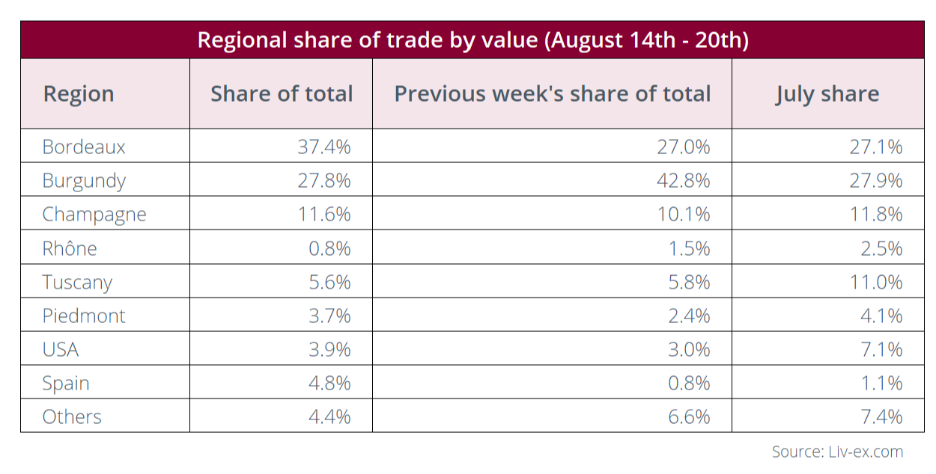
Bordeaux reclaimed its lead of the market from Burgundy, accounting for 37.4% of traded value.
- Bordeaux reclaimed its lead of the market from Burgundy, accounting for 37.4% of traded value.
- Two vintages of Latour – the 2006 and the 2009 – featured amongst the top five wines by traded value
- With many European members away from their desks for August, US buyers took the lead, claiming 45% of purchased value
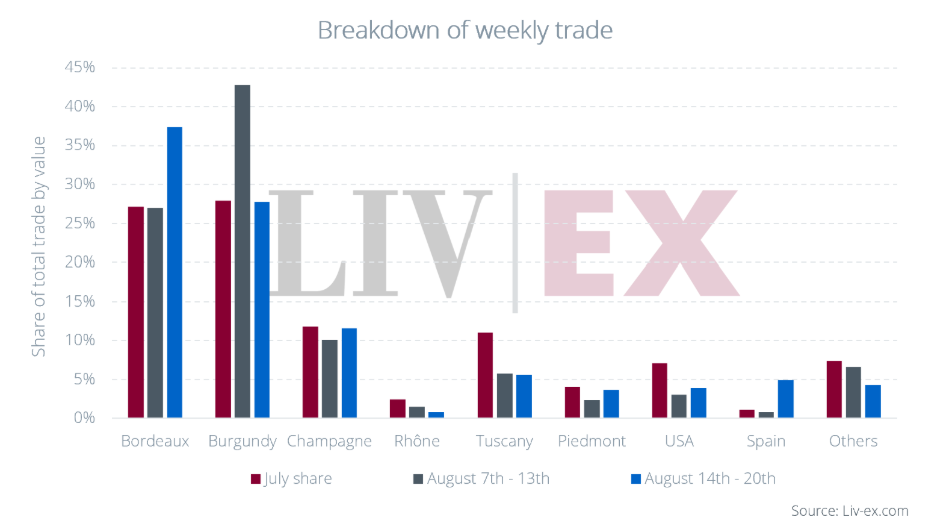
Bordeaux reclaimed its lead of the market, its share of trade rising from 27.0% last week to 37.4% this week. Latour was the region’s top-traded producer, across vintages accounting for 20% of the region’s traded value.
Burgundy’s share fell from 42.8% last week to 27.8% this week. Nevertheless, high value, rare wines from the region continued to trade actively, with Domaine de la Romanee-Conti, Leflaive, Leroy and Kei Shiogai in the lead.
Champagne followed in third place with an 11.6% share of the market. Salon was the top-traded producer across vintages, though Jacques Selosse’s Substance was the top-traded individual wine.
Demand for Italian wines remained weak, Tuscany and Piedmont together accounting for just 9.3% of traded value. Tignanello and Gaja, Barbaresco were the regions’ top-traded wines by value respectively.
Spain had a strong week, claiming 4.8% of traded value, thanks largely to US purchasing of Vega Sicilia.
Author: Marianne Marfleet
What Happened In Fine Wine This Week: Lafite drives Bordeaux trade
Lafite and Carruades account for 10% of weekly trade as Bordeaux strengthens share.
Lafite Rothschild and its second wine, Carruades de Lafite, together accounted for around 10% of total traded value this week, highlighting continued demand for the First Growth and its wider range.
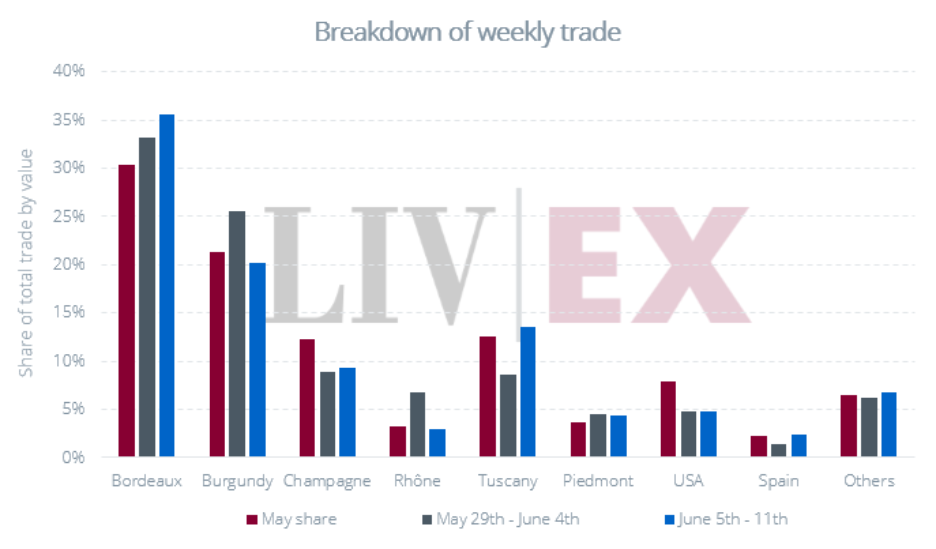
Overall trading volumes were lower week-on-week, with UK participation seeing the most notable decline. Despite this, Bordeaux increased its share of traded value, rising from 33.2% last week to 35.6%.
Within the region, Lafite featured prominently among the most actively traded wines by value, while Petrus ranked second in terms of Bordeaux trade. Activity was also influenced by the release of several 2025 vintages, although UK buyers were relatively subdued, accounting for 15.5% of Bordeaux trade during the period.
Burgundy held its position as the second most traded region, though its share fell from 25.6% to 20.2%. Trading focused on the 2023 vintage, with wines from producers including Joseph Faiveley, Sylvain Cathiard and Claude Dugat seeing consistent volumes.
Champagne’s share increased slightly to 9.3%, although it remains below levels seen in May. Jacques Selosse 2008 was the region’s top-traded wine by value, with transactions reported at £22,800 per 12×75 case.
Tuscany recorded one of the more notable increases in share, rising from 8.6% to 13.5%. Sassicaia was the leading wine by value both within the region and across the wider market, accounting for a significant proportion of Tuscan trade.
Piedmont remained broadly stable, representing 4.4% of total traded value. Activity was concentrated among established producers including Giacomo Conterno, Produttori del Barbaresco and Gaja, which together made up around half of the region’s trade.
A concentrated week for top names
While overall activity declined, trading continued to focus on a relatively small number of regions and producers. Bordeaux’s increased share, supported by strong demand for Lafite and Carruades, was a key theme, alongside steady interest in Burgundy 2023s and continued liquidity for leading Italian wines.
Access the full insight for a detailed breakdown of weekly trade, pricing movements and buyer activity by becoming a Liv-ex member.
Copyright © 2026 Liv-ex Ltd. All rights reserved.
Author: Marianne Marfleet
Tom Burchfield, Head of Market Intelligence, ProWein Agora Takeaways
Tom Burchfield, Head of Market Intelligence, shares insights from his presentation and panel discussion at ProWein Agora, alongside his takeaways from the event itself.

First time at ProWein Agora. A maze of stands. The no and low section was pretty massive, a sign of it being perhaps the one wine category that is growing. The spirits section also vast.
I managed to locate my former Vivino colleagues (where I worked for six years) to catch up with old friends. They told me the fair was half as big as last year, itself half as big as the year before and that there were fewer attendees. Still felt vast to me.

Agora
This year ProWein reintroduced the Agora stage, where various experts present on and discuss key topics within the industry. How to market to the new generation? How to market no and low? How to leverage new technologies including AI to better serve customers? What is the current state of the fine wine market and where is it going?
That one was the topic I presented on. A lot of ground to cover in 20 minutes, and the aim was to set the scene for a debate with Krister Bengtsson (founder of Star Wine List) and Robert Joseph (journalist and consultant). To further condense my 20 minutes into a 3-bullet point summary of where the market is and where it’s heading:
- Price stability. At the top of the fine wine market, more wines are now either seeing flat or gently rising prices than falling prices.
- Fragmentation. The fine wine market is broader than ever, and this trend is likely to continue with the next generation of collectors.
- Stratification. At the same time, across segments within traditional regions like Bordeaux and Burgundy we see the top of the pyramid looking more secure than further down. Within Bordeaux the portion of the industry that is at risk is growing.
Scene set, half an hour of interesting debate.
Is demand for fine wine elastic?
Yes, in my opinion, not for others.
My take is that participants are doing everything they can to maintain higher release prices – squeezing supply, pouring cash into production to achieve high scores. Is that sustainable on their side? Is it worth the effort with prices softening post-release? I believe there is a price that works. We see this consistently with Bordeaux after release. There is a price at which demand is unlocked. You can try to avoid market reality or you can accept it.
To download Tom’s presentation slides, please fill out the form here.
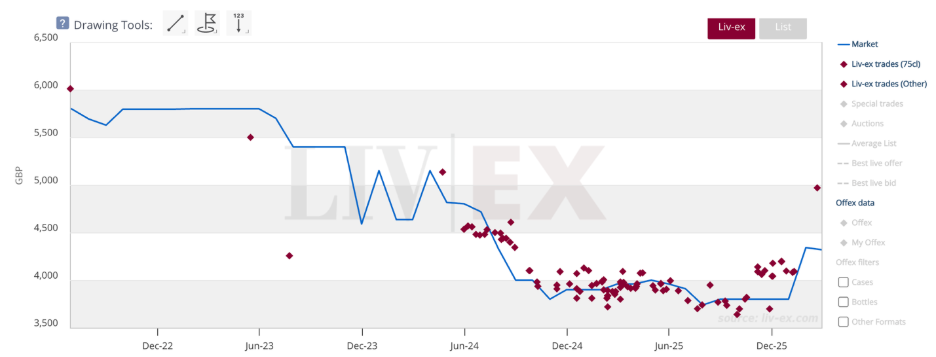
Liv-ex trades of Lafite 2021
A flight to value. Something we all agree upon. Whether that’s the collapse in demand for Second Wines or changing tastes in the on-trade, consumers are after value.
The next generation of collectors. We agree that price is a challenge. The industry needs a broad base of potential collectors. How does that happen for Burgundy, where even regional wines are becoming a special occasion indulgence? The on-trade needs sommeliers that have not just tasted, but drunk both the classics and the future classics.
GLP-1 medications. An existential threat for the fine wine market? Some say yes, I say not at this point. Fine wine is sheltered to some degree.
Other reflections
- Betraying my ignorance, but I had no idea that Dusseldorf has a big Japanese community? I do now, and can vouch for some excellent ramen as a counterpoint to wurst.
- The drinks industry is clearly faced with many challenges. The more we discuss these, try things, share successes and challenges the better. But don’t forget that wine has an incredible ability to bring people together. Despite the current challenges, people were having fun at ProWein.
- Of the UK contingent travelling to Dusseldorf on the Saturday, judging by how many were supporting the team in blue in the 6 Nations rugby decider, a high proportion were Scottish.
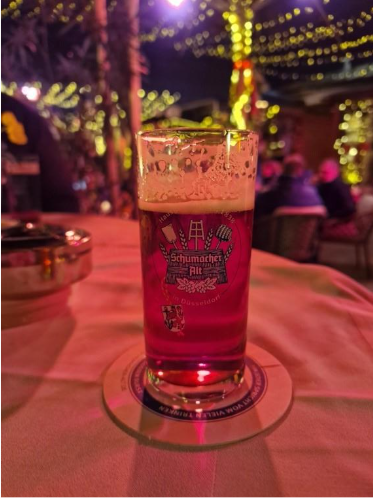
- Was everyone in the brauerei? Heading to Brauerei Schumacher to sample the city’s trademark Alt Bier on Saturday night, it was packed full of Proweiners – probably to be expected, drinks industry people warming up for vinous delights with malted beverages.

Author: Marianne Marfleet
Liv-ex: Your Trusted Partner for Seamless Wine Logistics
Liv-ex moves wine from seller to buyer, checks and verifies wine in our high tech, bonded warehouses, and ensures sellers are paid correctly and on…
Buying and selling wine internally involves a maze of alcohol import/export laws, bonded warehousing rules, and customs documentation. Moving wine across borders, and trading with new regions increases operational costs and can lead to longer lead times for your customers.
At Liv-ex we handle every aspect of logistics. This includes moving the wine from seller to buyer, checking and verifying wine in our high tech, bonded warehouses, and ensuring sellers are paid correctly and on time.
Liv-ex reduces the complexity of buying and selling fine wine as we act as the single point of contact on the other side of every deal, meaning one invoice, one transportation partner, one payment, despite doing businesses with other wine businesses all over the world.
So how does it work?
- Once a seller accepts a buyers bid on their wine, the trade is matched, and the wine is sold
- We collect stock from the seller, or the seller delivers directly to one of the Liv-ex warehouses, in either London, Bordeaux or Belgium
- Our warehouse team validates the wine ensuring that it complies with the Liv-ex contract
- The seller is paid as soon as we validate the wine
- The buyer pays and we move the wine to them
How does Liv-ex reduce risk in the secondary market?
To keep our exchange safe, each prospective Liv-ex member undergoes a thorough vetting process; two trade references are required, and an Exchange Committee is in place to assess every prospective member.
Liv-ex trading contracts ensure buyers know the condition of wines, delivery parameters and packaging before they bid on wine, so buyers know what they are getting with no surprises. Our benchmark SIB contract (Standard in Bond) requires the wine to be in good condition, that packaging is original and in good condition, and that the duty status is In Bond, meaning the buyer can receive their wine in 30 days.
Our wine storage facilities include state-of-the-art security and climate control systems to ensure wines are protected around the clock. Members can store their wines in our warehouses pre and post trade, before deciding whether to trade again or ship onwards.
When thorough checks are required, we take the bottles out of cases to photograph them. We use ultraviolet torches to check the labels as well as checking them for other producer specific anticounterfeiting measures such as microprint, holograms and QR codes. We inspect capsules, including checking any prooftags. And we also check the cork, sediment and glass embossing or laser etching.
How does Liv-ex simplify buying and selling internationally?
Liv-ex arranges and handles the full process of bonded transport and storage, manages customs paperwork, and oversees chain-of-custody checks, cross-border transfers and warehouse reconciliation. We also use a trusted network of Liv-ex-approved storage partners to bolster these capabilities. For businesses managing high volumes of trades, we overcome common bottlenecks in invoicing, logistics, and fulfilment that would otherwise drain profitability.
We understand that sellers require prompt payment, and buyers expect fast delivery. We have a standardised payment calendar so that sellers know exactly when they will be paid. And an individual stock management portal so that buyers can access live updates on their purchases and arrange onward movement of their stock as soon as it hits their account.
If you’d like to reduce the logistic burden of trading wine on the secondary market, speak to us about becoming a Liv-ex member.
Author: Marianne Marfleet
En Primeur Reflections from Tom Burchfield, Head of Market Intelligence
Tom talks to us about his experience of attending En Primeur; the Chateau he visited, the wines he tasted, and his expectations of pricing to…
En Primeur Reflections from Tom Burchfield, Head of Market Intelligence
Along with most of the UK trade, we boarded the first Easy Jet flight from Gatwick to Bordeaux on Sunday morning. Bleary-eyed, I travelled with our CEO James Miles, Chief Commercial Officer Anthony Maxwell, and our Broker for Europe, Paolo-Luca Rossi. There was a sense of nervous anticipation. Rumours had it that the wines in Bordeaux had turned out better than expected. Word on the street was that producers were ready to face the current market state. We would see…
We headed straight to the Ballande & Meneret tasting. A huge warehouse, almost devoid of human life greeted us. Stacks of 2021s lined the tasting space, hoping for another day in the sun. We tasted c.50 wines, organised by appellation, and mostly towards the lower end of the price scale. I tasted quite a lot of green and unripe tannins. There were a few successes (Rauzan-Segla was a team favourite), but we left fearing that this year may not be the turning point we’d hoped for. After a streak of bad vintages, and a tough growing season, we wondered what the rest of En Primeur week would bring?
Day two began with a trip up the Left Bank to Saint-Estephe, starting with Montrose. After the mixed bag at Ballande, Montrose lifted our spirits – it was a very delicious wine. A quick hop skip and a jump over to Calon where we had a chance to chat with the team around the vintage, the market, and their plans.
In advance of tasting week, the Liv-ex Market Intelligence team (Market Analyst Sophia Gilmour, Data Analyst Alex Chisholm and I) had published our En Primeur book. We included an opening ‘state of the Bordeaux market’ report and individual analyses on each major wine. I brought a copy of the book along to Bordeaux, with individual printouts of the wine analyses, which I offered to each producer we met.
When we showed the data, the response was generally consistent insofar as there really did appear to be a willingness to support the campaign (this gave me a boost). There was also talk about reducing the number of negociants they worked with. Among other things, we routinely ask:
- How many full-time employees do you have?
- What about producing more grand vin and less of the second and third wines?
- How much is one critics’ point worth to you?
- Will you release at a price that will make the 2024 the cheapest in the market?
In that very charming bordelais manner, our hosts managed to come across as both humble and confident, that the market would come around to their will.
Day three begins with a drive to Libourne for the Moueix tasting, followed by a mind-altering sequence at Le Pin, Lafleur, Petrus, and lunch at Cheval Blanc. Possibly the most fascinating meeting of the trip, the Cheval team appeared committed to releasing the 2024 at a ‘no-brainer’ price. This left us feeling confident that we’d touch down in the UK with a promising En Primeur campaign ahead….
We took the last flight back to London for the Easter break and the anticipation of Pontet-Canet kicking things off next week.
EP campaign – hard work
At Liv-ex, we send our members real-time analysis of each major release. As the campaign began, we hopefully asked each other the same question: ‘Do you think Chateau X will do enough’? The further the campaign went on, the more inevitable the answer became: ‘They’ll get close, but probably not do quite enough’.
En Primeur coverage had been too focused on the percentage increase or decrease from the previous year’s release. While this made for good marketing material and enticing news stories, it is largely insignificant. Moreover, comparing a decade of generally poor release prices to one another makes little sense at all.
The crux of whether a release represented a good buying opportunity was simple and boiled down to one question: Were there less expensive back vintages, of similar or better quality, available on the market?
If the answer was no, then it could have been a ‘buy’. You do need to factor in costs of carry, and with storage currently c.£15 per 12×75 a year, this is not insignificant. .
However, if the answer was yes, then the release could not be considered a no-brainer ‘buy’. If there were multiple better rated and considerably less expensive back vintages available, then it really wasn’t a buy.
Unfortunately, this year’s campaign had few instances where the price and quality presented a better offer than what was already available on the market from previous years. Lafite and Mouton spring to mind, and Carmes Haut-Brion ascent continued. While release price reductions were commendable, there were better alternatives available.
It’s was notable that, according to our members, even when a release appeared a no-brainer buying opportunity, it was often been met by disengaged end consumers. Buyer’s apathy had taken hold, or as one more forthright traditional EP buyer told me: ‘We’ve been ****** for too many years, why buy this middling vintage?’
It was interesting that the frustration with the system had reached a point where participants from across the supply chain were now daring to put their heads above the parapet. As the first releases came out, UK merchants publicly told their customers that they had hoped for better prices. This was quite remarkable. There couldn’t have been many other industries where sales emails told you that the price wasn’t great.
Similar stories emerged from La Place, where negociants had not been shy of showing their dismay at prices they knew wouldn’t sell. Reportedly, the courtiers were also shaking their heads in disbelief.
So what might the future hold?
Before the campaign kicked off, we had thought that the small crop of 2024s represented an opportunity for producers to reset and price at a level that would invigorate the market. There may not have been any price good enough to reinvigorate the market, but now we’ll never know… So what could 2025 hold?
We had to hope that 2025 would be a beautiful and bountiful vintage. One that was cheaper for producers to make, and theoretically gave the trade an easier thing to sell. While still 12 months away, we anticipated that the market could not stomach further price rises. It would have to be priced well below other back vintages. In a falling market, this was no easy feat, and one that might be hard to contemplate. But that’s what needed to be done. If the 2024 campaign had felt like last chance saloon, then for some another misstep might well result in closing time.
Author: Marianne Marfleet
Offer Your Customers Greater Variety Without Investing in New Stock
Liv-ex members can pull over 23,000 Liv-ex listings onto their ecommerce site to offer their customers increased choice and variety.

It’s more important than ever for wine businesses to find ways to attract new customers and appeal to a broader audience. But for many businesses, investing in new stock and experimenting with new offers requires upfront investment and risk that’s hard to justify in a downward market.
At Liv-ex we’ve developed a solution that lets you showcase all the wine available on the Liv-ex exchange, without the need to invest in the stock upfront. Liv-ex members that connect their ecommerce site to the exchange can automatically show wine available on Liv-ex, offering more variety to their customers.
Bulk out your portfolio at no extra cost
Liv-ex members can pull over 23,000 Liv-ex listings onto their ecommerce site to offer their customers increased choice and variety. Members who choose to integrate with Liv-ex are able to create tailored views for each of their customers, to showcase only the most relevant, and of-interest wines, to create a personalised buying experience for them.
Liv-ex is very powerful as a way to expand your offering! Starting with 1,000 wines, we now have a ‘virtual cellar’ of 23,000 wines, thanks to Liv-ex. Gianluca Queiroli Wine Empire
Read full case study here.
Reduce Risk and Streamline Operations
Before becoming a Liv-ex member, every prospective member undergoes a thorough vetting process; they need to provide two trade references, before an Exchange Committee vets the business, so you know every wine you are listing on your ecommerce site comes from a trusted and reputable wine business.
Additionally, most wines on the exchange are available under the Standard in Bond (SIB) contract, meaning its condition is verified and the wine is held in bonded storage. Members can connect their ecommerce sites knowing that if the wine is listed, it is available and can be delivered in 30 days.
Liv-ex moves the wine between seller and buyer, and verifies it in one of our state of the art warehouses. Liv-ex warehouse employees undergo regular authentication training to ensure they feel confident identifying issues with stock. We have developed a bespoke algorithm to quantify the fraud risk surrounding a wine so the appropriate checks can be conducted. As a result, around 28,000 cases of wine were checked by our warehouse teams in 2024.
When thorough checks are required, we take the bottles out of cases to photograph them. We use ultraviolet torches to check the labels as well as checking them for other producer specific anticounterfeiting measures such as microprint, holograms and QR codes. We inspect capsules, including checking any prooftags. And we also check the cork, sediment and glass embossing or laser etching.
To further enhance security for our members, Liv-ex engages the services of an independent authentication expert who conducts ad-hoc audits of our warehouses and assists in training our staff to spot potential counterfeit bottles.
Author: Marianne Marfleet
UK Wine Show x Liv-ex: Tom Burchfield: Episode 1 – The Fine Wine Market
Tom Burchfield, Head of Market Intelligence at Liv-ex, joined Chris Scott on the UK Wine Show for the first of a three-part podcast series. In…

Tom Burchfield, Head of Market Intelligence at Liv-ex, joined Chris Scott on the UK Wine Show for the first of a three-part podcast series.
In this opening episode, Tom discusses sophistication of the Fine Wine market, Bordeaux pricing and the use of data and technology for decision making in the wine industry.
Tom kicked things off by outlining the value of Liv-ex for wine businesses, the role of Market Intelligence at Liv-ex, and his plans to bring greater personalisation to the insights his team delivers.
The next episode dives deeper into Bordeaux En Primeur. Listen here.
Author: Marianne Marfleet
How to Sell Wine in Your Sleep with Liv-ex Automation
Through automated selling, wine businesses can achieve greater sales, and with Liv-ex logistics services, increased sales doesn’t mean increased admin.
Imagine having a high-performing salesperson working around the clock—never taking breaks, handling deals while you’re off the clock, and connecting you to new buyers across the globe.
That’s the power of automation with Liv-ex… expose your entire stock list to our network of members around the world—each with their own base of private clients—giving you access to hundreds of thousands of potential customers worldwide.
Automation with Liv-ex
Benefit from automated and frictionless, round-the-clock deal-making. Through automated selling, wine businesses can achieve greater sales, and with Liv-ex logistics services, increased sales doesn’t mean increased admin.
By connecting your ERP system to the Liv-ex Exchange, you automatically list your available stock, enabling anyone in our member base to buy. But don’t worry, you remain in total control. You set the price and quantity you want to sell, there are no listing fees, no limits on how much you can offer, and no risk of double-selling.
With members around the world, the Exchange is up and running 24/7, so you can sell while you sleep, or even when you’re on holiday.
Members already benefiting from automated selling
Goedhuis Waddesdon was one of the earliest adopters of automated selling. Since then, they haven’t looked back—maintaining consistently high trade volumes, with annual sales more than double what they were before automation.
Another leading merchant, Jeroboams, tripled their sales since going live.
It’s been a gamechanger for us! It allows us—to sell while we’re asleep or away from our desks. Since going live, we’ve trebled our sales on Liv-ex, which is a huge advantage in the current market. Alex Turnbull Head of Private and Online Sales, Jeroboams
Read full case study here.
Seamless Logistics for Liv-ex Sellers
At Liv-ex we handle every aspect of logistics. This includes moving the wine from seller to buyer, checking and verifying wine in our high tech, bonded warehouses, and ensuring sellers are paid correctly and on time.
Liv-ex reduces the complexity of buying and selling fine wine as we act as the single point of contact on the other side of every deal, meaning one invoice, one transportation partner, one payment, despite doing businesses with other wine businesses all over the world.
Author: Marianne Marfleet
The Wine Conversation: Justin Gibbs on The Bordeaux Market
Liv-ex co-founder Justin Gibbs joins Sarah Kemp on The Wine Conversation podcast for a deep dive into the ever-evolving Bordeaux market.

Liv-ex co-founder Justin Gibbs joins Sarah Kemp on The Wine Conversation podcast for a deep dive into the ever-evolving Bordeaux market.
In this episode, Justin uncorks the challenges, explores the opportunities, and shares his insights on what the 2024 En Primeur Bordeaux campaign might have in store.
To listen to the podcast on The Wine Conversation website, simply click here.