Author: Grace Geldard
Talking Trade 23rd of January: California claims 14% of trade, led by Screaming Eagle
The US had its strongest week in recent memory, accounting for 14.1% of trade. While Screaming Eagle led, Harlan, Opus One and Montelena all saw significant demand.
The latest Talking Trade is now live!
- Bordeaux took back its lead of the market, led by 2021 Bordeaux. Burgundy and the US followed in second and third place.
- Screaming Eagle 2023, Figeac 2021 and Domaine de la Romanee-Conti, Echezeaux 2022 were the top-traded wines of the week by value.
- Despite ongoing tariff threats, US buying remained consistent at 20%.
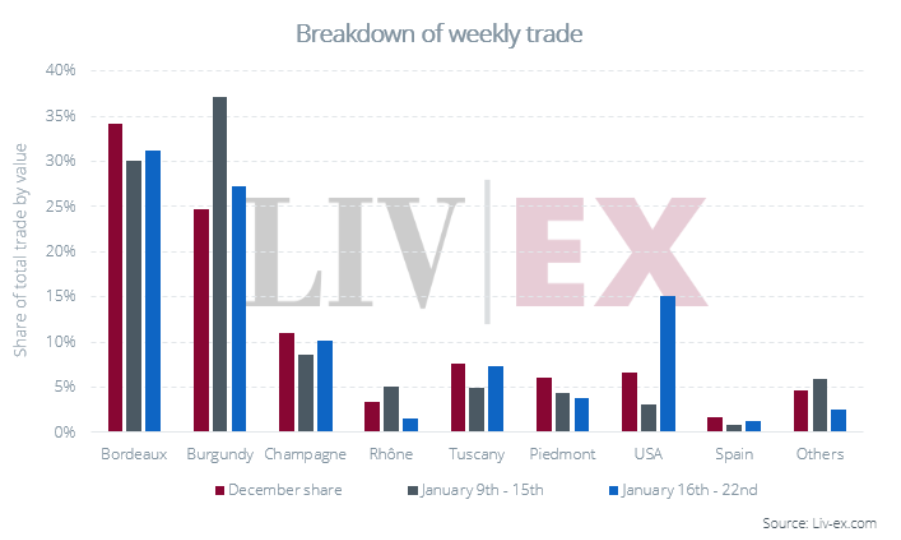
Bordeaux led the market with a 31.2% share of traded value. The 2021s, now generally trading well below their ex-chateau release prices, took centre stage. The 2016s and 2019s followed.
Following a strong close last week, Burgundy fell back into second place behind Bordeaux with a 27.2% share of the market. Domaine de la Romanee-Conti was the top-traded producer by far, accounting for over 10% of trade overall. Echezeaux and assortment cases changed hands most frequently.
The US had its strongest week in recent memory, accounting for 14.1% of trade. While Screaming Eagle led, Harlan, Opus One and Montelena all saw significant demand. Though US buyers took a larger share of purchased value, Asian buyers bought more frequently than any other region.
Champagne followed in third with a 10.1% share. While the Grand Marques generally claim most of the region’s trade, Jacques Selosse came out on top this week with Millesime 2013 and Initial NV leading the producer to a 23% share.
Tuscany reclaimed some of its ground after a weak close last week. San Guido was by far the top-traded producer, the 2020 and 2022 vintages of Sassicaia in the top positions by value.
Copyright © 2026 Liv-ex Ltd. All rights reserved.
Author: Grace Geldard
The Fine Wine Market in 2025
Hear from Tom Burchfield, Head of Decision Intelligence & Alex Chisholm, Data Analyst, on their perspectives on what’s to come in fine wine this year.
Hear from Tom Burchfield, Head of Market Intelligence, and Alex Chisholm, Data Analyst, as they share their perspectives in this short video – exploring why there is cause for optimism in 2026.
For the complete picture, dive into the full report to understand the story behind the numbers and uncover actionable insights for the year ahead.
Liv-ex members received this report last year. Now you can download your exclusive copy of the Liv-ex Year In Review Report.
Download the Full Report
Author: Grace Geldard
Inspired Money x Liv-ex Podcast: Exploring the Liv-ex Power 100 Report
In a recent episode of Inspired Money, Sophia Gilmour and Robbie Stevens joined host Andy Wang to delve into the new Liv-ex Power 100 Report

Exploring the Liv-ex Power 100 Report on Inspired Money
In a recent episode of Inspired Money, Market Analyst Sophia Gilmour and Head of Broking Robbie Stevens joined host Andy Wang to delve into the new Liv-ex Power 100 Report, which ranks the most influential fine wine brands in the secondary market.
Our experts shared key insights on market trends, standout brands, and the factors shaping today’s fine wine market landscape.
Listen to the full discussion here:
Author: Grace Geldard
Knight Frank x Liv-ex Podcast: What’s driving the uptick in the global fine wine market?
In a recent episode on Knight Frank podcast, Liv-ex Head of Market Intelligence, Tom Burchfield joins Liam Bailey.

In a recent episode of the Knight Frank podcast, Liv-ex Head of Market Intelligence, Tom Burchfield, joined Liam Bailey.
They unpack a challenging three-year period for the Liv-ex 100, why Tuscany has shown resilience, and what the recent rebound could mean for the end of the downturn.
Listen here:
Author: Grace Geldard
What’s Really Happening In The Fine Wine Market In Q1?
Our Market Intelligence team, led by Tom Burchfield, Head of Market Intelligence, and Sophia Gilmour, Market Analyst, offers an insider’s look at what’s ahead this…

Our Market Intelligence team, led by Tom Burchfield, Head of Market Intelligence, and Sophia Gilmour, Market Analyst, offers an insider’s look at what’s ahead this quarter.
They explore:
- What they are looking forward to this quarter in the market
- The exclusive insights and reports Liv-ex members can expect
This is your first glimpse of the intelligence driving smarter decisions across the market, helping our members stay ahead and make informed choices every step of the way.
Author: Grace Geldard
Talking Trade 16th of January: Burgundy leads the market as UK trade hosts 2024 vintage tastings
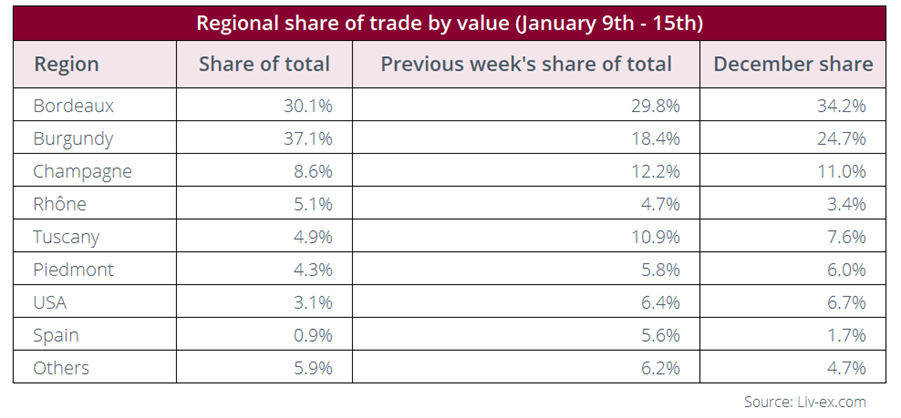
Burgundy claimed 37.1% of traded value. Bordeaux followed in second place with 30.1%.
The latest Talking Trade is now live!
- Burgundy claimed 37.1% of traded value. Bordeaux followed in second place with 30.1%.
- For the second week running, Haut Brion 1989 was the top-traded wine of the week by value. Roulot’s 2023 Meursault and DRC, La Tache 2022 came in second and third.
- UK buyers pulled ahead, claiming 43% of traded value.
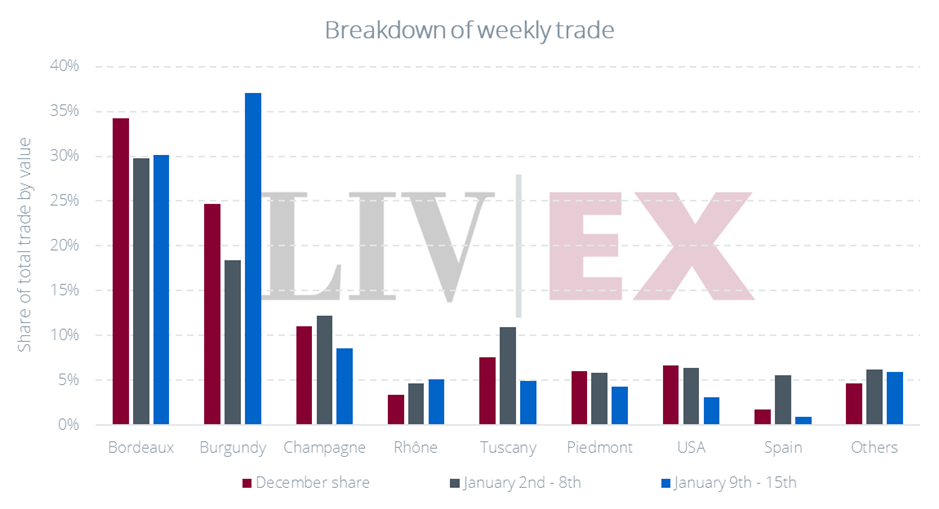
With tastings of the 2024 vintage taking place in London this week, Burgundy led the market, accounting for 37.1% of traded value, over 70% of which was purchased by UK buyers. The 2022s were the top-traded by value, though the 2023s traded most frequently.
Bordeaux followed in second place. With the 1989 vintage again in the top spot, Haut-Brion was the region’s top-traded wine overall. Petrus followed, a single bottle of the 1966 changing hands alongside several recent vintages.
Champagne’s share fell from 12.2% to 8.9%. Higher value, rarer wines led the region, with Salon and Dom Perignon P2 amongst the top traded wines by value.
The Rhone had a decent week, holding a 5.1% share. Jean Louis Chave was the region’s top-traded producer by value, with the Hermitage Rouge and Blanc and Ermitage Cathelin all trading.
Italy pulled back this week, both Tuscany and Piedmont seeing their shares decline. Giacomo Conterno and Biondi-Santi were the region’s top traded producers, rising ahead of the Super Tuscans who typically claim the top spots.
Copyright © 2025 Liv-ex Ltd. All rights reserved.
Author: Grace Geldard
Using the Liv-ex Bid:Offer Ratio to Predict Market Movements
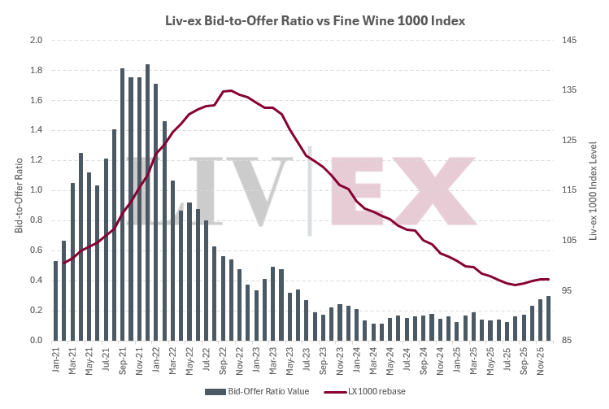
Across a decade of Liv‑ex data, the Bid:Offer Ratio has consistently acted as a leading indicator, often signalling market shifts 2–5 months in advance.

In every market downturn there’s always the question of when the market will turn, when have we truly hit the bottom? In fine wine, where information is fragmented and outcomes are shaped by a mix of sentiment, scarcity, critics scores, and macro‑economics, the answer is rarely obvious at first glance. Yet over the past decade, one indicator has consistently signalled change earlier than most. The Liv‑ex Bid:Offer Ratio.
Across a decade of Liv‑ex data, the Bid:Offer Ratio has consistently acted as a leading indicator, often signalling market shifts 2–5 months in advance. For anyone buying or selling wine, from merchants, to traders, or investment advisors, this metric can help reveal where demand is building, where supply is thinning, and where prices may be heading next.
What is the Bid:Offer Ratio?
While it sounds technical, the concept is simple. Bid:Offer ratio reflects the balance between buying interest and selling pressure across the thousands of wines listed on the Liv‑ex exchange. The data is driven directly from real trading behaviour, not surveys, not opinions, but genuine bids and offers, it captures market sentiment in its purest form. When buyers are willing to place strong bids, confidence tends to be building. When offers dominate, caution is usually taking hold. Over time, this balance reveals patterns that precede price movements by months.
Rising ratios have historically preceded periods of stability or gentle recovery, while declining ratios have warned of softening markets well before prices began to fall. In a category where transparency has traditionally been limited, this kind of early signal can be invaluable.
How reliable is Bid:Offer Ratio at predicting market movement?
Its strength is most visible in the broader indices, where long‑term analysis shows a striking relationship between today’s supply‑demand balance and the direction prices take several months down the line. Of course, no single variable can ever tell the full story; fine wine is influenced by everything from vintage quality to global wealth trends, and as 2025 showed us, political turbulence as well. We can look to a real-world example to highlight the application of Bid:Offer ratio…
Ahead of the 2022 peak, Bid:Offer Ratios fell sharply, indicating a weakening demand base months before the market started on a downward trend. More recently, in 2025, the ratios began rising from historic lows in mid‑summer. Only later did indices such as the Liv‑ex 100 start to show signs of recovery. Once again, the signal moved before the market.
This ratio offers a glimpse into the kind of visibility that Liv-ex members have available to them every day. It demonstrates how real‑time marketplace data; bids, offers, volumes, liquidity, can be transformed into insight that supports better decision‑making. Making it possible to de-risk existing positions, decide whether it’s the right time to take on new stock if the market shows signs of softening, or conversely maximise opportunity by moving before prices rise.
As the fine wine market continues to evolve, data‑driven understanding is becoming a differentiator. The Bid:Offer Ratio is not just a metric; it is a reflection of market intent. It highlights where confidence is building, where caution remains, and where the next pockets of recovery may emerge. Tools like this help separate opinion from insight, empowering businesses to remain ahead of the curve.
Be the first to know when the fine wine market shifts with the Liv‑ex Bid:Offer Ratio by becoming a Liv-ex member.
Copyright © 2025 Liv-ex Ltd. All rights reserved
Author: Grace Geldard
Talking Trade 9th January: Haut-Brion 1989 claims 1st place; US share of buying climbs to 30%
Bordeaux led the market this week, while Burgundy claimed the top spot over the festive period.
The latest Talking Trade is now live!
- Bordeaux led the market this week, while Burgundy claimed the top spot over the festive period.
- Haut-Brion 1989, Unico 2015 and Petrus 2021 were the top-traded wines of the week by value.
- US buying has held steady at 30% over the past three weeks, though trade levels (as expected) have dipped overall.
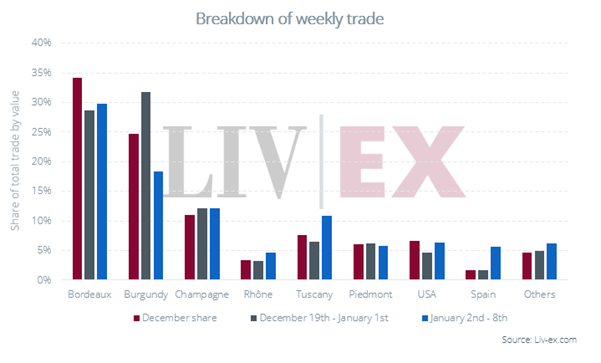
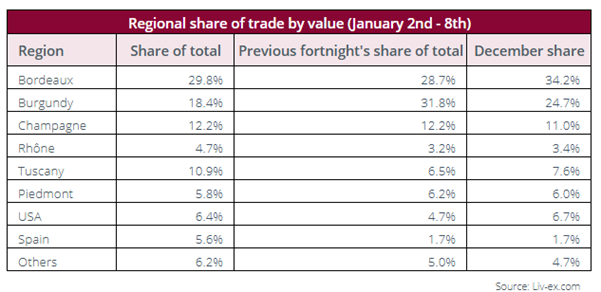
Bordeaux led the market this week with a 29.8% share of traded value. The 2019 and 2021 vintages were the top-traded by value.
Burgundy followed with an 18.4% share, down on its strong performance over the Christmas period. Clos de Tart 2016 was the top-traded wine by value, coming in fifth place overall.
Champagne came in third place, claiming 12.2% of traded value. While the 2015 vintage was the top-traded by value, 2008s changed hands most frequently. Dom Perignon dominated, though Louis Roederer and Krug also took substantial shares.
The Rhone took a 4.7% share, up from December’s 3.4%. While Rayas has been leading the Rhone 100’s recent upward price movement, E. Guigal was the top-traded producer this week, accounting for a third of its trade.
Both Tuscany and Piedmont had strong weeks, though the former dominated with a 10.9% share of overall trade value, San Guido and Masseto claiming the top positions.
US wines performed relatively well, claiming a 6.4% market share. UK buyers led, taking over half of traded value.
Thanks to Vega Sicilia, making up 60% of trade, Spain’s share rose to 5.5%. Alongside trades of recent vintage Unico, Valbuena and Alion, a magnum of 1962 Unico – still within its drinking window — also changed hands.
Author: Grace Geldard
Power 100
Liv-ex has published its annual Power 100 report, ranking the most influential fine wine brands in the secondary market.
Liv-ex has published its annual Power 100 report, ranking the most influential fine wine brands in the secondary market. After a challenging 2024, the latest findings reveal early signs of stability and renewed buyer confidence.
The topics covered in the Power 100 2025:
- Regional breakdown
- Bordeaux: a question of pricing
- Cheval Blanc moved up. Yquem provides a example of how fair pricing can positively impact a brand.
- Burgundy: mid-range prevails
- Given that most Burgundy brands produce multiple wines under both domaine and maison labels, the Power 100 is inherently skewed in their favour.
- Italy: Super Tuscans
- Having taken Bronze last year, San Guido claimed Silver this year, solidifying its reputation as not only one of the most important, but most reliable brands on the market.
- Champagne: Selosse and Salon
- The region nevertheless performed well in the Power 100
- The rest of the world
Liv-ex members received the Power 100 Report at the end of last year.