Author: Grace Geldard
New Guide: Liv-ex for US Fine Wine Businesses
US demand is returning. But with margins squeezed, retailers need to find new ways to stay competitive.
Download the Guide
Guide Summary
This guide explores how Liv-ex can help your business source stock globally through a single marketplace, improve margins by reducing intermediary costs, and expand your range without investing in inventory upfront.
US fine wine retailers are data hungry and leverage Liv-ex automation services to drive business growth. Download this guide to learn how Liv-ex helps US fine wine businesses buy, sell, and grow.
Other Guides You Might Be Interested In…
The Importance of Quality Data Guide
Author: Grace Geldard
This Week In Fine Wine: US buyers maintain lead; focus on top vintage Bordeaux
Despite buying less than last week (by value) US buyers continued to lead the market, claiming 41% of traded value.

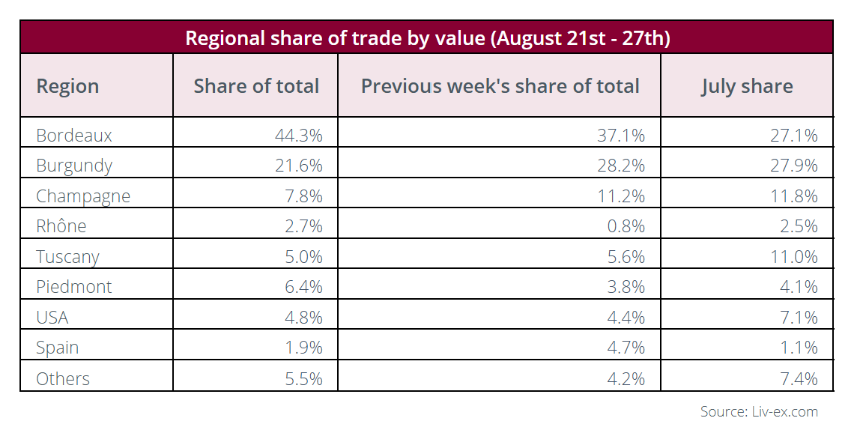
- Bordeaux took a strong lead of the market, taking 44.3% of traded value, buyers largely opting for top end, strong vintages.
- Lafite 2016, Lynch-Bages 2020 and Leoville-Poyferre 2009 were the week’s top-traded wines by value. All three have seen steady upward price movement over the past few months.
- Despite buying less than last week (by value) US buyers continued to lead the market, claiming 41% of traded value.
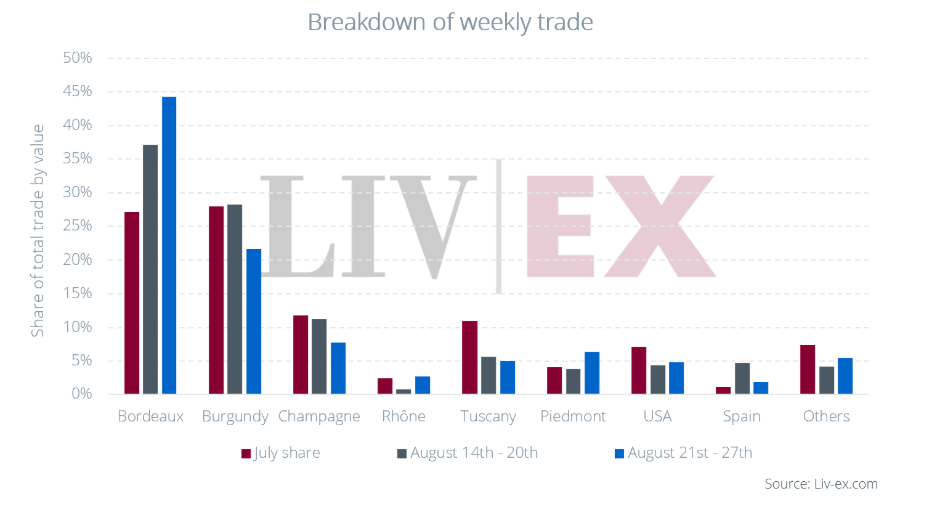
Bordeaux dominated trading this week, accounting for 44.3% of total traded value as buyers gravitated towards the region’s top recent vintages. US demand remained a key driver, with American buyers responsible for 50.9% of Bordeaux trade by value, particularly in the 2009, 2016, 2020 and 2022 vintages.
Burgundy retained second place but saw its share of trade fall to 21.6%, from 28.2% the week before. The region’s activity was led by Domaine de la Romanée-Conti and Jean-Claude Ramonet, which together represented more than a third of Burgundy trade.
In Champagne, trading volumes fell, with the region’s share slipping to 7.8%. Following the passing of Yayoi Kusama, Veuve Cliquot – who partnered with the artist for their 2012 vintage – saw higher demand, accounting for 23.1% of the region’s trade.
Among Italy’s leading regions, Piedmont edged ahead of Tuscany by traded value. Gaja and Giacomo Conterno were the region’s principal drivers of activity, while San Guido led trading in Tuscany.
Missed last week’s trade blog? Read it here.
Author: Grace Geldard
New: Guide to Data-Driven Buying, Selling and Pricing of Fine Wine
Data has become more readily available and easy to access through the rise of the internet, connected systems and now AI.
Download the Guide
Guide Summary
This guide explores the range of Liv-ex data and how it can help you make smarter buying, selling, and pricing decisions. Learn how our market intelligence provides a comprehensive view of the fine wine market, and hear firsthand how members use Liv-ex data to gain a competitive edge.
But how do you make sense of it all? In this free 11-page guide, discover how Liv-ex can help you identify which data is accurate, reliable and trustworthy enough to support business decisions.
Other Guides You Might Be Interested In…
The Importance of Quality Data Guide
Author: Grace Geldard
New: The Importance of Quality Data Guide
Learn what quality wine data looks like and how it can help you buy smarter, sell more effectively, increase margins, and strengthen customer trust.
Download the Guide
Guide Summary
This guide explores what quality data means in the wine trade, the risks of relying on poor-quality data, and the role data plays in pricing, buying, selling, and client advisory. It also examines how Liv-ex data is used in practice by members across the global fine wine market.
Get practical insights and actionable takeaways in this free 14-page guide.
Other Guides You Might Be Interested In…
Guide to Data-Driven Buying, Selling and Pricing of Fine Wine
Author: Grace Geldard
Senior Account Manager
An exciting opportunity for an experienced, knowledgeable and driven Account Manager who wants to take the lead in managing international client relationships and driving subscription growth.
Location: Borough, London SE1,
with regular travel to territories and member meetings under management
Competitive salary dependent on experience plus performance-related bonus, healthcare insurance and wellbeing benefits.
With customers in 50 countries, Liv-ex is the leading fine wine exchange globally. Our vision is to make the wine market more transparent, efficient, and safe, for the benefit of our members and wine lovers everywhere. Our culture is hardworking, entrepreneurial and friendly. Founded in 2000, Liv-ex’s trading, data and market intelligence platform is used by wine businesses around the world to better understand the market and execute buying and selling opportunities. We’re at an inflection point in our journey, embarking on a transformational phase that will redefine how the wine industry operates, trades, and leverages data intelligence. Despite our market leadership, we remain an agile, entrepreneurial, focused organization where senior leaders are involved in driving execution and delivering results.
Summary Purpose
The Senior Account Manager owns and grows a portfolio of high-value Liv-ex members, building senior relationships and driving subscription revenue, retention and long-term member value.
Reporting to the Head of Membership, the role combines strategic account ownership, commercial leadership and cross-functional coordination. The SAM leads account planning, renewal and upgrade conversations, acts as a senior escalation point and helps set the standard for account management practice.
Responsibilities
- Own and grow a portfolio of high-value members, developing trusted senior relationships that support retention, subscription growth and long-term value.
- Build account intelligence across decision-makers, trading activity, operational needs to realise growth potential.
- Create and maintain clear account plans, using data, market insight and structured reviews to prioritise activity.
- Lead renewal, upgrade, downgrade and churn-related commercial conversations with Customer Success and other internal stakeholders, taking ownership of the agreed approach and next steps.
- Identify, qualify and close growth opportunities across Exchange, Data, Settlement, Logistics, Pricing and related Liv-ex services.
- Apply a value-based selling approach, linking Liv-ex services to each member’s commercial goals, operational priorities and measurable outcomes.
- Act as a senior escalation point for complex member issues, coordinating the right internal response.
- Coordinate member engagement across Product, Broking, Customer Success, Data, Marketing, Finance, Logistics and Settlement.
- Use market knowledge, member data and platform insight to advise clients and shape strategic conversations.
- Maintain strong CRM discipline, including account plans, activity records, opportunities, forecasts, risks and next steps.
- Contribute to account management standards, playbooks and ways of working.
- Represent Liv-ex at industry events and use AI/automation tools where appropriate to improve productivity and customer engagement.
Knowledge, Skills & Experience
Essential
- Minimum 5 years experience in account management, commercial relationship management or business development, ideally in a subscription, marketplace, SaaS, data or B2B services environment.
- Proven track record managing and growing strategic or high-value client relationships.
- Strong commercial judgement, with experience leading renewal, upsell, cross-sell, negotiation or churn-prevention conversations.
- Experience applying value-based selling principles to uncover customer needs, quantify value and position solutions around business outcomes.
- Ability to build trusted relationships with senior decision-makers and operational stakeholders.
- Clear communicator able to explain complex products, data and commercial trade-offs.
- Analytical, organised and confident using customer, commercial and market data to prioritise activity.
- High standards of CRM discipline, including accurate account, opportunity and forecast records.
- Collaborative, proactive and self-motivated, with the judgement to progress account situations independently while working effectively across commercial, product, data, logistics, finance and operational teams.
Desirable
- Knowledge of the wine trade, fine wine market or luxury goods sectors.
- Experience with marketplaces, exchanges, data platforms or recurring revenue businesses.
- Experience using HubSpot or similar CRM systems.
- Additional language skills, particularly French and/or Chinese.
- Clean, valid driving license.
What Success Looks Like
Successful Senior Account Managers:
- Grow and retain a portfolio of high-value members.
- Lead effective renewal, upgrade and churn-prevention conversations.
- Maintain strong account plans and accurate HubSpot records.
- Use data, market insight and customer understanding to identify growth opportunities.
- Help members adopt and derive measurable value from Liv-ex products and services.
- Set a high standard for account management craft, collaboration, customer engagement and ownership of account outcomes.
Author: Grace Geldard
Which wines have been trending upwards on the Liv-ex Exchange this year?
The fine wine market may be showing signs of stabilisation, but not all wines are moving in the same direction. Read more here
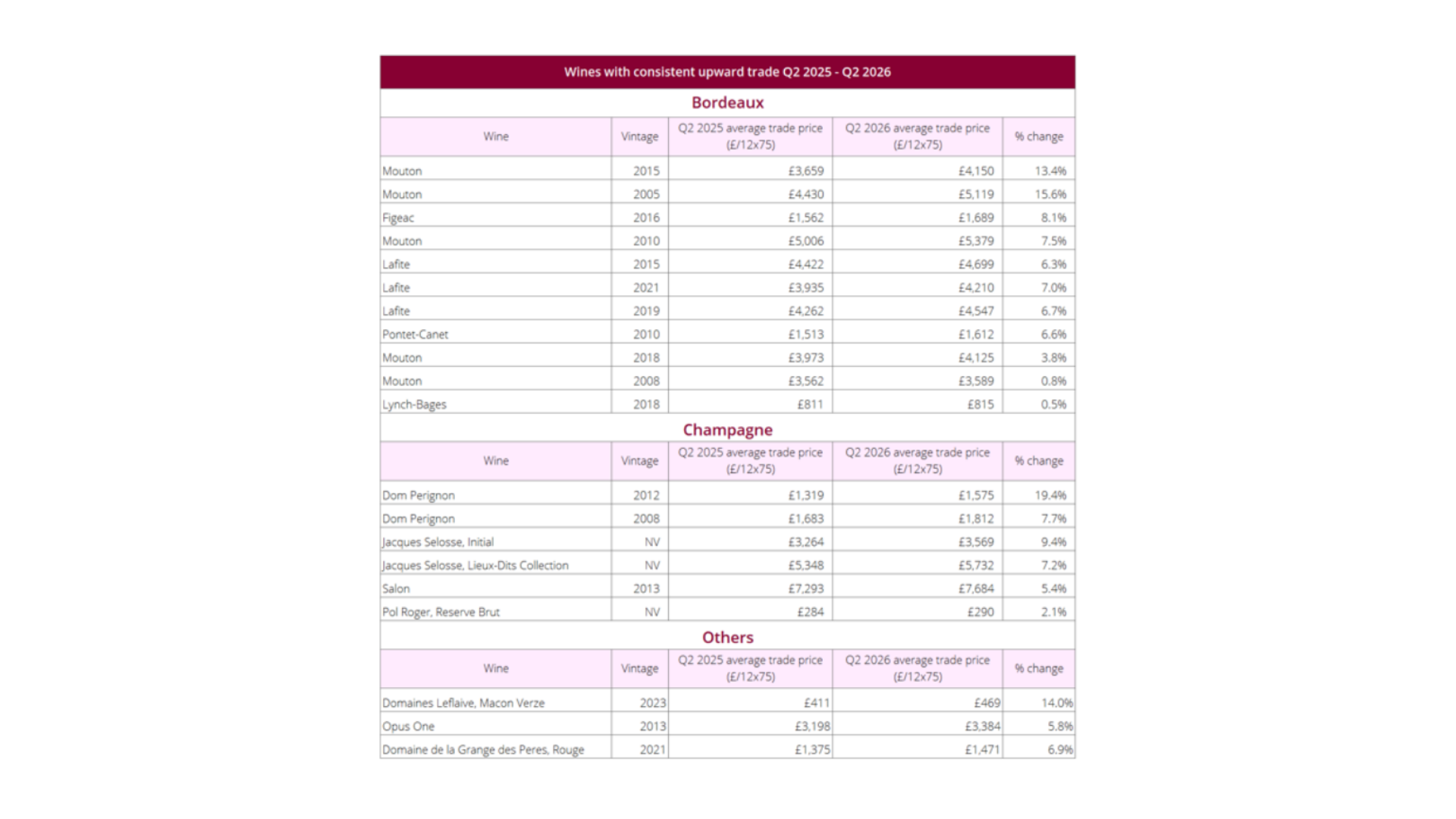
The fine wine market may be showing signs of stabilisation, but not all wines are moving in the same direction. While some continue to drift lower, others are beginning to attract renewed demand and record higher transaction prices.
For merchants looking to deploy capital with greater confidence, identifying these early signs of recovery can be just as important as finding value.
Wines showing sustained upward trading activity can provide useful signals that buyers are returning to the market and that prices are beginning to stabilise.
To identify where this may be happening, Liv-ex analysed transaction data from the past year and highlighted wines that have demonstrated a consistent upward trend in realised trade prices. While past performance is never a guarantee of future returns, these wines offer insight into where confidence appears to be rebuilding and which parts of the market deserve closer attention.
Defining an upward trend
There are many wines that are now trading above their 2025 lows, but a consistent upward trend is harder to find. Even if advertised prices online begin to climb, there is little publicly available sales data to validate this uptick. Therefore, we use only Liv-ex sales data to assess true market trends.
The results reveal an interesting pattern. Many of the wines showing the clearest signs of recovery come from the market’s most actively traded regions. However, pockets of opportunity are also emerging elsewhere, suggesting that demand is returning selectively rather than lifting the entire market at once.
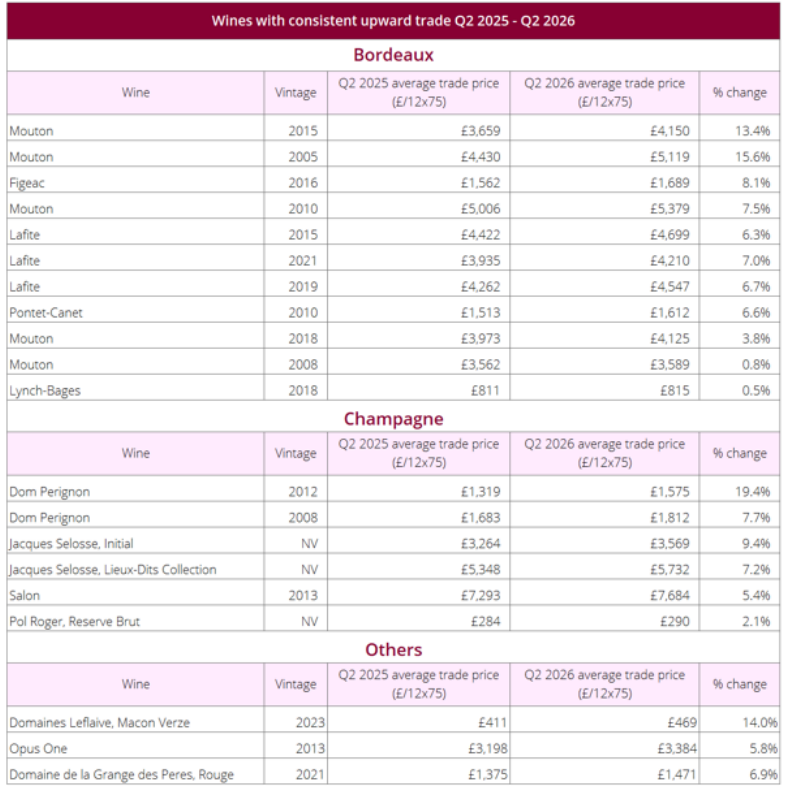
An upward trend was defined as three or four quarter-on-quarter increases in average trade price over the past year.
Bordeaux
Bordeaux comprised more of the top performing wines than any other region, thanks in part to its general liquidity (high volume and Liv-ex’s top-traded region). Mouton dominated, with five vintages on the list: 2015, 2005, 2010, 2018 and 2008. The 2015 had strong performance over the entire period but appears to have come to rest at its 2020 lows, the bulk of its upward movement taking place in late 2025.
Lafite 2015 tells a slightly different story. While, like Mouton 2015, it is currently trading at its 2020 lows, there is less evidence of prices coming to rest. With consistent upward momentum and a tight spread, there is more evidence pointing to continued positive price performance.
Prices of Lafite 2021, 2019 and Lynch-Bages 2018 all fell between Q2 and Q3 2025, but have ticked up each quarter since. Even for Lynch 2018, which just scraped its way onto this list, the newfound upward trend is evident.
For merchants, this is significant because Bordeaux remains the deepest and most liquid segment of the secondary market. Sustained price increases in highly traded wines are often more meaningful than similar movements in less liquid categories, as they reflect repeated buyer conviction rather than isolated transactions.
Champagne
As with Bordeaux, Champagne’s relative liquidity has allowed for more of the region’s wines to be considered in this analysis. Nevertheless, the Champagne 50 does appear to have now found support on its long term upward trendline – as we settle into recovery, it should be a region to watch. Some of the most impressive performances (defined upward trends) of the past year, however, have been for non-vintage Champagnes such as Pol Roger Reserve and Jacques Selosse’s Initial.
Champagne’s appearance on this list is particularly noteworthy given the pressure the category has faced during the broader market correction. Evidence of support emerging in the Champagne 50 and sustained strength in several non-vintage labels could suggest that buyers are beginning to recognise value at current price levels.
Conclusion
While the broader market remains challenging, these results demonstrate that opportunities still exist for buyers willing to take a selective approach. Rather than waiting for a broad-based recovery, merchants may benefit from focusing on wines where transaction data already shows signs of improving demand and strengthening pricing.
In uncertain markets, trade activity can often provide the clearest signal. Monitoring where buyers are consistently returning may offer valuable clues about the next phase of market recovery.
Author: Grace Geldard
What Happened In Fine Wine This Week: Trade value rose 22.4% week-on-week, driven by top-end Burgundy
Trade value on Liv-ex rose 22.4% week-on-week, driven by increased activity in top-end Burgundy.

Burgundy Extends Its Lead as Demand Concentrates at the Top End
This week’s trading provides further wine industry insight into where buyers and sellers are focusing their attention. Trade value on Liv-ex rose 22.4% week-on-week, driven by increased activity in top-end Burgundy. However, purchasing increased across all buyer geographies.
Burgundy accounted for 42.8% of total trade by value this week, strengthening its position as the market’s most actively traded region. As highlighted in recent Liv-ex commentary, demand for leading Burgundy producers has been building in recent months, and that trend continued this week. Leroy was the region’s most traded producer, contributing to Burgundy’s strong share of activity.
Bordeaux remained the second-largest contributor to trade. While it ceded ground to Burgundy in terms of market share, Bordeaux trade value still increased 10.8% week-on-week. Petrus was the region’s most traded producer, with the 2010, 2020 and 2021 vintages all changing hands during the week.
Elsewhere, trading activity was more subdued. All other major wine regions recorded a decline in trade value compared with the previous week, highlighting the continued concentration of demand among the market’s most established names.
What This Means for Investors and Merchants
For investors
- The week’s activity highlights continued demand for blue-chip Burgundy and Bordeaux.
- Trading remains concentrated among the market’s most established producers, underlining the importance of quality, brand strength and liquidity in the current environment.
- As part of the broader fine wine market outlook, investors may continue to find that leading wines attract the deepest pools of demand.
For merchants
- Buyer activity increased across every geography, suggesting engagement remains healthy despite demand being concentrated in fewer regions.
- Burgundy’s strong performance may present opportunities for merchants with access to sought-after stock.
- Current fine wine market performance indicates that well-known producers continue to command buyer attention, making careful stock selection increasingly important.
If you missed last week’s post, read here.
Copyright © 2026 Liv-ex Ltd. All rights reserved.
Author: Grace Geldard
Liv-ex H1 2026 Wine Market Report
The Liv-ex H1 2026 Wine Market Report reveals signs that the fine wine market is stabilising.
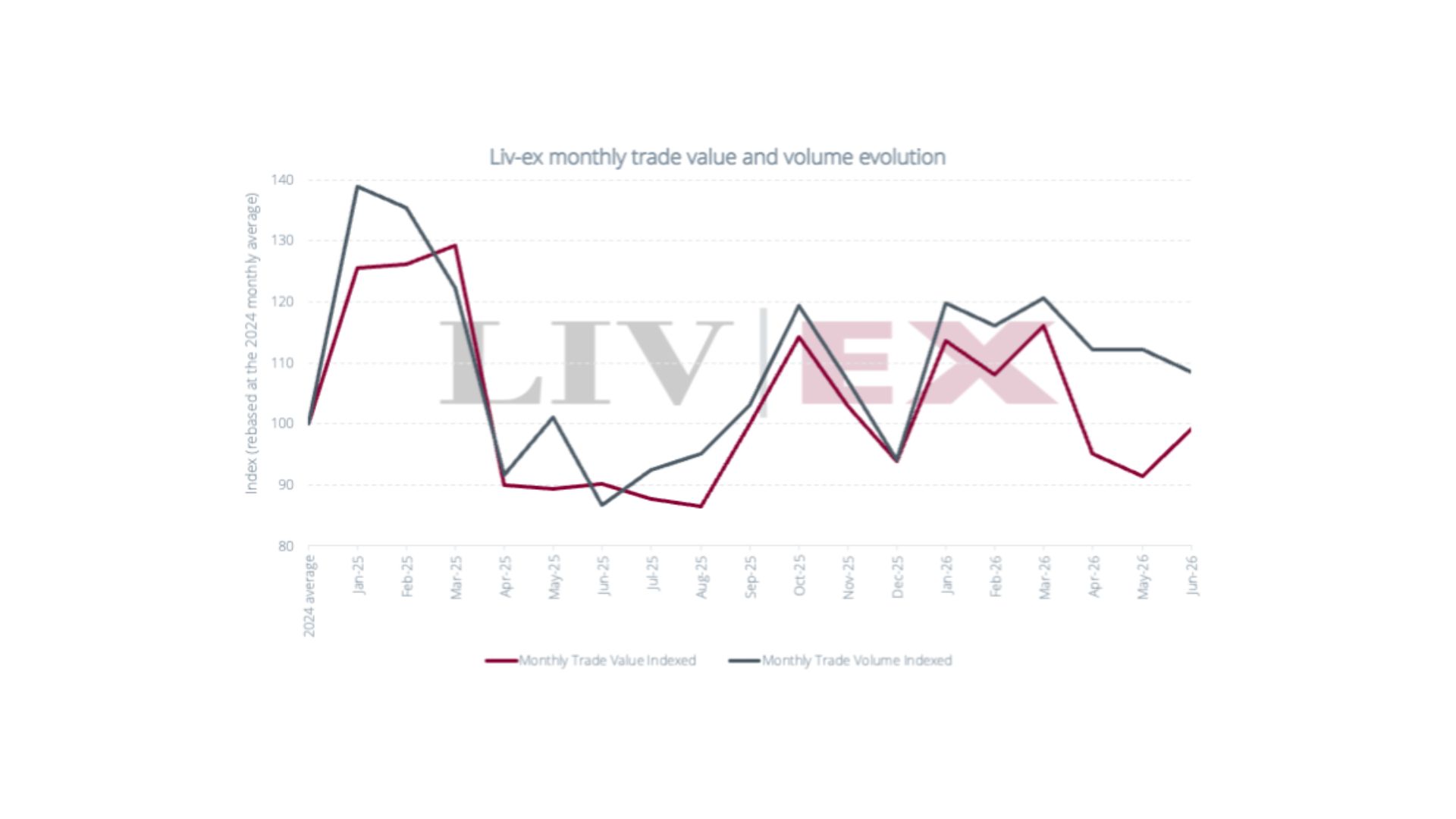
The topics covered in the report:
- US Buyers Account for More Than a Quarter of Purchase Value in Q2
- Older Bordeaux Finds Firmer Footing
- Outlook Improves as Price Stability Returns
Liv-ex is the exchange for fine wine, market data and insight. Membership brings wine professionals independent market data and insights and the ability to price, buy and sell wines through one point of contact.
Download the Report
Author: Grace Geldard
Liv-ex En Primeur Closing Report 2025
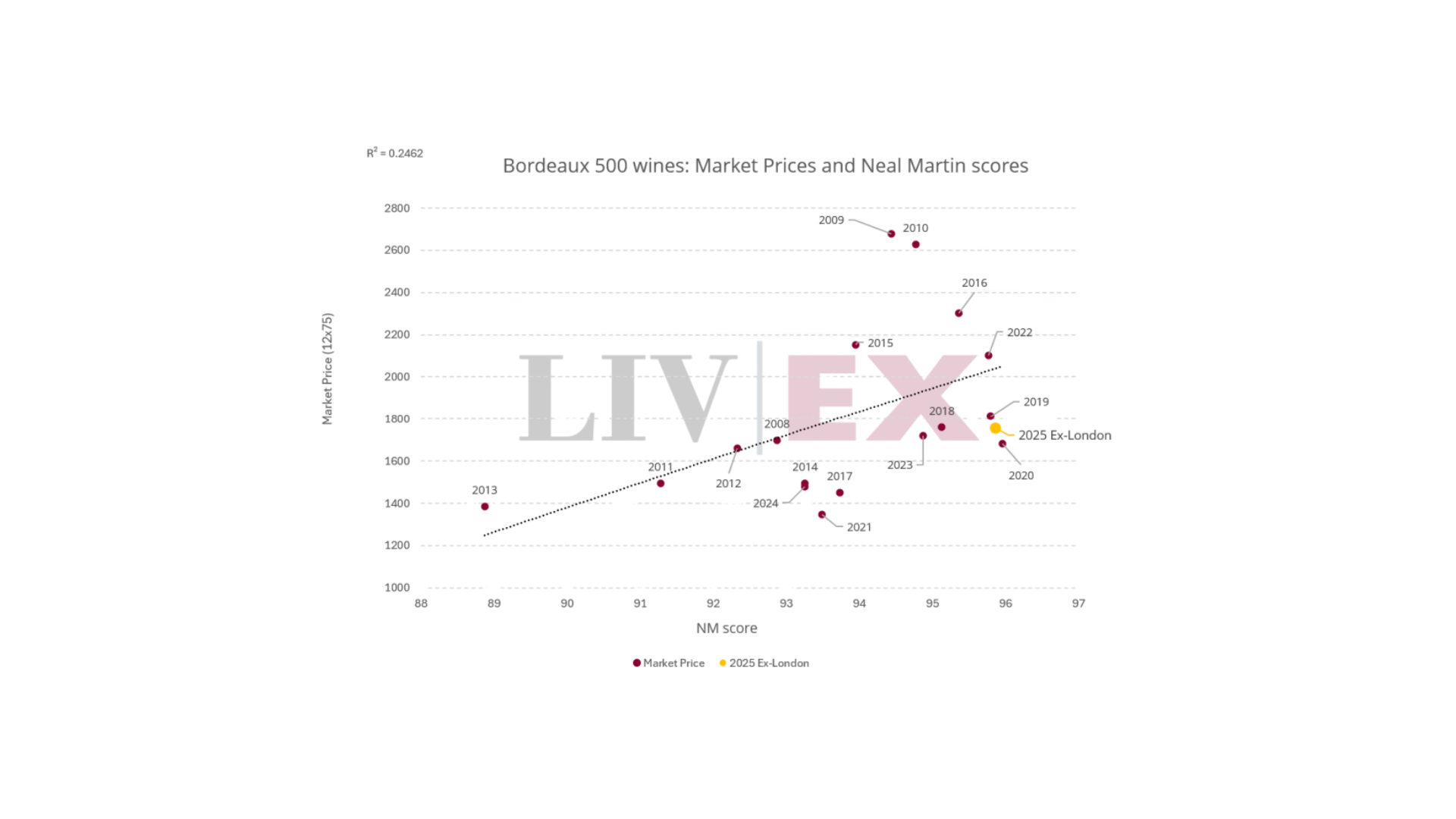
The Liv-ex En Primeur Closing Report looks back on the campaign and how it unfolded. En Primeur 2025 may well be better than we think.
The topics covered in the report:
- The backdrop and reception: The 2025s received very solid scores, generally ranking amongst the best of the past decade
- History repeats itself: En Primeur 2014, in many ways, lends itself to comparison with 2025.
- Best value releases
Missed the Liv-ex En Primeur Opening Report? Download your copy here.
Liv-ex is the exchange for fine wine, market data and insight. Membership brings wine professionals independent market data and insights and the ability to price, buy and sell wines through one point of contact.