Tag: Market Intelligence
Talking Trade 27th of March: US and Asian buyers both increase market share; Lafite leads
Bordeaux maintained its lead in the market, claiming 34.0% of traded value. Lafite led the region, commanding c.20% of its traded value.
The latest Talking Trade is now live!
- Bordeaux maintained its lead in the market, claiming 34% of traded value.
- Dom Perignon 2013 was the top-traded wine of the week by value, followed by Romanee-Conti 2008 and Lafite 2017.
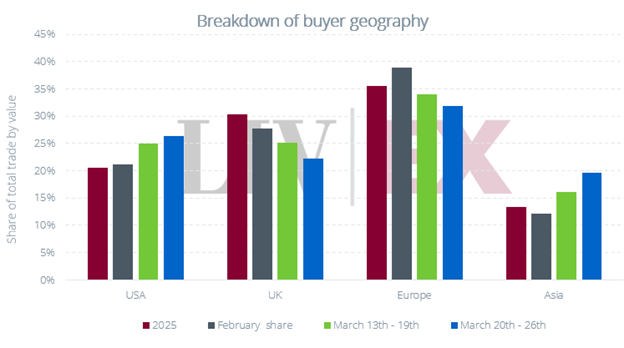
- Traded value fell overall, with UK and EU buyers buying 15+% less than last week.
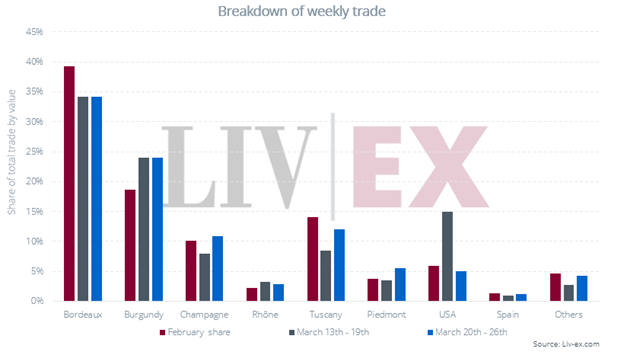
Bordeaux maintained its lead in the market, claiming 34.0% of traded value. Lafite led the region, commanding c.20% of its traded value. While the 2017 featured amongst the top five wines overall, ten other vintages, ranging from the 2006 to 2023, also changed hands.
Burgundy also kept its share steady on last week, accounting for 24.4% of traded value. Domaine de la Romanee-Conti’s Romanee-Conti was the top-traded wine by value; Domaine Dujardin’s Monthelie Les Vignes Rondes led by volume.
Champagne performed better this week than last week; its share up from 7.9% to 10.9%. Dom Perignon led, but was closely followed by Jacques Selosse, with Lieux-dits assortment cases, Substance and the flagship Millesime changing hands.
Tuscany’s share rose to 12.0%, shy of its February share of 14.0%, but up from 8.5% last week. Super Tuscans accounted for most of the region’s traded value, though Biondi-Santi also traded actively, taking a c.17% share of Tuscan trade.
Piedmont had a better week, its share rising from 3.5% to 5.5%. Gaja, Roagna and Giacomo Conterno led by value, while Produttori del Barbaresco led volume.
The US’s share fell from 15.0% last week to 5.0% this week. While Opus One, Promontory and Harlan Estate traded actively, this week saw a notable lack of action around Screaming Eagle.
Copyright © 2026 Liv-ex Ltd. All rights reserved.
Tag: Market Intelligence
Tom Burchfield, Head of Market Intelligence, ProWein Agora Takeaways
Tom Burchfield, Head of Market Intelligence, shares insights from his presentation and panel discussion at ProWein Agora, alongside his takeaways from the event itself.

First time at ProWein Agora. A maze of stands. The no and low section was pretty massive, a sign of it being perhaps the one wine category that is growing. The spirits section also vast.
I managed to locate my former Vivino colleagues (where I worked for six years) to catch up with old friends. They told me the fair was half as big as last year, itself half as big as the year before and that there were fewer attendees. Still felt vast to me.

Agora
This year ProWein reintroduced the Agora stage, where various experts present on and discuss key topics within the industry. How to market to the new generation? How to market no and low? How to leverage new technologies including AI to better serve customers? What is the current state of the fine wine market and where is it going?
That one was the topic I presented on. A lot of ground to cover in 20 minutes, and the aim was to set the scene for a debate with Krister Bengtsson (founder of Star Wine List) and Robert Joseph (journalist and consultant). To further condense my 20 minutes into a 3-bullet point summary of where the market is and where it’s heading:
- Price stability. At the top of the fine wine market, more wines are now either seeing flat or gently rising prices than falling prices.
- Fragmentation. The fine wine market is broader than ever, and this trend is likely to continue with the next generation of collectors.
- Stratification. At the same time, across segments within traditional regions like Bordeaux and Burgundy we see the top of the pyramid looking more secure than further down. Within Bordeaux the portion of the industry that is at risk is growing.
Scene set, half an hour of interesting debate.
Is demand for fine wine elastic?
Yes, in my opinion, not for others.
My take is that participants are doing everything they can to maintain higher release prices – squeezing supply, pouring cash into production to achieve high scores. Is that sustainable on their side? Is it worth the effort with prices softening post-release? I believe there is a price that works. We see this consistently with Bordeaux after release. There is a price at which demand is unlocked. You can try to avoid market reality or you can accept it.
To download Tom’s presentation slides, please fill out the form here.
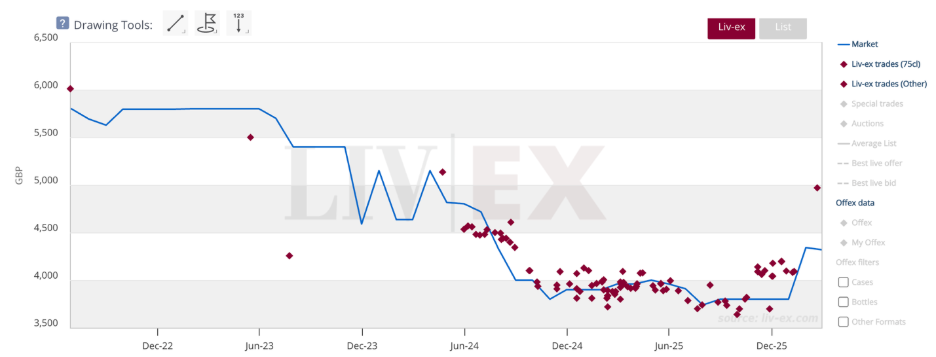
Liv-ex trades of Lafite 2021
A flight to value. Something we all agree upon. Whether that’s the collapse in demand for Second Wines or changing tastes in the on-trade, consumers are after value.
The next generation of collectors. We agree that price is a challenge. The industry needs a broad base of potential collectors. How does that happen for Burgundy, where even regional wines are becoming a special occasion indulgence? The on-trade needs sommeliers that have not just tasted, but drunk both the classics and the future classics.
GLP-1 medications. An existential threat for the fine wine market? Some say yes, I say not at this point. Fine wine is sheltered to some degree.
Other reflections
- Betraying my ignorance, but I had no idea that Dusseldorf has a big Japanese community? I do now, and can vouch for some excellent ramen as a counterpoint to wurst.
- The drinks industry is clearly faced with many challenges. The more we discuss these, try things, share successes and challenges the better. But don’t forget that wine has an incredible ability to bring people together. Despite the current challenges, people were having fun at ProWein.
- Of the UK contingent travelling to Dusseldorf on the Saturday, judging by how many were supporting the team in blue in the 6 Nations rugby decider, a high proportion were Scottish.
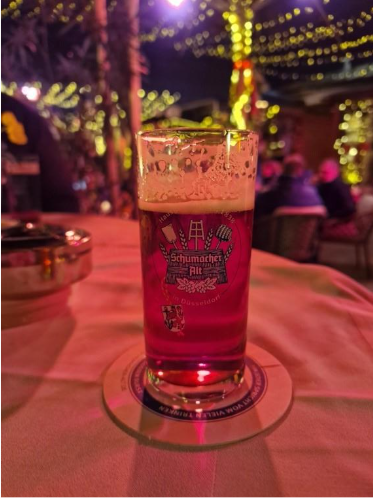
- Was everyone in the brauerei? Heading to Brauerei Schumacher to sample the city’s trademark Alt Bier on Saturday night, it was packed full of Proweiners – probably to be expected, drinks industry people warming up for vinous delights with malted beverages.

Tag: Market Intelligence
Talking Trade 20th of March: US wines claim 15% of trade value, Asian buying spikes
The US had a strong week, coming in third place with a 15% share of trade. Opus One was largely responsible, accounting for almost half the region’s…
The latest Talking Trade is now live!
- Bordeaux reclaimed its lead of the market from Burgundy, accounting for 34% of traded value.
- Tignanello 2022, Opus One 2018 and 2022 were the top-traded wines by value.
- US buying strengthened, levelling with the UK though with far fewer engaged parties.
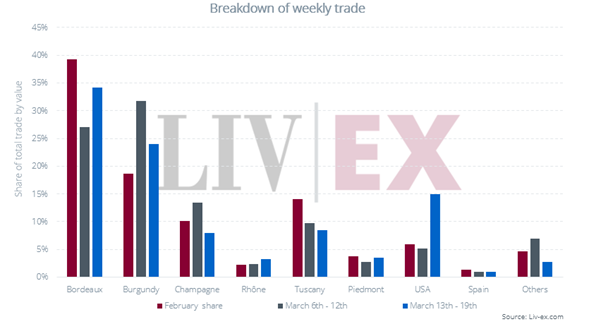
Bordeaux took back its lead of the market, claiming 34% of traded value. Lafite, Mouton and Haut-Brion were the top-traded wines. The 2023s are now beginning to trade following recent in-bottle tastings, Lafite 2023 changing hands at £3,806/$5,062 per 12×75 / €367 per bottle – its first physical trade taking place 7% below its ex-negociant release price (€396/btl).
Burgundy followed in second place with a 24% share. Domaine de la Romanee-Conti, Romanee-Conti; Domaine Comtes George de Vogue, Musigny; and Domaine Comte des Lafon, Montrachet were the region’s top-traded wines by value.
The US had a strong week, coming in third place with a 15% share of trade. Opus One was largely responsible, accounting for almost half the region’s traded value. US buyers took the lead, followed by the UK and Asia.
Champagne’s share fell from 13% last week to 8% this week. Bollinger dominated, La Grande Annee claiming close to a third of the region’s trade value. Dom Perignon and Cristal followed.
Tuscany also saw its share fall slightly; Piedmont’s rose but remains low. San Guido and Antinori led, though the next top traded producers all hailed from Piedmont– Giuseppe Rinaldi, Gaja and Giacomo Conterno.
Copyright © 2026 Liv-ex Ltd. All rights reserved.
Tag: Market Intelligence
Talking Trade 16th of March: Burgundy takes the lead, DRC top-traded overall
Burgundy led the market with a 32% share of traded value. Domaine de la Romanee-Conti came out on top by traded value, Domaine Leflaive took the top spot by…
The latest Talking Trade is now live!
- Bordeaux ceded its lead of the market to Burgundy, which accounted for 31% of traded value.
- Valdicava Brunello Riserva Madonna Piano 2019, Petrus 2000 and Cristal 2008 were the top-traded wines by value.
- UK buyers’ share of purchased value rose while each other buying geography’s fell.
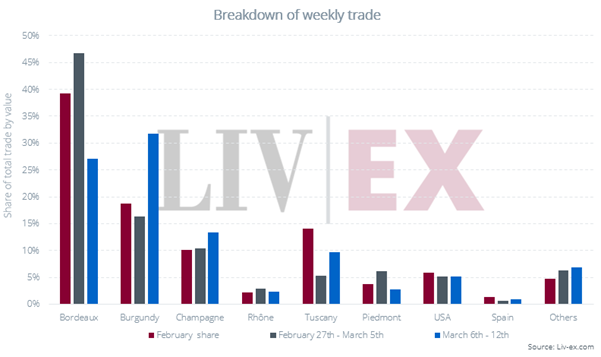
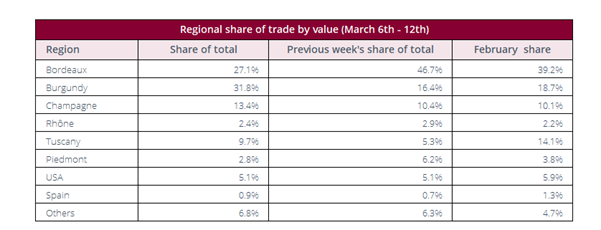
Bordeaux has dominated the market recently, peaking with a 47% share of traded value last week. This week, its share fell to 27%, ceding its first place position to Burgundy. Petrus led the region. Alongside more recent mature vintages, a case of the 1970, now in the final years of its drinking window, changed hands at £20,400/$27,132 per 12×75 /€1,972 per bottle.
Burgundy led the market with a 32% share of traded value. Domaine de la Romanee-Conti came out on top by traded value, Domaine Leflaive took the top spot by volume.
Champagne followed in third place, its share rising from 10% last week to 13% this week. Dom Perignon was the top-traded producer, led by the 2010, Oenotheque 1996 and P2 2008. All three have seen recent upticks in trade price, the 2010’s backed up by a significant increase in trade levels.
Tuscany had a stronger week, up from 5% to 10%. Brunello di Montalcino took the lead ahead of Bolgheri, with Valdicava and Fuligni seeing higher traded value than San Guido. Piedmont was less fortunate, its share falling to 3%.
The US’s share remained flat at 5%, Screaming Eagle taking the lion’s share of the region’s trade.
Copyright © 2026 Liv-ex Ltd. All rights reserved.
Tag: Market Intelligence
Talking Trade 6th of March: Pavie leads again, Bordeaux’s share rises to 47%
Bordeaux’s share of the market rose to 47% — its strongest week in recent memory. For the second week running, Chateau Pavie dominated, with the…
The latest Talking Trade is now live!
- Bordeaux’s share of the market rose to 47% — its strongest week in recent memory. Burgundy and Champagne followed, with all other regions taking less than 10% of traded value.
- For the second week running, Chateau Pavie dominated, with the 2018 and 2017 vintages in the top positions.
- US buyers’ share of purchased value rose to 27%, strengthening their position in second place behind European buyers.
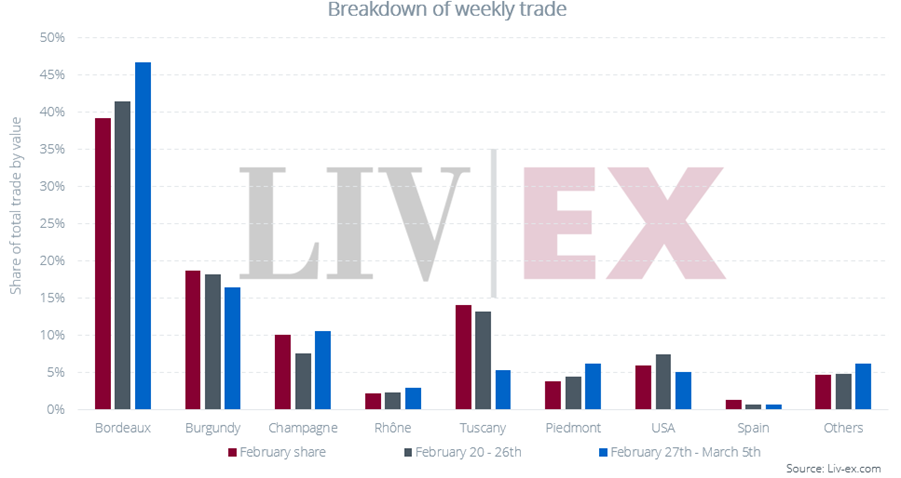
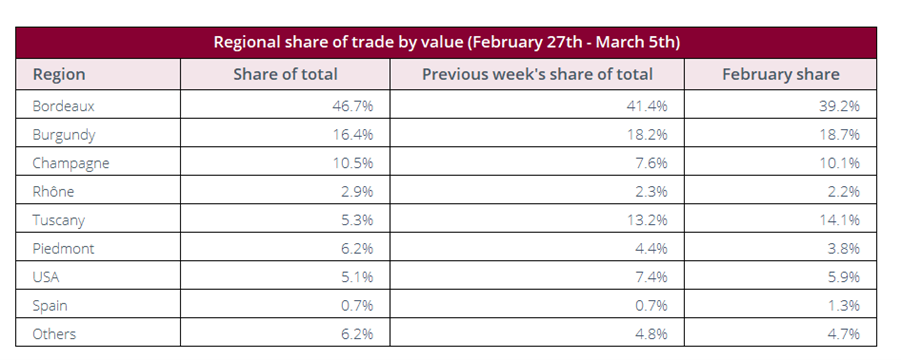
Bordeaux enjoyed another strong week, its share of the market rising from 41% last week to 46.7% this week. For the second week in a row, Chateau Pavie dominated, this time joined by Petrus, Beychevelle and Ausone.
Burgundy held its position in second place, though its share of traded value fell from 18% to 16%. Domaine Leflaive was the top-traded producer. Alongside recent vintage Puligny-Montrachet and Meursault, a single bottle of 1998 Montrachet changed hands at £10,075.
Champagne’s share increased from 7.6% to 10.5%. While the 2015 and 2016 vintages were the top-traded by value, the 2008 traded most frequently.
Tuscany’s share of trade fell to 5.3%, Piedmont overtaking with 6.2%. Still, Super Tuscans came out on top, with Tignanello and Sassicaia the top-traded Italian wines by value. Bartolo Mascarello’s Barolo came in third place.
The US’s share fell to 5.1%, down from 7.3% last week. Screaming Eagle led the region, with the 2022 Cabernet Sauvignon trading at £16,800 per 12×75. Promontory and Opus One followed.
Copyright © 2026 Liv-ex Ltd. All rights reserved.
Tag: Market Intelligence
Talking Trade 2nd of March: Pavie leads trade; US and Asian buyers increase market share
Bordeaux extended its lead of the market, claiming a 41% share of traded value. The 2020 vintage claimed the top position by both value and…
The latest Talking Trade is now live!
- Bordeaux extended its lead of the market, thanks largely to trades of recent vintage Chateau Pavie. Burgundy and Tuscany followed in second and third place.
- Alongside Pavie 2020, 2019 and 2017, Ornellaia 2022 and Chateau La Mission Haut-Brion 2016 featured amongst the top five wines by traded value.
- With Asian buyers returning to their desks following Lunar New Year and US buyers’ share creeping back up, both UK and EU buyers’ share fell.
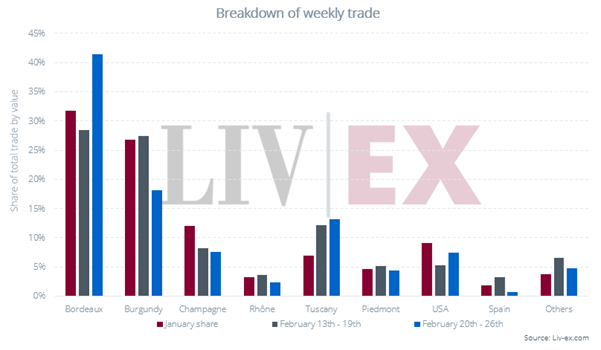
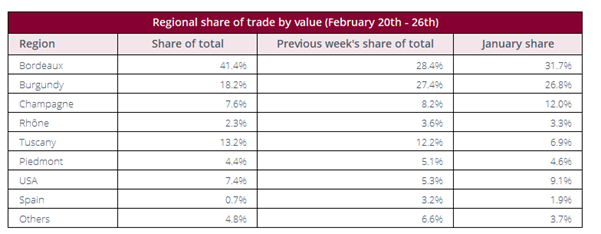
Bordeaux extended its lead of the market, claiming a 41% share of traded value. The 2020 vintage claimed the top position by both value and volume, followed by the 2019 and 2016 vintages. Pavie, La Mission Haut-Brion and Cos d’Estournel were the top-traded producers, First Growths taking a back seat this week.
Burgundy’s share fell from 27.4% last week to 18.2% this week. Armand Rousseau pulled ahead of Domaine de la Romanee-Conti as the region’s top-traded producer, thanks largely to US buyers.
Champagne’s share fell to 7.6%. While the 2013 and 2008 vintages traded most frequently and in the highest volumes, this week also saw trades of higher value, mature wines such as the 1998 vintage of both Dom Perignon P2 and Krug.
Tuscany’s share rose slightly from 12.2% to 13.2%. Ornellaia was by far the top-traded wine, claiming just over 40% of the region’s traded value. Fuligni Brunello di Montalcino joined Bolgheri’s heavy hitters amongst the top five.
The US’s share rose from 5.3% to 7.4%. Promontory was the top-traded wine by value, UK buyers accounting for around two thirds of purchasing and US buyers the remaining third.
Copyright © 2026 Liv-ex Ltd. All rights reserved.
Tag: Market Intelligence
Talking Trade 20th of February: Burgundy and Bordeaux level at 28% share of market, Leflaive takes the lead
Burgundy’s share rose from 15.0% to 27.5%, pushing the region into a close second place. Though the 2019s were the top traded by value.
The latest Talking Trade is now live!
- Bordeaux’s share of trade declined to 28.4%, just taking the edge over Burgundy with 27.5%.
- Domaine Leflaive’s Puligny-Montrachet, Clavoillon 2019, Guado al Tasso 2023 and Tignanello 2022 were the week’s top-traded wines by value.
- While the US’s share of traded value remains low, they are more active on the market (by number of trades) than both Asian and UK buyers.
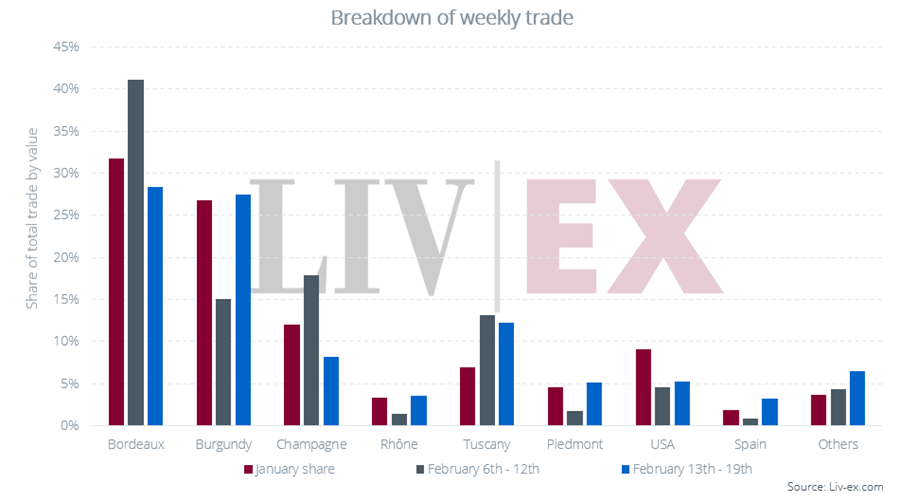
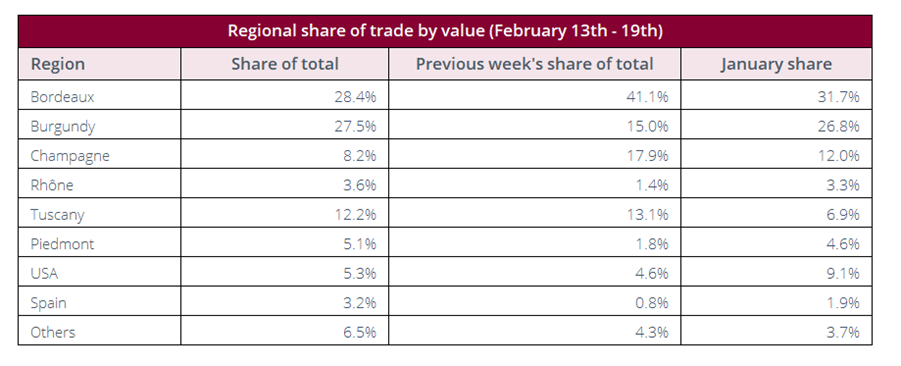
Though retaining its lead, Bordeaux’s share of traded value fell from 41.1% last week to 28.4% this week. Aromes de Pavie 2016 was the region’s top-traded wine by value, changing hands in decent volumes several times at £430 per 12×75 – a 49% discount to its ex-London release price.
Burgundy’s share rose from 15.0% to 27.5%, pushing the region into a close second place. Though the 2019s were the top traded by value, the 2023s claimed the top position by volume. Leflaive led the region, claiming 30% of its traded value. Domaine de la Romanee-Conti and Armand Rousseau followed.
Champagne’s share fell from 17.9% to 8.2%. Dom Perignon and Krug claimed the top positions amongst the region’s producers; trades of recent vintage (2015 and 2018) Winston Churchill pushed Pol Roger into third place ahead of Louis Roederer.
Tuscany held steady at 12.2% while Piedmont regained some of the ground it had lost last week, its share rising from 1.8% to 5.1%. Tignanello and Ornellaia were Italy’s top wines, though Bruno Giacosa and Gaja also traded actively, claiming third and fourth place.
The US, while falling short of its January share of 9.1%, saw an increase from 4.6% to 5.3% this week. Screaming Eagle continues to lead, with both the Sauvignon Blanc and Cabernet Sauvignon changing hands.
Spain, following weeks of diminished trade, saw a slight improvement, its share rising to 3.2%. While Vega Sicilia led by value, La Rioja Alta traded most frequently.
Copyright © 2026 Liv-ex Ltd. All rights reserved.
Tag: Market Intelligence
Talking Trade 13th of February : Bordeaux and Champagne lead, US buyers take a step back
Champagne had a strong week, overtaking Burgundy to claim second place. Though Selosse Millesime 2013 was the top-traded individual wine Krug fared best across vintages
The latest Talking Trade is now live!
- Bordeaux extended its lead of the market, claiming 41% of traded value
- The newly released Sassicaia 2023 led the market. Chateau Troplong Mondot 2022 and Angelus 2021 followed in second and third place.
- US buyers took a backseat, their share of traded value falling from 20% to 13%.
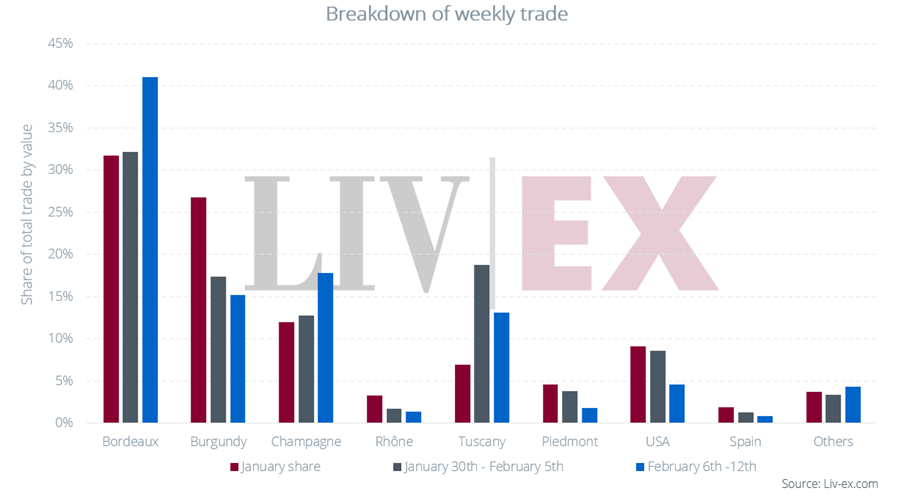
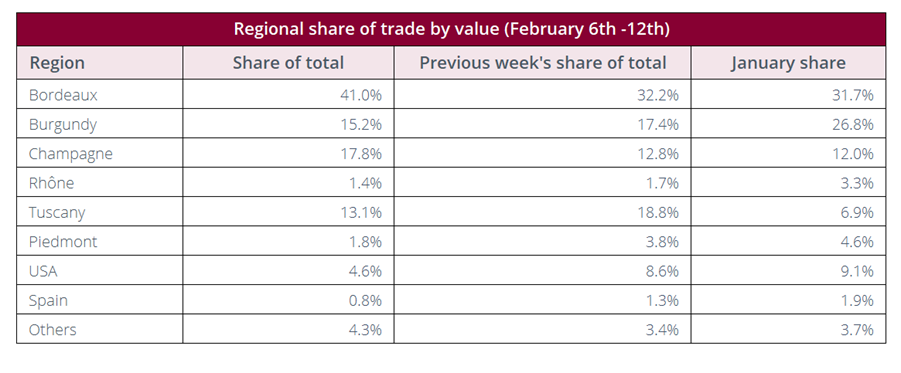
Bordeaux extended its lead of the market, its share of traded value up from 32.2% last week to 41.0% this week. Buyers concentrated their efforts on the 2022 vintage; prices generally having now fallen below ex-negociant levels.
Champagne had a strong week, overtaking Burgundy to claim second place. Though Selosse Millesime 2013 was the top-traded individual wine Krug fared best across vintages, accounting for a third of the region’s trade. The 2013 vintage will be released in the coming week.
Burgundy’s share fell from 17.4% last week to 15.2% this week, both weeks short of its January share of 26.8%. Domaine Leflaive was the top-traded producer, with several cuvees changing hands.
Though Tuscany’s share of trade fell from last week, San Guido continued to dominate, coming in as the broader market’s top traded wine of the week.
Following a strong few weeks, the US’s trade share fell to 4.6%. Though Screaming Eagle continued to lead the market, it was the Sauvignon Blanc rather than the Oakville Cabernet Sauvignon that traded most actively this week.
Copyright © 2026 Liv-ex Ltd. All rights reserved.
Tag: Market Intelligence
Talking Trade 6th of February: Tuscany overtakes Burgundy by market share, Sassicaia leads
Bordeaux pulled further into the lead, claiming 37.5% of traded value. The 2022 vintage was the top-traded by both value and volume
The latest Talking Trade is now live!
- Though Bordeaux continues to lead, Tuscany displaced Burgundy as the second top-traded region by value.
- Sasssicaia 2021, ahead of the release of 2023 today, was the top-traded wine by value and volume.
- US buying continues to hold at around 22% of purchasing, buyers focusing largely on back vintage Bordeaux.
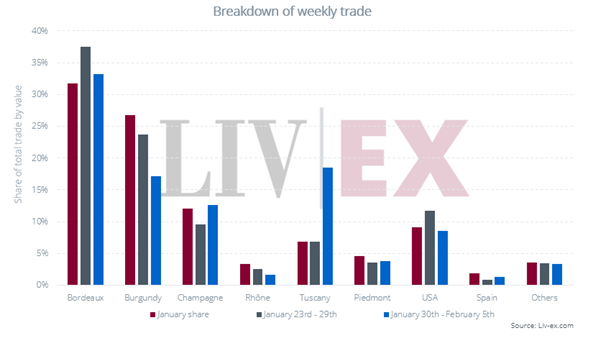
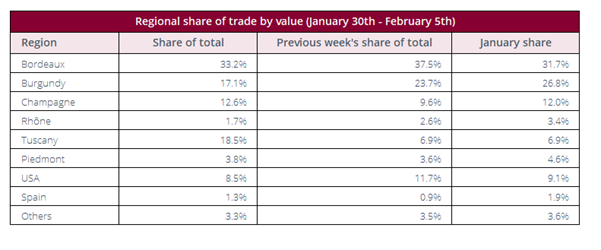
Bordeaux led the market with a 33.2% share of traded value, down on a strong close last week at 37.5%. Buyers concentrated their efforts on top vintages this week, with the 2016s, 2019s, 2020s and 2022s trading most frequently.
Taking 18.5% of trade, Tuscany pulled ahead of Burgundy as the second top-traded region by value. Sassicaia was by far the top-traded wine, accounting for over half of the region’s trade. Brunello di Montalcino, which has fallen by the wayside with reduced US purchasing, re-entered the fold, Fuligni coming in as Tuscany’s second top-traded producer.
Burgundy followed in third place with a 17.1% share. Buyers tended towards slightly lower value wines in higher volumes, with Domaine de la Tour, Robert Groffier and Comtes Georges de Vogue coming in as the top three producers by trade value.
Champagne claimed 12.6% of trade, up slightly from 9.6% last week. Jacques Selosse 2008 was the top traded wine by value, changing hands between £26,160 and £27,300, a marked increase from its low of £20,064 in April 2024. Recent upward price movement has been confirmed by rising trade frequency.
The US had another strong week (8.5%), again led by Screaming Eagle. Opus One also traded actively, with demand led largely by Europe and the UK.
Copyright © 2026 Liv-ex Ltd. All rights reserved.