Navigating En Primeur Amidst a Challenging Fine Wine Market
For a growing number of merchants, the central challenge of En Primeur is no longer uncertainty, it is credibility.
Automation
When the En Primeur model breaks down
For a growing number of merchants, the central challenge of En Primeur 2025 is no longer uncertainty, it is credibility. In recent campaigns, new releases have frequently struggled to justify their pricing when compared with the broader secondary market. In many cases, buyers have been able to purchase back vintages that are physically available, already approaching drinkability, or with a few years of age, at prices below those asked for wines still in barrel.
This dynamic has fundamentally altered how En Primeur is perceived. What was once a route to early access and long‑term value increasingly carries the risk of immediate underperformance. For merchants committing capital, the danger is not only financial. Advising clients to buy wines that later trade cheaper on release can erode confidence and damage long‑standing relationships.
Against this backdrop, intuition and tradition are no longer sufficient. En Primeur decisions now demand far greater scrutiny.
Why data now matters more than ever
What does this mean for merchants, and their customers, who are still drawn to the tradition and excitement of buying En Primeur?
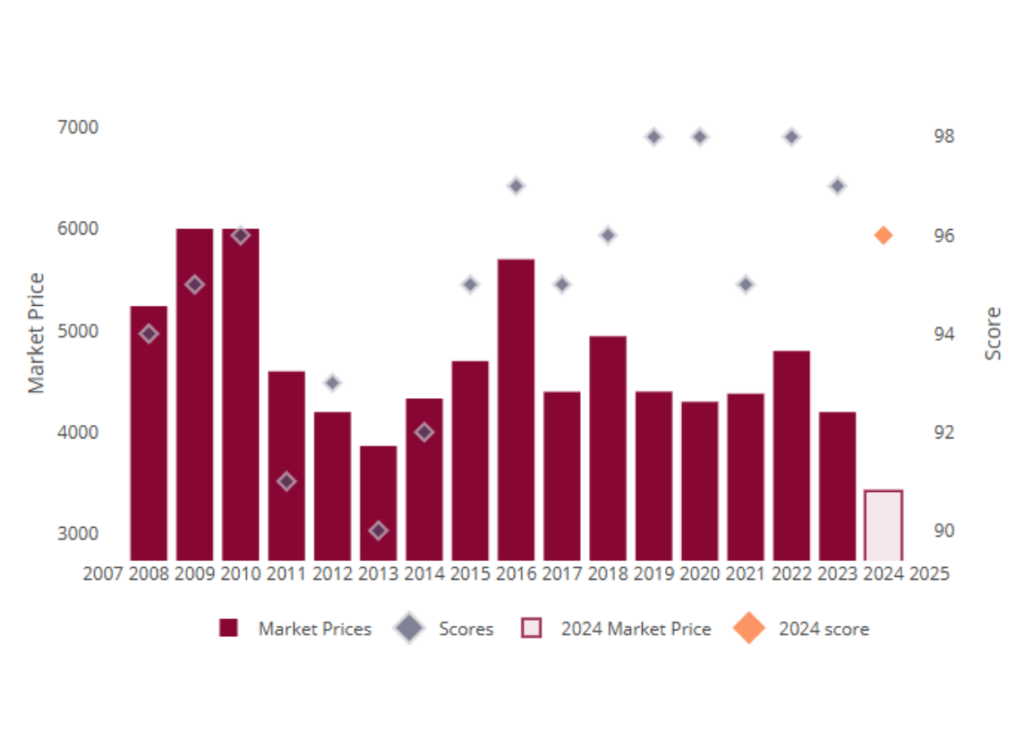
Merchants must interrogate En Primeur offers far more rigorously than before. That means understanding how critics’ scores have translated into real‑world pricing in previous vintages, how similar wines have performed after release, and whether a new price genuinely reflects scarcity, quality and demand.
Without this context, En Primeur becomes a speculative exercise. With it, merchants can begin to distinguish between releases that may still offer value and those where patience is the more rational strategy.
This is where transactional data and historical market performance become essential tools. Looking beyond list prices to examine how wines have actually traded over time allows buyers to sense‑check release decisions against market reality, not marketing narrative.
Analysing new releases within market context
One of the biggest mistakes a merchant can make during En Primeur is treating each campaign in isolation. Critics scores alone cannot be relied on to assess the opportunity, and risk, at hand. Capital committed to Bordeaux must now compete with opportunities across regions, vintages and styles that are already available and proven in the market.
Being able to compare new releases with established alternatives, and to understand how price, score and demand have interacted historically, gives merchants a clearer framework for decision‑making. It also enables more transparent conversations with clients, grounded in evidence rather than expectation.
Liv‑ex support during En Primeur
This is where Liv‑ex plays a central role during En Primeur. By providing access to independent analysis, as well as transactional exchange data and historical pricing, alongside vital critics scores.
During the campaign, Liv‑ex supports members with ongoing insight, helping them interpret critics’ scores, track sentiment as it evolves, and understand how new prices sit relative to both back vintages and the wider fine wine market. This allows merchants to remain selective, adapt strategy as the campaign unfolds, and avoid being locked into early decisions that no longer make sense.
Crucially, this support extends beyond allocation. Once wines enter the secondary market, merchants can benchmark performance, refine pricing strategies and respond quickly to demand, protecting both margins and reputation.
It’s not too late to access Premium Market Intelligence to help you navigate the campaign with confidence . Contact our business development team to prepare for En Primeur 2025
Tag: Automation
Liv-ex Blog
The Impact of Macro Economics on the Fine Wine Market
Fine wine prices rise and fall, not just in line with quality or reputation, but in response to economic forces shaping demand around the world.…
Automation
What’s the relationship between the global economy and the fine wine market?
Despite thousands of years of production, distribution, consumption and culture, fine wine is not abstract from modern economies. Like all product classes, its prices are impacted by the surrounding economic landscape.
Fine wine prices rise and fall, not just in line with quality or reputation, but in response to economic forces shaping demand around the world. For wine businesses navigating today’s environment and understanding that relationship has never been more important.
A Market Defined by Dual Demand
Unlike many luxury products, fine wine is sought for two very different purposes: consumption and investment. This dual demand makes fine wine even more susceptible to macro-economic patterns and cultural phenomena, because it’s impacted by consumption trends, as well as investment behaviour and wealth more broadly.
When consumer confidence is high, discretionary spending grows. When investors feel optimistic, alternative assets attract interest. When either shift, the fine wine market feels it.
Interest Rates: More Than a Simple Cause and Effect
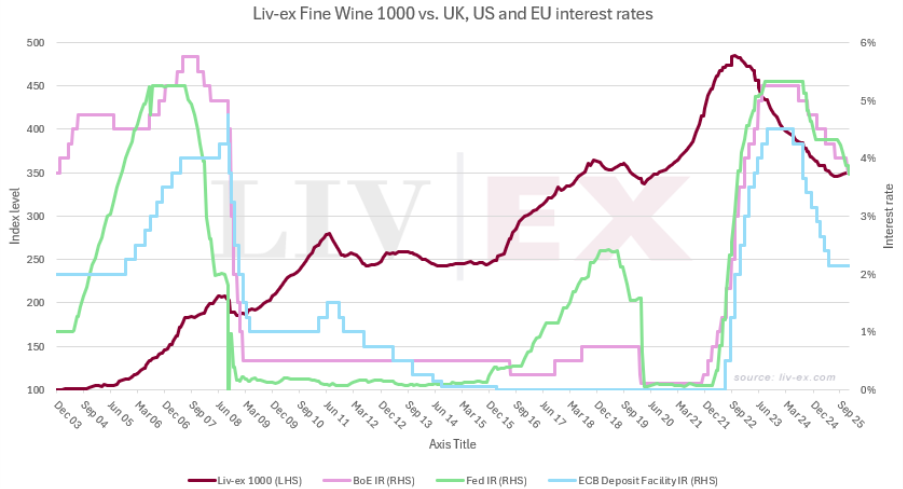
Interest rates are often used as an indicator of overall economic health, and while their relationship with fine wine is often discussed, its rarely quantified. In theory, low rates should lead to increased demand.
monetary policy
The chart shows that in periods of ultra-low rates, such as the COVID-19 lockdowns and the 2008 financial crisis, fine wine prices immediately rose. Conversely, fine wine has also performed well during moments of relatively high rates, such as in 2018. This suggests that it’s not the headline rate that matters, but the underlying conditions policies are responding to.
Inflation, growth expectations, investor appetite and access to capital all play interconnected roles in shaping demand for fine wine and subsequent price performance.
Inflation: A More Direct Link to Fine Wine Prices
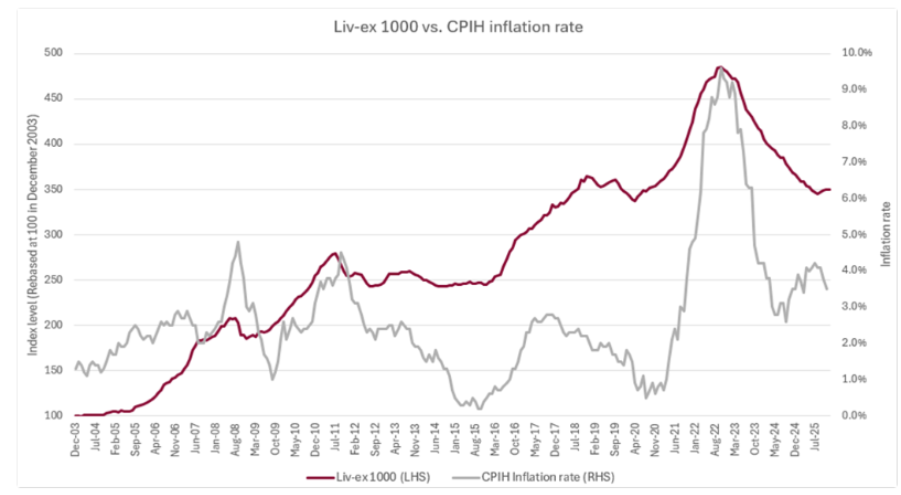
Inflation has shown a more consistent relationship with fine wine pricing. Not because it’s part of the consumer shopping basket. The factors impacting the price of eggs, petrol and milk are different from those impacting fine wine. Although production costs are affected, most of the wine traded on the secondary market was manufactured years ago.
monetary policy
During periods of high inflation, tangible assets often gain appeal as investment opportunities. Fine wine can benefit from this as investors look to diversify beyond public markets.
Wine differs from housing and even luxury goods, such as watches and bags, in the nature its collected and the scale of its production. Traditionally, a fine wine collector will buy cases of six or more bottles of wine and continue to do so year after year. While release pricing is a product of labour, materials and perceptions of quality, and will in turn rise with inflation. Therefore, production costs are more relevant compared to other asset classes.
Recent years, however, have highlighted the risks: release prices have been set beyond what the market has been willing to pay, creating a mismatch between cost expectations and investor appetite.
As inflation has normalised over the past year, stability has returned, reducing volatility and helping rebuild confidence. For merchants, importers and producers, these dynamics underline a key point: inflation doesn’t just affect costs, it shapes behaviours.
The full article explores the interaction between real interest rates and fine wine prices, accessible only to Liv-ex Members.
What This Means for the Fine Wine Trade Today
After three years of disruption; marked by high inflation, rising rates and overly confident release prices – the environment is shifting.
Inflation has eased. Monetary policy is stabilising. And prices for many recent vintages have corrected to more appealing levels for buyers.
But monetary policy alone cannot reset the fine wine market. The stock cycle must play out. Vintages produced during periods of high cost and high expectation still need to be absorbed before the next growth phase can begin.
Why Market Intelligence Matters
For businesses operating in the fine wine industry, the lesson is clear – fine wine does not exist in isolation. Its performance is tied to the same macroeconomic factors influencing global wealth, investor sentiment, consumption patterns and financial stability.
To make informed decisions, whether in pricing, buying, inventory management or strategy, wine businesses need visibility into these relationships.
Fine Wine Market Insights and Analysis That You Can Trust
Liv-ex Market Intelligence is analysis of the fine wine market. It’s built on the industry’s most comprehensive pool of transactional data. It gives members the clarity, context, and confidence…
Automation
The fine wine industry has undergone some seismic shifts… In recent years, businesses have had to navigate shifting demand, changing global consumption, unpredictable En Primeur campaigns, and tariff‑related uncertainty. Even in 2025, early signs of recovery were disrupted by renewed trade tensions and a challenging Bordeaux EP.
In this environment, intuition and experience alone are no longer enough. To protect margins and stay ahead of changing demand, fine wine businesses need timely, unbiased intelligence.
Access to these insights gives members a clear competitive advantage – by enabling them to see market shifts well before others they can maximise opportunity and minimise risk.
What is Liv‑ex Market Intelligence?
Liv-ex Market Intelligence is analysis of the fine wine market. It’s built on the industry’s most comprehensive pool of transactional data. It gives members the clarity, context, and confidence to make informed commercial decisions, across buying, selling, pricing, and strategy.
It is:
Timely: Highly responsive and where possible, forward-looking analysis
Detailed: Combining high‑frequency trading data with in‑depth regional analysis
Independent: Not swayed by any position, speculation or bias
Personalised: Custom reports tailored to your business activity
How Market Intelligence Helps Fine Wine Businesses
1. Understand the market you operate in
Access the industry’s clearest view of fine wine dynamics, from real-time shifts to deep dives into regions and wines driving broader market trends. See what’s moving, where demand is shifting, and which wines are falling out of favour.
2. Act early on emerging trends
Spot demand up to six months before it’s reflected in list prices. Liv‑ex’s transactional data reveals real buying appetite before pricing changes appear publicly, giving you time to adjust strategy, stock, and pricing.
3. Optimise your commercial performance
Benchmark your own buying, selling, and stock list performance against the wider market. Understand where you are outperforming, and where margin opportunities are being missed.
4. Empower your whole team
Give your sales, buying, and leadership teams access to trustworthy data they can confidently share with customers and use equally in boardroom reporting as purchasing negotiations.
Why Independent Transaction Data Matters
Liv-ex Market Intelligence reports on transactional exchange data; this is the genuine price a wine has been sold at and bought for on the Liv-ex exchange. To further contextualise, it also uses the Liv-ex Market Price, which is data gathered from listed prices that is cleaned, standardised and categorised by Liv-ex.
Transactional exchange data is a leading indicator of market shifts. The graph below shows how changes in the Liv-ex bid:offer ratio precedes the mid price for Lafite.
Bid:offer ratio being the total value of bids against the total value of offers – or simply a measure of demand and supply
Mid price being the middle point between the highest bid and lowest offer – ie. the point at which a wine is most likely to transact
liv-ex market intelligence
This is why members rely on Liv‑ex Market Intelligence to understand where the market is heading.
What types of Market Intelligence do Liv-ex member receive?
Personalised Market Report: A tailored monthly report analysing the most important market movements alongside your own buying, selling, and stock list activity – helping you identify new opportunities and respond to risk
Extended Reports: Comprehensive research into global regional dynamics, supply‑demand trends, pricing behaviour, and brand positioning
Market Updates: In‑depth analysis of regions, producers, trade flows, and brand performance – vital for businesses embedding data‑driven decision making into buying and sales strategies
Release Analysis: Independent evaluation of new releases – quickly see whether a wine is attractively priced, how it compares to back vintages, and whether it represents a buying opportunity
Talking Trade: Weekly, high‑frequency updates showing which wines, regions, and trends are driving market activity in the moment – essential for spotting emerging demand early.
“Liv-ex Market Intelligence is incredibly useful for tracking price evolution and assessing purchasing decisions. I sell wines on Liv-ex and regularly use the platform to check prices, but the Market Intelligence reports take it to the next level. They provide real support for my decision-making.”
Rodolphe de Noose, Ovinia
Ready to Stay Ahead of the Market?
Liv‑ex Market Intelligence helps fine wine businesses anticipate shifts, protect margins, and make confident decisions.
If you’d like to explore becoming a Liv‑ex member or would like to see examples of our latest reports, please reach out to our business development team.
With Bordeaux En Primeur fast approaching, do you have the insights you need to make confident, well-informed decisions? Get in touch here to see how Liv-ex Market Intelligence can support your strategy.
Tag: Automation
Liv-ex Blog
Offer Your Customers Greater Variety Without Investing in New Stock
Liv-ex members can pull over 23,000 Liv-ex listings onto their ecommerce site to offer their customers increased choice and variety.
Automation
It’s more important than ever for wine businesses to find ways to attract new customers and appeal to a broader audience. But for many businesses, investing in new stock and experimenting with new offers requires upfront investment and risk that’s hard to justify in a downward market.
At Liv-ex we’ve developed a solution that lets you showcase all the wine available on the Liv-ex exchange, without the need to invest in the stock upfront. Liv-ex members that connect their ecommerce site to the exchange can automatically show wine available on Liv-ex, offering more variety to their customers.
Bulk out your portfolio at no extra cost
Liv-ex members can pull over 23,000 Liv-ex listings onto their ecommerce site to offer their customers increased choice and variety. Members who choose to integrate with Liv-ex are able to create tailored views for each of their customers, to showcase only the most relevant, and of-interest wines, to create a personalised buying experience for them.
Liv-ex is very powerful as a way to expand your offering! Starting with 1,000 wines, we now have a ‘virtual cellar’ of 23,000 wines, thanks to Liv-ex.
Gianluca Queiroli
Wine Empire
Before becoming a Liv-ex member, every prospective member undergoes a thorough vetting process; they need to provide two trade references, before an Exchange Committee vets the business, so you know every wine you are listing on your ecommerce site comes from a trusted and reputable wine business.
Additionally, most wines on the exchange are available under the Standard in Bond (SIB) contract, meaning its condition is verified and the wine is held in bonded storage. Members can connect their ecommerce sites knowing that if the wine is listed, it is available and can be delivered in 30 days.
Liv-ex moves the wine between seller and buyer, and verifies it in one of our state of the art warehouses. Liv-ex warehouse employees undergo regular authentication training to ensure they feel confident identifying issues with stock. We have developed a bespoke algorithm to quantify the fraud risk surrounding a wine so the appropriate checks can be conducted. As a result, around 28,000 cases of wine were checked by our warehouse teams in 2024.
When thorough checks are required, we take the bottles out of cases to photograph them. We use ultraviolet torches to check the labels as well as checking them for other producer specific anticounterfeiting measures such as microprint, holograms and QR codes. We inspect capsules, including checking any prooftags. And we also check the cork, sediment and glass embossing or laser etching.
To further enhance security for our members, Liv-ex engages the services of an independent authentication expert who conducts ad-hoc audits of our warehouses and assists in training our staff to spot potential counterfeit bottles.
Tag: Automation
Liv-ex Blog
The Industry Standard for Pricing Fine Wine
At Liv-ex we’ve dramatically reduced the time it takes for wine businesses to value wine, by bringing a wealth of data points into one place.
Automation
Exchange
Do you remember the days when buying and selling wine was done over the phone? And the market lacked transparency without readily available data on the value and price of wine. Our founders, James Miles and Justin Gibbs, certainly do, because that’s exactly why they started Liv-ex back in 2000. With a mission to make the fine wine industry more transparent, efficient and safe.
The internet brought with it the ability to buy and sell wine with businesses further afield, opening new opportunities and expanding the possibility of growth. But the internet age also brought an added burden, with information more available than ever, pricing wine became more complex than ever. With numerous sources across the web, diligent wine businesses could spend hours searching, scrolling, and documenting price points in a spreadsheet, ready for analysis.
At Liv-ex we’ve dramatically reduced the time it takes for wine businesses to value wine, by bringing a wealth of data points into one place, and creating tools to support rapid price matching for even the longest lists of wine. We’ve brought transparency to the market by showing a wealth of data points, enabling businesses to make informed and therefore accurate decisions.
Liv-ex Transactional Data
Many online merchants showcase advertised or ‘desired’ prices. This is the price a seller hopes to get for the wine, but it isn’t possible to see the price the wine actually sold for. Liv-ex is different.
Liv-ex Transactional Data shows the price at which a wine has sold, providing the most accurate view of a wines value in the market. Historic Transactional Data can be seen for the past 25 years, allowing members to see the changes and trends in a wines value over time. We supplement Transactional Exchange Data, the sale price of wine on Liv-ex, with Transactional Auction Data, to show the sale price of wine from major auction houses as well.
Transactional Exchange Data is unique to Liv-ex and cannot be found anywhere else, and the combination of Exchange Data and Auction Data provides members with the genuine value of a wine at any given movement in time.
List Data
List data shows advertised prices of wine, although not as accurate as transactional data, list data adds a depth of insight, beyond the sales made on the Liv-ex Exchange and at Auction Houses. We obtain, clean and categorised list data at scale, showcasing perceived value across the secondary market.
Long gone are the days of website-hopping, complex spreadsheets, and countless hours spent compiling data. We save our members time by bringing a vast array of data sources into one place, and not only this, we standardise, categorise and dissect the data, and turn it into several meaningful data points for our members. These data points include the average list price, the lowest list price and the availability of stock across the market.
Relying on limited data from a small number of sources can lead to inaccurate pricing, stock not moving or selling your wines at too low of price point. At Liv-ex we analyse 200 million data points daily.
How do we gather so much information? Liv-ex has members and industry connections that provide their list data to us. They trust us because we are totally independent in the market, we do not hold stock and we do not compete with our members for business. We work with merchants that do not list their data anywhere online, and this breadth of data cannot be found anywhere else.
Product Data
Liv-ex pulls essential product data into the exchange so that you can build a view of a wines value, including critics scores, drinking windows and ABVs. Find all of this information alongside Transactional Data and List data to save you time when it comes to client consultancy, as well as import and tax documentation that may come next.
List Valuations with Liv-ex
Not only does the Liv-ex Exchange house an extensive dataset to support accurate valuations, we have tools to help you value an entire list of wines in minutes. By simply uploading a spreadsheet of wines, we can return the last Transactional price of each wine, as well as the lowest and average List prices, and details of the same wines currently for sale on the Liv-ex Exchange.
Tag: Automation
Liv-ex Blog
How to Sell Wine in Your Sleep with Liv-ex Automation
Through automated selling, wine businesses can achieve greater sales, and with Liv-ex logistics services, increased sales doesn’t mean increased admin.
Automation
Imagine having a high-performing salesperson working around the clock—never taking breaks, handling deals while you’re off the clock, and connecting you to new buyers across the globe.
That’s the power of automation with Liv-ex… expose your entire stock list to our network of members around the world—each with their own base of private clients—giving you access to hundreds of thousands of potential customers worldwide.
Automation with Liv-ex
Benefit from automated and frictionless, round-the-clock deal-making. Through automated selling, wine businesses can achieve greater sales, and with Liv-ex logistics services, increased sales doesn’t mean increased admin.
By connecting your ERP system to the Liv-ex Exchange, you automatically list your available stock, enabling anyone in our member base to buy. But don’t worry, you remain in total control. You set the price and quantity you want to sell, there are no listing fees, no limits on how much you can offer, and no risk of double-selling.
With members around the world, the Exchange is up and running 24/7, so you can sell while you sleep, or even when you’re on holiday.
Members already benefiting from automated selling
Goedhuis Waddesdon was one of the earliest adopters of automated selling.Since then, they haven’t looked back—maintaining consistently high trade volumes, with annual sales more than double what they were before automation.
Another leading merchant, Jeroboams, tripled their sales since going live.
It’s been a gamechanger for us! It allows us—to sell while we’re asleep or away from our desks. Since going live, we’ve trebled our sales on Liv-ex, which is a huge advantage in the current market.
Alex Turnbull
Head of Private and Online Sales, Jeroboams
Read full case study here.
Seamless Logistics for Liv-ex Sellers
At Liv-ex we handle every aspect of logistics. This includes moving the wine from seller to buyer, checking and verifying wine in our high tech, bonded warehouses, and ensuring sellers are paid correctly and on time.
Liv-ex reduces the complexity of buying and selling fine wine as we act as the single point of contact on the other side of every deal, meaning one invoice, one transportation partner, one payment, despite doing businesses with other wine businesses all over the world.